Valrico, Florida
Tree Trimming and Pruning in Valrico, FL
Valrico presents two pruning jobs that need different thinking. Planted landscape trees respond well to ordinary clearance and structural work. Old unmanaged boundary trees need remedial deadwood removal and, sometimes, reduction of the heaviest limbs — and they cannot be brought into good structure in a single visit.
- Hillsborough County
- Larger lots
- Former agricultural land
What this means on Valrico properties
The remedial work on old trees has real value where houses have since been built beneath them. Decades of accumulated deadwood held in a large unmanaged canopy is exactly the material that comes down in the first strong wind, and clearing it is straightforward, high-value work compared with attempting to reshape the tree.
Isolated specimen trees standing in open ground on larger lots carry the full wind load with no shelter, and old field-edge trees often carry structural defects that were never an issue when nothing stood beneath them.
Valrico is unincorporated, placing it under Hillsborough County provisions. Requirements can vary by property and jurisdiction. Property owners should confirm current requirements with the relevant local authority before work begins.
Common reasons to prune
Deadwood clearance from old field-edge trees now overhanging a garden or driveway is usually better staged than attempted in one visit. Long-unmanaged trees carry more accumulated deadwood than expected.
- Dead limbs held in the canopy above a walkway, drive or seating area.
- Branches touching or rubbing a roof, gutter, wall or window.
- Crossing and rubbing branches that are wounding each other where they meet.
- Old boundary or field-edge growth that was never managed as a garden tree.
- Clearance along a long driveway or approach where growth has closed in from both sides.
Pruning versus removal
Pruning solves branch problems. It does not solve trunk problems, and it cannot make a tree fit a space that is fundamentally too small for it.
Pruning is the right tool Branch-level issues
- Clearance can be achieved by removing a limited share of the canopy.
- The trunk and root flare are sound.
Pruning will not fix it Whole-tree issues
- Decay is in the main stem or root flare, not in the branches.
- Roots are in direct conflict with a slab, wall or drain.
Working aloft, and why it is the risk
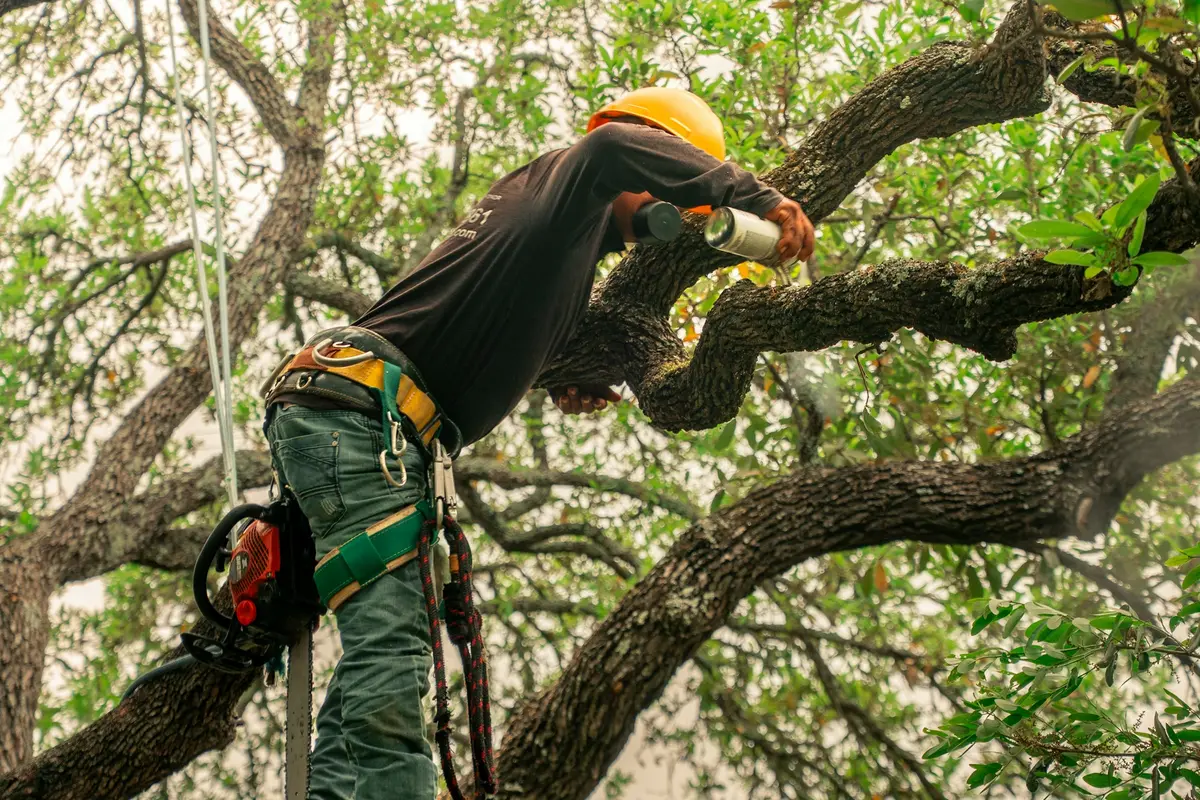
Deadwood is lighter than live wood but far more brittle, and it breaks rather than bends. A dead limb being removed can shed pieces sideways instead of dropping where you expect, so the area below stays clear for the whole operation rather than just for the final cut.
Never approach, move or work near a downed or sagging power line, and do not assume a line is inactive. Keep people, pets and vehicles well clear, and report the line to your electric utility or emergency services before anyone goes near the area.
How pruning work is normally approached
- Agree the objective
Clearance, deadwood, structure or sightlines. Pruning without a stated objective is how trees end up over-cut.
- Assess from the ground and in the canopy
Attachment points, decay, previous cuts and the tree's response to earlier work all change what is sensible now.
- Set the limit
How much live canopy comes off is decided before cutting starts, and kept modest. Removing too much at once weakens the tree and triggers stress regrowth.
- Balance the canopy
Where weight is one-sided, reduction is spread rather than concentrated, so the tree is not left with a new imbalance.
- Clear and check
Debris removed, cuts reviewed from the ground, and any follow-up interval discussed if the work is staged.
What sets the size of a pruning job
- Whether any part of the work overhangs a neighbouring property.
- How long since the last prune, since neglected canopies need more work to bring back.
- Whether the work is clearance over a structure or general canopy management.
- How many trees are actually involved. On a larger parcel the answer is frequently more than the one that prompted the call, and doing them together shares the mobilisation.
- Whether there is a genuine drop zone. Open ground is the one thing that makes tree work straightforward, and where it exists the method changes completely.
- Whether the tree is a planted landscape specimen or remnant growth from earlier land use. Old field-edge trees frequently carry structural defects that never mattered while nothing stood beneath them.
Decide these before the visit
- Whether there are cables, lights or fixtures within the canopy.
- Whether beds, pots or delicate plantings need protecting underneath.
- Whether any part of the canopy crosses a boundary.
- Decide whether material can stay on the property. On a larger lot that is often a genuinely useful option, and it changes what the work involves.
- Walk the property before you call and count what actually needs attention, rather than describing the single tree that prompted it. Several trees in one visit is normally more efficient than separate calls.
- Locate anything buried across the approach — septic field, well, irrigation line, soakaway — before machinery crosses it. Undocumented systems are common and expensive to find the hard way.
Debris and cleanup
Chip can be taken away or left for use as mulch, which some property owners prefer. If you want it kept, decide where it goes before the day, since a chip pile in the wrong place is awkward to move later.
- Where there is room, chip and trunk rounds can often be left in an agreed position rather than hauled, which reduces what has to be carried and loaded.
- Larger parcels usually allow material to be staged near the working area, so the carry is short and the loading happens in one place.
- Where ground conditions limit vehicle access, material is often staged nearer the road and loaded from there, which needs a position agreeing in advance.
Hauled away, chipped on site, or stacked in an agreed position — all three are normal, and they are different amounts of work. Whichever you want should be stated in the scope before the day rather than settled afterwards.
Tree Trimming and Pruning in Valrico: common questions
Can an old unmanaged tree be brought into shape?
Not quickly, and attempting it in one visit would take far too much live canopy. The realistic approach is removing deadwood and defective material first, then reducing the heaviest limbs over more than one visit.
Is it worth pruning a tree at a boundary I barely use?
If nothing is beneath it, often not. Where a house, driveway or garden has since been built within its reach, deadwood removal becomes worthwhile because the target has changed even though the tree has not.
Can branches over my neighbour's property be cut?
There are rules about this and they vary. What is reasonable, and from which side, depends on local law and on the situation. It is worth agreeing with the neighbour before scheduling rather than discovering a disagreement mid-job.
Can several trees across the property be looked at in one visit?
Usually, and it is generally the more efficient way to do it because the setup, the access and the equipment move are shared. Whether it works in practice depends on whether the trees sit on the same access route or need separate positioning.
The trees along the boundary were here before the house. Does that matter?
It often does. Trees that grew as field-edge or hedgerow growth develop differently from planted specimens, and defects that were harmless in open ground become relevant once a building, a drive or a fence line arrives underneath. It is worth mentioning when you describe the tree.
Related tree services in Valrico
When pruning will not be enough
Where the concern is in the trunk or the root flare rather than the branches, pruning cannot resolve it. This is the comparison worth making before booking either.
Compare pruning with tree removalIf the tree looks unwell rather than overgrown
Fungal growth at the base, a cavity, dieback at the top of the canopy or a lean that has changed are condition questions, not clearance questions.
Read about hazardous tree assessmentIf it is mostly the brush you want gone
Where material is already on the ground from earlier work or a storm, hauling is a separate job from cutting.
See how debris removal is handledDiscuss Trimming Your Trees in Valrico
Tell us whether the tree is old boundary growth or planted stock, and what sits underneath it. That determines what pruning is worth doing in Valrico.
- Phone: 877-269-2454
- Serving Tampa Bay, Florida
Information on this page is general guidance for property owners and managers in the Tampa Bay area. It is not an arboricultural assessment, a legal opinion, a permitting determination or an insurance decision. Tree condition and site risk can only be judged in person.