Valrico, Florida
Dead and Hazardous Tree Removal in Valrico, FL
The most useful thing an assessment does in Valrico is distinguish the two tree populations. Old agricultural boundary trees frequently carry structural defects that developed over decades without any intervention — large limbs at weak unions, included bark, internal decay — while planted landscape trees usually present more conventional problems.
- Hillsborough County
- Former agricultural land
- Larger lots
If the tree is threatening people, an occupied building or your only access, call straight away rather than waiting.
Before anyone goes near it
A description over the phone is a useful start, but the things that most often matter — the state of the root flare, the sound of the stem, the extent of a cavity, movement in the soil — need someone standing at the tree. Nobody should be given a definitive verdict on a hazardous tree remotely, and we will not offer one.
Never approach, move or work near a downed or sagging power line, and do not assume a line is inactive. Keep people, pets and vehicles well clear, and report the line to your electric utility or emergency services before anyone goes near the area.
What this means on Valrico properties
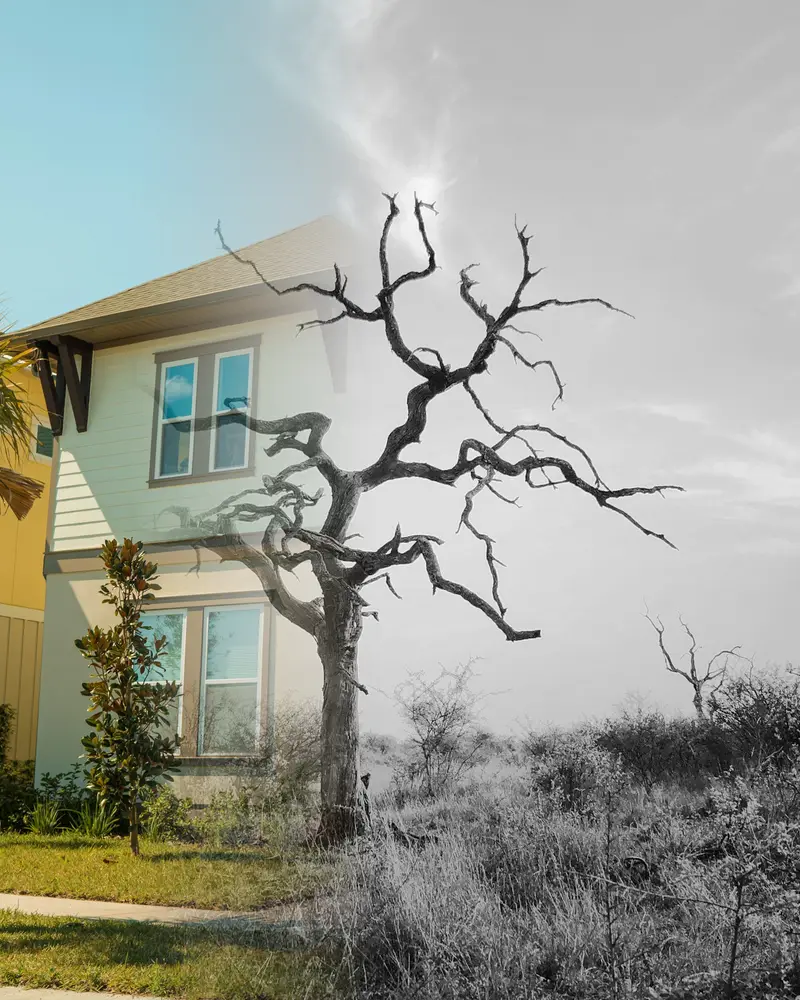
The change that matters is what has been built beneath them. A defective field-edge tree standing over pasture was a low-consequence situation for fifty years. The same tree standing over a house, a driveway or a pool built in the last twenty is a genuine risk, and the tree has not changed at all — the target has.
Properties frequently combine planted landscape trees with remnant growth from earlier land use, including old field-edge trees and boundary lines that were never managed as ornamentals. The two behave quite differently.
Valrico is unincorporated, placing it under Hillsborough County provisions. Requirements can vary by property and jurisdiction. Property owners should confirm current requirements with the relevant local authority before work begins.
Observable indicators worth taking seriously
A large included union with visible decay at a previous failure point is worth assessing, particularly where a garden or garage has been built underneath a tree that was there long before either.
- Dead branches concentrated at the top of the canopy rather than scattered through it.
- A lean that has changed, or soil cracked and lifted on the opposite side of the base.
- Recent trenching, paving or grade change within the root zone.
- Clearance along a long driveway or approach where growth has closed in from both sides.
- Old boundary or field-edge growth that was never managed as a garden tree.
What an on-site assessment actually looks at
- The root flare and the soil around it, since most catastrophic failures start below eye level.
- The main stem, checked for cavities, cracks, included bark and old wound response.
- Whether the defect can be managed by reducing the canopy or only by removal.
- The proportion of dead to live canopy, and where the dead wood sits.
- What lies within the potential fall zone, and whether people are under it regularly.
Remove it, or keep watching it?
Not every defective tree needs to come down, and removing a tree that could have been managed is a loss. Risk is a combination of how likely a failure is and what would be underneath it — both halves have to be looked at, in person.
Monitoring can be reasonable Defect present, target absent
- There is a documented starting point, so any change can actually be noticed.
- Deadwood is confined to individual limbs that can be removed on their own.
Removal is the honest answer Stem, base or repeated failure
- Extensive dieback from the top of the canopy downward.
- Decay, a cavity or fungal fruiting bodies on the main stem or root flare.
From concern to resolution
- Describe what you are seeing
Which part of the tree, how long it has looked that way, and what has changed recently. Change over time is often more informative than a single symptom.
- Restrict use of the area
If people park, play or sit under the tree, moving that activity elsewhere is a sensible interim step while the tree is being looked at.
- On-site inspection
Base, stem, unions and canopy are examined in person. Photographs help a phone conversation but do not substitute for standing under the tree.
- Plan the takedown
Compromised trees are dismantled differently, since a decayed stem cannot be assumed to hold a climber or take rigging loads.
- Complete and reassess
The stump is dealt with as agreed, and any neighbouring tree showing similar signs is noted.

Factors that shape a hazardous removal
- The extent of decay at the base, which affects how predictable the fall direction is.
- Whether the tree can be felled in one piece or must be taken down in small sections.
- Whether a lift or crane is needed because the tree cannot support a climber.
- Whether the tree is a planted landscape specimen or remnant growth from earlier land use. Old field-edge trees frequently carry structural defects that never mattered while nothing stood beneath them.
- The length of the approach from the road to the working area — a long unmade track changes the plant that can realistically be brought in.
- How many trees are actually involved. On a larger parcel the answer is frequently more than the one that prompted the call, and doing them together shares the mobilisation.
Useful information to gather
- Any work done near the tree in recent years — trenching, paving, fill, root cutting.
- Photographs of the base, the trunk and the full canopy from a distance.
- Whether the tree has failed before, and which part failed.
- Decide whether material can stay on the property. On a larger lot that is often a genuinely useful option, and it changes what the work involves.
- Say whether the approach is made-up surface or open ground, and whether it has stayed wet recently. It is the difference between driving to the tree and working off it.
- Walk the property before you call and count what actually needs attention, rather than describing the single tree that prompted it. Several trees in one visit is normally more efficient than separate calls.
Debris and cleanup
Where decay involves fungal activity, it is reasonable to prefer that material leaves the property rather than being chipped and spread as mulch nearby. If you have a preference, say so before work starts.
- Where ground conditions limit vehicle access, material is often staged nearer the road and loaded from there, which needs a position agreeing in advance.
- Where there is room, chip and trunk rounds can often be left in an agreed position rather than hauled, which reduces what has to be carried and loaded.
- Larger parcels usually allow material to be staged near the working area, so the carry is short and the loading happens in one place.
Hauled away, chipped on site, or stacked in an agreed position — all three are normal, and they are different amounts of work. Whichever you want should be stated in the scope before the day rather than settled afterwards.
Dead and Hazardous Tree Removal in Valrico: common questions
The tree was here long before the house. Does that matter?
Practically, yes. It usually means the tree developed without structural management and its defects were never a problem because nothing was beneath it. The risk arrived with the house, not with the tree.
Can these old trees be kept?
Sometimes, with deadwood removal and reduction of the heaviest limbs to lower the load. Whether that is enough depends on where the defects sit — an included union in the main stem is a much harder problem than defects in individual limbs.
Can you tell me if my tree is dangerous from photos?
No, and we would not. Photographs help decide whether a visit is warranted, but the key indicators — the root flare, stem soundness, soil movement — need to be examined in person.
The ground is soft where the tree is. Does the work have to wait?
Sometimes, and it is usually better than the alternative. Driving heavy equipment over saturated ground leaves damage that outlasts the tree work. Where waiting is not practical, the method shifts toward smaller equipment and more hand carrying, which takes longer but leaves the ground intact.
Can several trees across the property be looked at in one visit?
Usually, and it is generally the more efficient way to do it because the setup, the access and the equipment move are shared. Whether it works in practice depends on whether the trees sit on the same access route or need separate positioning.
Related tree services in Valrico
If the assessment points to removal
What a removal involves on a constrained property, and why access decides the method more often than the size of the tree.
Read about tree removalIf the defect turns out to be branch-level
Deadwood and poorly attached limbs can often be addressed without losing the tree. That is a better outcome where the stem is sound.
Compare with pruningIf it has already moved
A tree that has shifted, or soil that has lifted at the base, is not something to schedule around.
See what counts as urgentHave a Declining Tree Assessed in Valrico
Tell us the tree's history relative to the buildings and what you are seeing now. Keep the area under it clear while it waits to be assessed.
- Phone: 877-269-2454
- Serving Tampa Bay, Florida
Information on this page is general guidance for property owners and managers in the Tampa Bay area. It is not an arboricultural assessment, a legal opinion, a permitting determination or an insurance decision. Tree condition and site risk can only be judged in person.