After the tree
Stump Grinding and Removal in Tampa Bay, FL
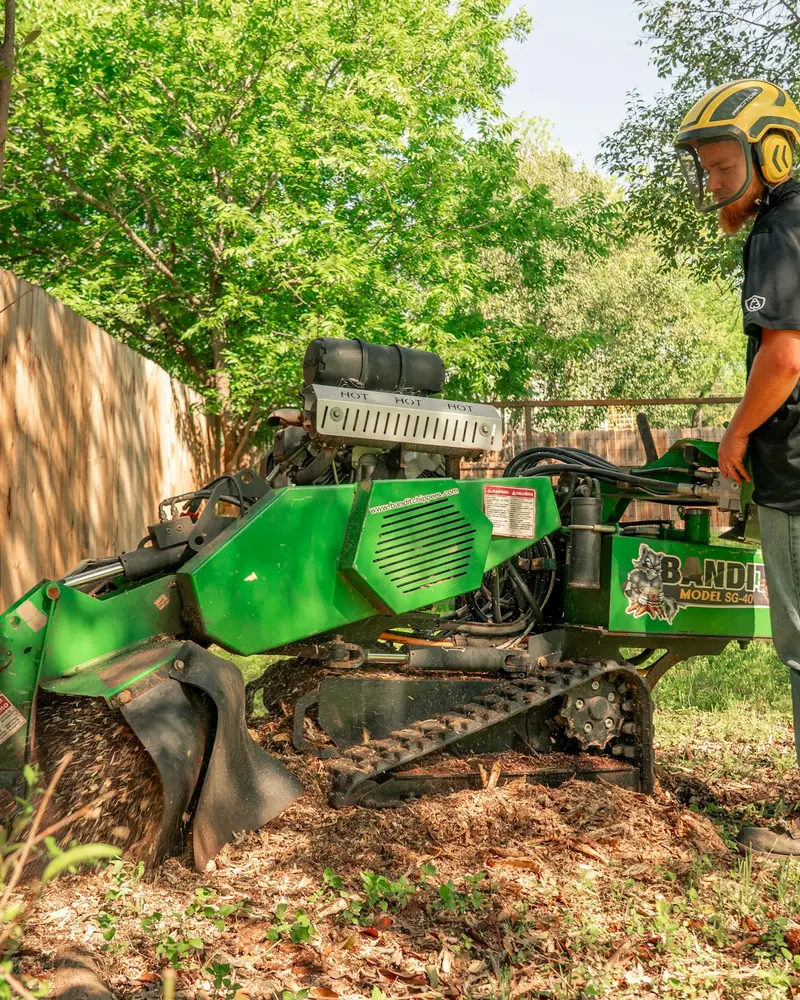
Grinding and full removal are two different operations with two different outcomes. Grinding uses a machine to reduce the stump and its surface flare below grade, leaving deeper roots to break down naturally. Full extraction pulls the root mass out and leaves a substantial hole — it is occasionally necessary, and rarely the right default.
- Tampa Bay, Florida
- Hillsborough · Pinellas · Pasco
- Residential & commercial
What this service covers
For lawn, planting and ordinary landscaping, grinding is almost always the sensible choice. It causes far less disturbance to surrounding soil, turf and paving, and the depth can be matched to what the space will actually be used for. Full removal generally becomes relevant only where excavation, construction or utility work requires the ground to be genuinely clear.
Two practical details decide most stump jobs. The first is access: the machine has to physically reach the stump, and the narrowest gate or side gap on the route is usually the binding constraint. The second is what happens to the spoil — grinding produces considerably more chip-and-soil mix than people expect, and where it goes should be decided before the grinder arrives rather than after.
Safety before anything else
Irrigation lines, low-voltage lighting cable, septic components and service laterals all live at grinding depth. A grinder finds them instantly and expensively. Anything you know about the buried layout is worth saying before the machine is positioned.
Never approach, move or work near a downed or sagging power line, and do not assume a line is inactive. Keep people, pets and vehicles well clear, and report the line to your electric utility or emergency services before anyone goes near the area.
Stump work on Tampa Bay properties
Irrigation is close to universal on residential property across the region, and buried irrigation lines, valve boxes and low-voltage lighting cable near a stump are the main hazard in this work. Locating what is underground before grinding starts is not a formality — a grinder finds these things very efficiently and very expensively.
Sandy soils across much of the area make grinding relatively straightforward, but older properties frequently have rubble, old concrete or fill around a stump from previous work. Embedded stone damages grinder teeth and slows the job significantly, which is why the collar around the stump is cleared before cutting starts.
Requirements can vary by property and jurisdiction. Property owners should confirm current requirements with the relevant local authority before work begins.
Why stumps get dealt with
The intended use of the space sets the required depth, so it is the first thing to settle.
Residential situations
- A stump catching the mower in an otherwise usable lawn.
- Replanting in or near the same position.
- A shed base, patio or fence line planned across the spot.
- Surface roots lifting turf or paving around the base.
Commercial and site situations
- Stumps in parking islands and landscape beds after removals.
- Trip hazards on pedestrian routes across a managed site.
- Clearing ground ahead of resurfacing or kerb work.
- Multiple stumps across a site handled in one mobilisation.
Reasons stumps get dealt with
- It sits in a lawn and catches the mower every time.
- Something is going to be planted in the same spot.
- Paving, a slab, a shed base or a fence line is planned across it.
- It is a trip hazard on a route people actually use.
- Surface roots radiating from it are lifting turf or paving.
- It has begun to decay and is attracting insects near a structure.
- Sprouts keep coming from the stump or from roots around it.
- It is visible from the front of a property and looks unfinished.
- It is in the way of a grade change or drainage work.
- The property is being sold or handed over and should look resolved.
Grinding or full removal
These are different operations with different outcomes and different amounts of disturbance. Grinding is the usual choice; full extraction is occasionally necessary.
Stump grinding Most situations
- A machine reduces the stump and surface flare to chip, below grade.
- Deeper roots stay in the ground and break down over time.
- Far less disturbance to surrounding soil, turf and paving.
- Depth can be matched to the intended use of the space.
- Leaves a chip-and-soil void that is backfilled or cleared.
Full stump removal Occasionally needed
- The stump and major root mass are excavated out of the ground.
- Leaves a substantial hole requiring fill and compaction.
- Heavier equipment and much more disruption to the surrounding area.
- Typically driven by construction, deep excavation or utility work.
- Not usually necessary for replanting, lawn or ordinary landscaping.
How grinding is normally carried out
- Confirm what is underground
Buried utilities, irrigation lines and low-voltage cable near a stump are a real hazard to a grinder. Locating comes before cutting.
- Check access width
Grinders come in different sizes; the constraint is usually the narrowest gate or gap between a house and a fence on the route in.
- Clear the collar
Soil, rock and debris around the stump are cleared away, since grinding through embedded stone damages teeth and slows everything down.
- Set the target depth
Depth is chosen for the intended use — lawn, planting bed, or something that will be built on. Deeper costs more time and produces more spoil.
- Grind the stump and the flare
The visible stump plus the buttress roots at the surface are reduced, since leaving the flare intact leaves an obvious ridge.
- Handle the spoil
Grindings are a mix of wood chip and soil. They are either removed, or backfilled into the void and topped, depending on what you want.
- Level and finish
The area is brought back to a grade that suits its next use, and the surrounding surface is cleared down.
What changes a stump job
- Stump diameter measured at ground level, which is usually wider than the trunk above.
- The spread of surface roots, since these often matter more than the stump itself.
- Required depth, which is much greater for a planting hole or a slab than for lawn.
- Access width and whether the machine can reach the stump at all.
- Slope and whether the grinder can be positioned stably.
- Rock, rubble or old concrete around the base.
- Nearby utilities, irrigation and cable that need locating and avoiding.
- How many stumps are being done in one visit.
- Whether the grindings stay on site or are hauled away.
- Proximity to a wall, fence or paving that limits how the machine can be worked.
Worth sorting before the grinder arrives
- Know what the space will become — lawn, bed, paving or a structure.
- Mark irrigation heads, valve boxes, lighting cable and any known service runs.
- Measure the narrowest point on the access route, gate posts included.
- Clear pots, furniture and ornaments from around the stump.
- Decide whether grindings stay as backfill or are taken away.
- Note any nearby tree you want protected from root damage during the grind.
- Confirm whether surface roots should be taken out as well as the stump.
- Say if the area needs to be usable immediately afterwards.
Debris and site finish
Grinding produces more spoil than people expect — a stump ground below grade yields a mound of chip and soil considerably larger than the stump looked. It has to go somewhere, and that is a decision worth making in advance.
Backfilling with the grindings is the simplest option, but the mix settles over months and is not a good growing medium. If you are planting in the same spot, removing the grindings and bringing in soil is usually the better result.
Fine chip travels. Surfaces, paths and any nearby pool or water feature are worth considering before grinding starts, and screening or covering is straightforward when it is planned rather than improvised.
Questions we are asked about this service
How deep does grinding go?
It depends on what the space is for. A lawn finish needs relatively little; a planting hole needs more; anything being built on needs a specific depth agreed in advance. Deeper means more time and more spoil, so it is worth being clear about the end use.
Do all the roots come out?
No. Grinding removes the stump and the surface flare. Lateral and deeper roots remain and decay slowly. That is fine for lawn and most planting, but it matters if you are excavating or building.
Can I plant a new tree in the same spot?
Not directly into the ground-out hole if it is full of grindings. Wood chip mixed into soil is a poor rooting medium. Removing the spoil and backfilling with soil, or shifting the planting position slightly, both work better.
Will the stump grow back?
The stump itself will not, but some species sucker vigorously from remaining roots after the top is removed. Where that happens, the sprouts need dealing with separately rather than being a sign the grind failed.
Why does access matter so much?
Because the grinder has to physically reach the stump. A machine that fits through a standard gate handles most residential work; a stump behind a narrow side path with a step may need a smaller machine, more hand work, or a different approach entirely.
What about utilities near the stump?
That is the main safety issue in this work. Irrigation, low-voltage lighting and buried services near a stump need to be located before grinding starts, and it helps enormously if you can point out what you know is there.
Can grinding be done at the same time as the removal?
Usually, if it is planned in advance. Felling and grinding use different equipment, so knowing up front that the stump is included means it happens in one visit rather than needing a return trip.
What if the stump is very close to a wall or paving?
Then the machine's working position becomes the constraint. A stump tight against a wall may need a smaller machine or more hand work, and the flare on the wall side may not be fully reachable — which is worth knowing before the work rather than after.
Tell us what the space becomes next
Lawn, a planting bed, paving or a structure — each needs a different grinding depth and a different decision about the spoil. Access width and any buried irrigation are the other two things worth mentioning when you call.
- Phone: 877-269-2454
- Serving Tampa Bay, Florida
Information on this page is general guidance for property owners and managers in the Tampa Bay area. It is not an arboricultural assessment, a legal opinion, a permitting determination or an insurance decision. Tree condition and site risk can only be judged in person.