St. Petersburg, Florida
Tree Removal in St. Petersburg, FL
Removals here are usually decided by side clearance. St. Petersburg's older grid puts substantial mature trees on lots with very little room between structures, so material comes down in controlled sections rather than being felled, and the practical route out is often the alley rather than the street.
- Pinellas County
- Peninsula city
- Coastal exposure
What this means on St. Petersburg properties
The city administers its own code provisions, which are not the same as those applying in unincorporated Pinellas County or in neighbouring municipalities. Because so much of the housing stock predates the trees reaching full size, removals here are frequently about a tree that was appropriate when planted and is not appropriate now — which is a different conversation from a tree that is failing.
A grid of established neighbourhoods with a long planting history sits alongside waterfront districts and mid-century subdivisions, so it is common to find substantial mature trees on modest lots with limited side clearance.
St. Petersburg is an incorporated Pinellas County city administering its own code provisions for trees. Requirements can vary by property and jurisdiction. Property owners should confirm current requirements with the relevant local authority before work begins.
Reasons removal ends up being the right answer
On an alley-served block the alley can be what makes a rear-yard removal feasible at all. Where it is blocked or too narrow to use, the same tree becomes a considerably longer job, so its condition is worth checking before booking.
- Persistent decline that has not responded to changes in irrigation, grade or care.
- A species that has outgrown the space it was planted in and cannot be reduced sensibly.
- A tree planted too close to a foundation, driveway or septic field for its mature size.
- Growth closing in over a narrow side route that is the only way in or out.
- Growth into a rear alley or shared access that other properties also depend on.
Removal or retention: how the decision is usually framed
Removal is permanent, so it is worth being clear about which problem it solves. A tree with a structural defect in the main stem is a different case to a healthy tree in an inconvenient place.
Points toward keeping the tree Reversible problems
- Decline followed a change in irrigation, grade or root-zone conditions that can be corrected.
- Defects are limited to individual limbs rather than the trunk or root flare.
Points toward removal Structural or spatial
- Repeated failures from the same union, where pruning has already been tried.
- Decay, cavity or fungal fruiting bodies at the base or on the main stem.
How the work is kept safe
Before a saw starts, the area a section could reach has to be empty and stay empty. That includes the space people habitually cut through — a side gate, a bin store, a shortcut across a lawn. An exclusion zone that relies on everyone remembering is not an exclusion zone.
Never approach, move or work near a downed or sagging power line, and do not assume a line is inactive. Keep people, pets and vehicles well clear, and report the line to your electric utility or emergency services before anyone goes near the area.
How a planned removal usually runs
- Site walk and decision
The tree, its target zone and the access route are looked at together. Sometimes the outcome is that removal is not the best option.
- Protect what stays
Beds, irrigation, paving, fencing and neighbouring plantings that could take incidental damage are identified and protected or worked around.
- Canopy reduction
Limbs are removed in a planned order so the tree stays balanced as it comes apart, rather than becoming top-heavy on one side.
- Stump decision
Cut low, ground down, or left at a workable height for a later grind — this depends on what the space is going to become.
- Site finish
Material removed or staged, hard surfaces cleared, and the ground left in a state that matches what happens next on that spot.
What actually determines the work involved
- Whether limbs can be dropped freely or have to be rigged down piece by piece.
- Whether the stump is included and how deep the grind needs to be for the intended use.
- Proximity to a boundary and the need to work without encroaching on a neighbour.
- Whether the tree stands sheltered or exposed. A tree that grew up inside surrounding canopy carries wind very differently once that shelter is gone.
- Whether the tree has outgrown the space it was planted in. Landscape trees chosen for a new plot frequently reach the roofline and the fence line decades later, and that is a different problem from a defect.
- How much of the work is correcting years of growth rather than routine maintenance — the first visit to a long-unmanaged tree is normally the largest.
Questions worth answering before you call
- Any timing constraint — events, deliveries, other trades already booked.
- Whether you want the wood removed entirely or some of it left cut on site.
- Whether any part of the canopy overhangs a neighbouring property.
- Look at the ground at the base of the tree and mention anything unusual — cracking, lifting, or soil that has moved in an arc on one side.
- Where kerbside space is shared or contested, letting immediate neighbours know in advance usually prevents the awkward conversation happening mid-job.
- Decide whether the objective is storm preparation or general maintenance. They lead to different work on the same tree.
Debris and cleanup
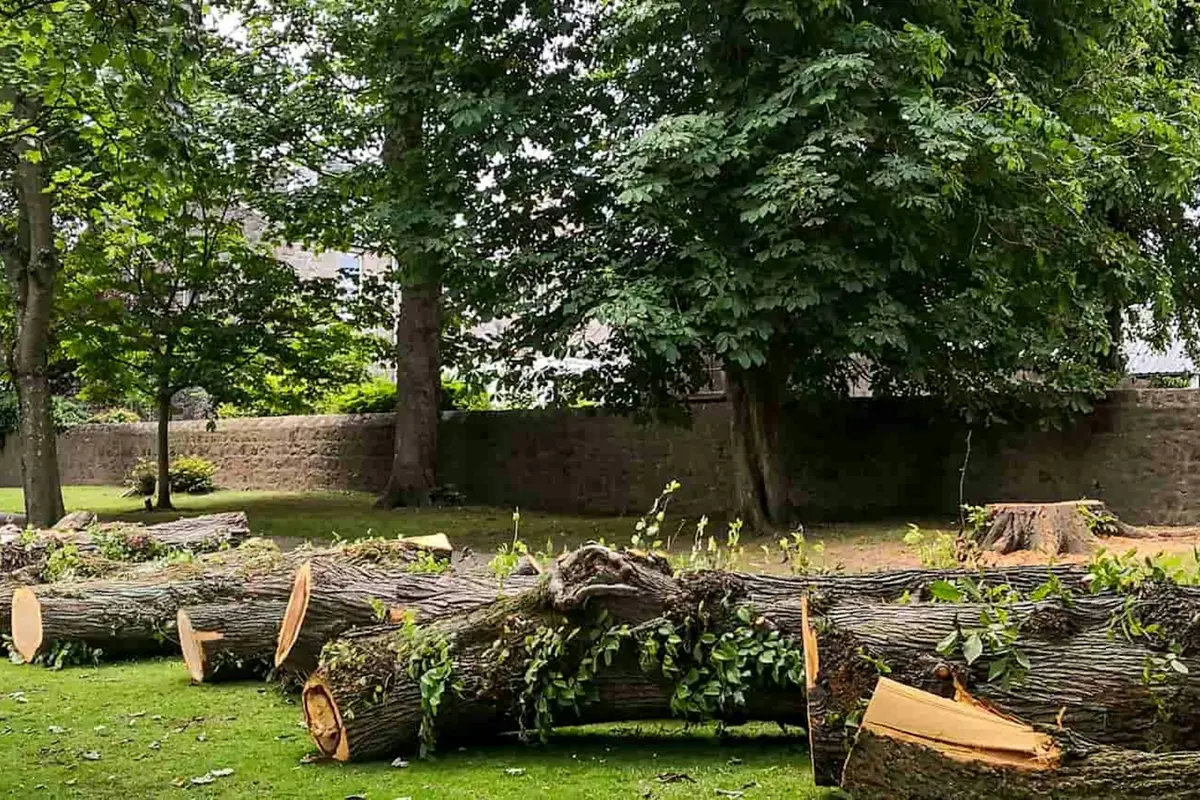
You can usually choose what happens to the wood. Full haul-away leaves the cleanest site; leaving rounds or chip on site reduces the volume that has to be carried out and can be useful if you have a use for it. It is worth deciding before the day rather than during it.
- On ground that holds water, staging is normally kept to firm surfaces such as a drive or path rather than lawn, which sometimes lengthens the carry.
- Trunk wood is cut to a size the access will take rather than to the largest size the machine could handle.
- Where the vehicle has to stand away from the property, everything is carried to it, so the distance between the tree and the kerb is a real part of the cleanup time.
Hauled away, chipped on site, or stacked in an agreed position — all three are normal, and they are different amounts of work. Whichever you want should be stated in the scope before the day rather than settled afterwards.
Tree Removal in St. Petersburg: common questions
Is approval needed to remove a tree in St. Petersburg?
The city has its own tree provisions and what applies depends on the tree and the property. A neighbour's experience is not a reliable guide, particularly if they are outside the city limits. Requirements can vary by property and jurisdiction, so confirm with the relevant local authority before work begins.
Is it better to work from the alley or the street?
Whichever gives a shorter carry and a workable position, and that varies by block. If your alley is passable, say so when you call — it often makes the difference between a straightforward job and a long one.
How long does a removal take?
Anything from part of a morning for a modest tree with open access to a full day or more where every piece has to be rigged out over a structure. Access is usually a bigger factor than the size of the tree.
There is nowhere obvious to park a truck. Is that a problem?
It is a planning question rather than a blocker. What matters is whether a chipper can be positioned within a workable carry of the tree, and whether that position can be held for the day. Tell us what the street is like when you call and it can be worked out beforehand rather than on arrival.
Is rear alley access better than working from the street?
Sometimes considerably, and sometimes not at all — a rear alley can be the shortest route to the tree or too narrow and too congested to use. It is worth telling us it exists either way, so the approach can be decided before a truck is committed to a street position.
Related tree services in St. Petersburg
Before committing to removal
Where the problem is clearance, deadwood or a rubbing limb, pruning usually solves it and keeps the tree. It is worth ruling that out first.
Compare tree removal with pruningWhat happens to the stump
Felling and grinding are separate operations with different equipment. If you want the stump gone, it has to be planned into the same visit.
Read about stump grindingIf condition is the reason
Where the removal is prompted by decay, a defect or a lean rather than by space or a planned change, the assessment comes first.
Read about hazardous tree assessmentRequest Tree Removal Information in St. Petersburg
Tell us the gap between the tree and the nearest structure, and whether the alley behind you is usable. In St. Petersburg those two facts usually set the method.
- Phone: 877-269-2454
- Serving Tampa Bay, Florida
Information on this page is general guidance for property owners and managers in the Tampa Bay area. It is not an arboricultural assessment, a legal opinion, a permitting determination or an insurance decision. Tree condition and site risk can only be judged in person.