Carrollwood, Florida
Tree Removal in Carrollwood, FL
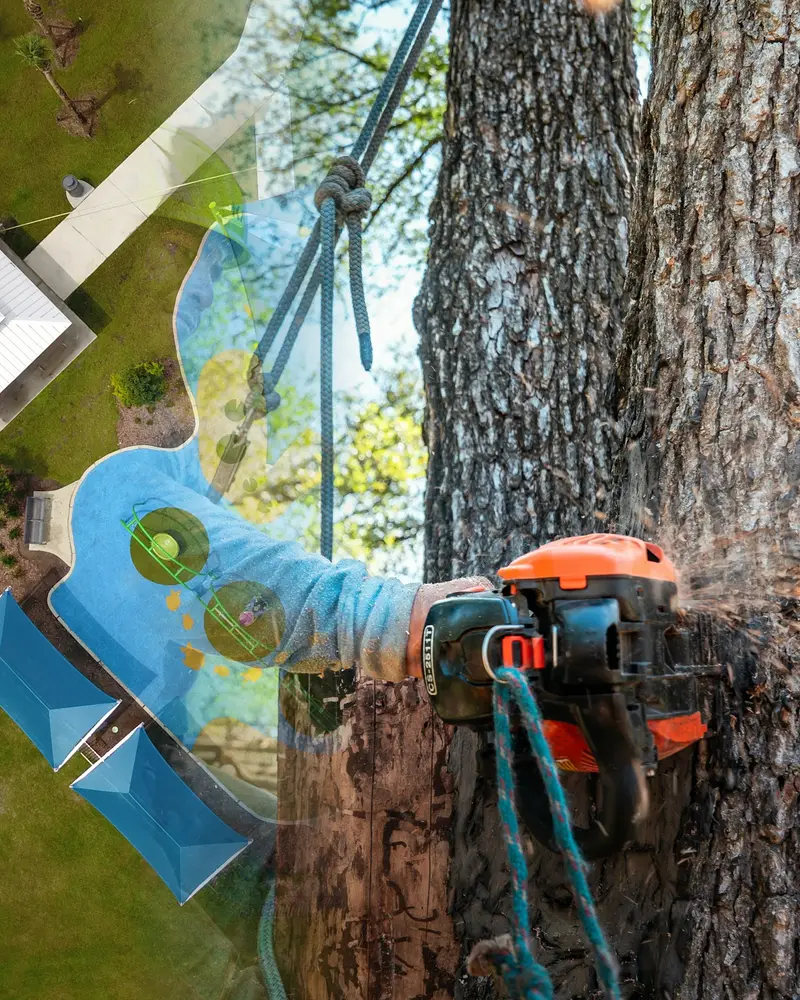
There is effectively no such thing as a straight fell in Carrollwood. The trees are large, the lots are fully planted, and the canopy overlaps the neighbours on both sides — so removals here are sectional dismantles where each piece is lowered into a small controlled space and carried out.
- Hillsborough County
- Lake Carroll area
- Established canopy
What this means on Carrollwood properties
Protecting what stays is a real part of the job in this neighbourhood, and often a larger part than the removal itself. Established beds, specimen shrubs, walls and adjacent trees represent decades of growth, and a removal that saves a day by dropping material through them is not a good outcome. Carrollwood is unincorporated so Hillsborough County provisions apply, and some neighbourhoods operate their own association requirements as well.
Carrollwood is an established unincorporated community north-west of central Tampa, developed largely from the 1960s onward around Lake Carroll and a series of connected neighbourhoods.
Carrollwood is unincorporated, so Hillsborough County provisions apply; some neighbourhoods additionally operate their own association rules. Requirements can vary by property and jurisdiction. Property owners should confirm current requirements with the relevant local authority before work begins.
Reasons removal ends up being the right answer
Where a large tree stands in a rear garden surrounded by mature planting, every section is lowered rather than dropped, and protecting what stays usually drives the method more than the removal itself does.
- Construction, an addition, a pool or a fence line that the tree sits directly in.
- Persistent decline that has not responded to changes in irrigation, grade or care.
- A species that has outgrown the space it was planted in and cannot be reduced sensibly.
- Growth overhanging a dock, deck or seawall, where anything dropped would go into the water rather than onto ground.
- A tree that has reached the roofline or the fence line decades after being planted for a smaller space.
Removal or retention: how the decision is usually framed
Removal is permanent, so it is worth being clear about which problem it solves. A tree with a structural defect in the main stem is a different case to a healthy tree in an inconvenient place.
Points toward keeping the tree Reversible problems
- The tree provides shade or screening that would be difficult and slow to replace.
- The conflict is with something movable — a shed, a bed, a path alignment.
Points toward removal Structural or spatial
- A planned build, pool or driveway occupies the space the tree stands in.
- Repeated failures from the same union, where pruning has already been tried.
How the work is kept safe
A tree with genuine clear ground around it can often be felled in one piece, which is faster and safer. A tree with a roofline, cage or fence inside its reach has to come apart in sections that are lowered under control. Choosing the first method on a site that needs the second is where most avoidable property damage comes from.
Never approach, move or work near a downed or sagging power line, and do not assume a line is inactive. Keep people, pets and vehicles well clear, and report the line to your electric utility or emergency services before anyone goes near the area.
How a planned removal usually runs
- Site walk and decision
The tree, its target zone and the access route are looked at together. Sometimes the outcome is that removal is not the best option.
- Method selection
Straight felling, sectional dismantling or a lift-assisted approach, chosen by what is underneath and how much room there is to drop material.
- Canopy reduction
Limbs are removed in a planned order so the tree stays balanced as it comes apart, rather than becoming top-heavy on one side.
- Stem sectioning
The trunk is taken in lengths that suit the drop zone and what can be moved out through the available access.
- Site finish
Material removed or staged, hard surfaces cleared, and the ground left in a state that matches what happens next on that spot.
What actually determines the work involved
- Whether limbs can be dropped freely or have to be rigged down piece by piece.
- Proximity to a boundary and the need to work without encroaching on a neighbour.
- Whether the stump is included and how deep the grind needs to be for the intended use.
- How much of the working footprint is left once the house, the deck and the water's edge are accounted for — on a frontage lot the answer is often very little.
- Whether community-level requirements apply on top of county provisions, which can affect timing as much as scope.
- Whether ground protection needs putting down before machinery or heavy sections cross planted areas or lawn.
Questions worth answering before you call
- Whether you want the stump ground, and whether anything will be planted or built there.
- Whether irrigation, low-voltage lighting or a septic system runs near the tree.
- The width of the narrowest gate or side path on the access route.
- Note which limbs actually concern you. Under a dense crown it is easy to point at the wrong tree from the ground.
- Move boats, lifts and anything on the dock clear of the working area if that is possible, or say what cannot be moved.
- Say what sits between the tree and the water — a seawall, dock, lift, bulkhead or open bank — and roughly how much clear ground is left between them.
Debris and cleanup
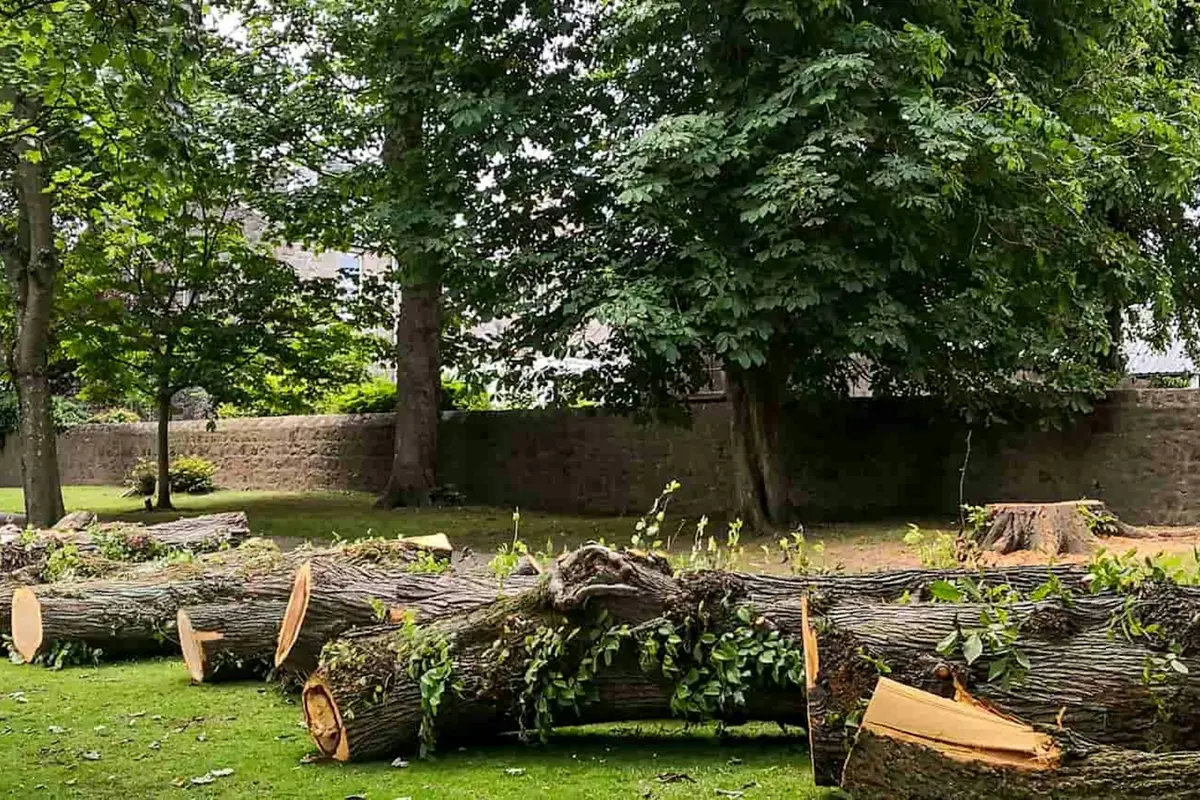
A removal generates far more volume than most people expect, because a standing canopy is deceptively compact. Brush is chipped, and trunk sections are cut to whatever length can be handled through the access available.
- Staging space on a frontage lot is usually limited, so material tends to be loaded as it comes down rather than piled.
- Overlapping canopies tend to produce more brush than expected, because material caught in a neighbouring crown comes down as well as the material that was cut.
- Long-unmanaged canopies carry more accumulated deadwood than expected, so the volume coming down on a first visit is often higher than on subsequent ones.
Hauled away, chipped on site, or stacked in an agreed position — all three are normal, and they are different amounts of work. Whichever you want should be stated in the scope before the day rather than settled afterwards.
Tree Removal in Carrollwood: common questions
Will the surrounding planting survive the removal?
That is planned for rather than hoped for. Sections are lowered into agreed positions and protection is put down where needed. Some contact is occasionally unavoidable in a very tight space, and it is better to identify what matters most beforehand.
Do county rules or association rules apply?
Potentially both. Carrollwood is unincorporated so Hillsborough County provisions apply, and some neighbourhoods have their own requirements. Requirements can vary by property and jurisdiction, so confirm before work begins.
How long does a removal take?
Anything from part of a morning for a modest tree with open access to a full day or more where every piece has to be rigged out over a structure. Access is usually a bigger factor than the size of the tree.
Can dead limbs high in a dense canopy be seen from the ground?
Often not reliably. Under a heavy interlocking crown, dead material thirty or forty feet up is genuinely difficult to identify from below, and it tends to be held in place rather than falling clear. That is a reasonable reason to have someone look rather than to guess.
Will the surrounding planting be damaged?
That is planned for rather than hoped for — sections are lowered into agreed positions and protection goes down where it is needed. In a genuinely tight space some contact is occasionally unavoidable, which is why it helps to say beforehand what matters most to you.
Related tree services in Carrollwood
Before committing to removal
Where the problem is clearance, deadwood or a rubbing limb, pruning usually solves it and keeps the tree. It is worth ruling that out first.
Compare tree removal with pruningWhat happens to the stump
Felling and grinding are separate operations with different equipment. If you want the stump gone, it has to be planned into the same visit.
Read about stump grindingIf condition is the reason
Where the removal is prompted by decay, a defect or a lean rather than by space or a planned change, the assessment comes first.
Read about hazardous tree assessmentRequest Tree Removal Information in Carrollwood
Tell us what surrounds the tree and what in the garden matters most to you. In Carrollwood protecting what stays shapes the removal method.
- Phone: 877-269-2454
- Serving Tampa Bay, Florida
Information on this page is general guidance for property owners and managers in the Tampa Bay area. It is not an arboricultural assessment, a legal opinion, a permitting determination or an insurance decision. Tree condition and site risk can only be judged in person.