Largo, Florida
Tree Removal in Largo, FL
Largo removals are defined by clearance rather than by tree size. With modest setbacks and closely spaced structures, there is usually no drop zone at all, so trees are dismantled in small sections that are lowered into whatever gap exists — often a strip of ground three or four feet wide.
- Pinellas County
- Densely built
- Mid-peninsula city
What this means on Largo properties
Largo administers its own municipal code, distinct from unincorporated Pinellas County areas immediately adjacent, which is worth checking rather than assuming from a neighbour's experience across a boundary. On the community properties there is an additional layer: park or association rules on what may be removed and when work may happen.
Working room is the defining constraint. Narrow side yards, carports, screen rooms and closely parked vehicles frequently mean material has to be lowered in small sections rather than dropped.
Largo is an incorporated Pinellas County city administering its own code, and adjacent unincorporated areas are governed differently. Requirements can vary by property and jurisdiction. Property owners should confirm current requirements with the relevant local authority before work begins.
Reasons removal ends up being the right answer
Where a mature tree stands in a side yard with a few feet of clearance to the house on one side and a fence on the other, every section is lowered by rope and carried to the street. That is slower than felling and it is not optional.
- A species that has outgrown the space it was planted in and cannot be reduced sensibly.
- Storm history that has left the tree with more wound than sound wood.
- Roots lifting a walkway, slab or wall where the conflict will only worsen.
- A tree newly exposed because whatever sheltered it has gone.
- A tree that has reached the roofline or the fence line decades after being planted for a smaller space.
Removal or retention: how the decision is usually framed
Removal is permanent, so it is worth being clear about which problem it solves. A tree with a structural defect in the main stem is a different case to a healthy tree in an inconvenient place.
Points toward keeping the tree Reversible problems
- The conflict is with something movable — a shed, a bed, a path alignment.
- Defects are limited to individual limbs rather than the trunk or root flare.
Points toward removal Structural or spatial
- Root conflict with a slab, foundation or drain that will keep escalating.
- Decay, cavity or fungal fruiting bodies at the base or on the main stem.
How the work is kept safe
A tree with genuine clear ground around it can often be felled in one piece, which is faster and safer. A tree with a roofline, cage or fence inside its reach has to come apart in sections that are lowered under control. Choosing the first method on a site that needs the second is where most avoidable property damage comes from.
Never approach, move or work near a downed or sagging power line, and do not assume a line is inactive. Keep people, pets and vehicles well clear, and report the line to your electric utility or emergency services before anyone goes near the area.
How a planned removal usually runs
- Site walk and decision
The tree, its target zone and the access route are looked at together. Sometimes the outcome is that removal is not the best option.
- Method selection
Straight felling, sectional dismantling or a lift-assisted approach, chosen by what is underneath and how much room there is to drop material.
- Canopy reduction
Limbs are removed in a planned order so the tree stays balanced as it comes apart, rather than becoming top-heavy on one side.
- Stem sectioning
The trunk is taken in lengths that suit the drop zone and what can be moved out through the available access.
- Site finish
Material removed or staged, hard surfaces cleared, and the ground left in a state that matches what happens next on that spot.
What actually determines the work involved
- Gate width and any overhead obstruction on the access route.
- Whether a chipper and truck can get within reach or everything must be carried out.
- Proximity to a boundary and the need to work without encroaching on a neighbour.
- Whether roof or gutter clearance is part of the objective, which is a different scope from general canopy work.
- How close the canopy sits to the roofline, gutters and any carport. Low single-storey roofs sit well inside the fall radius of limbs that look comfortably clear from the ground.
- Whether material can be dropped at all, or whether every piece has to be rigged and lowered into a small space — the difference between those two is substantial.
Questions worth answering before you call
- Whether you want the wood removed entirely or some of it left cut on site.
- Any timing constraint — events, deliveries, other trades already booked.
- Whether any part of the canopy overhangs a neighbouring property.
- Decide whether vehicles can be moved off the driveway for the day, and whether a gate or side access can be unlocked and left open.
- Where a screened enclosure, pool deck or spa sits under the canopy, say so when you call — it changes the rigging plan more than the size of the tree does.
- Note whether anything nearby has been removed or thinned recently — a tree that was sheltered and is now exposed is worth flagging.
Debris and cleanup
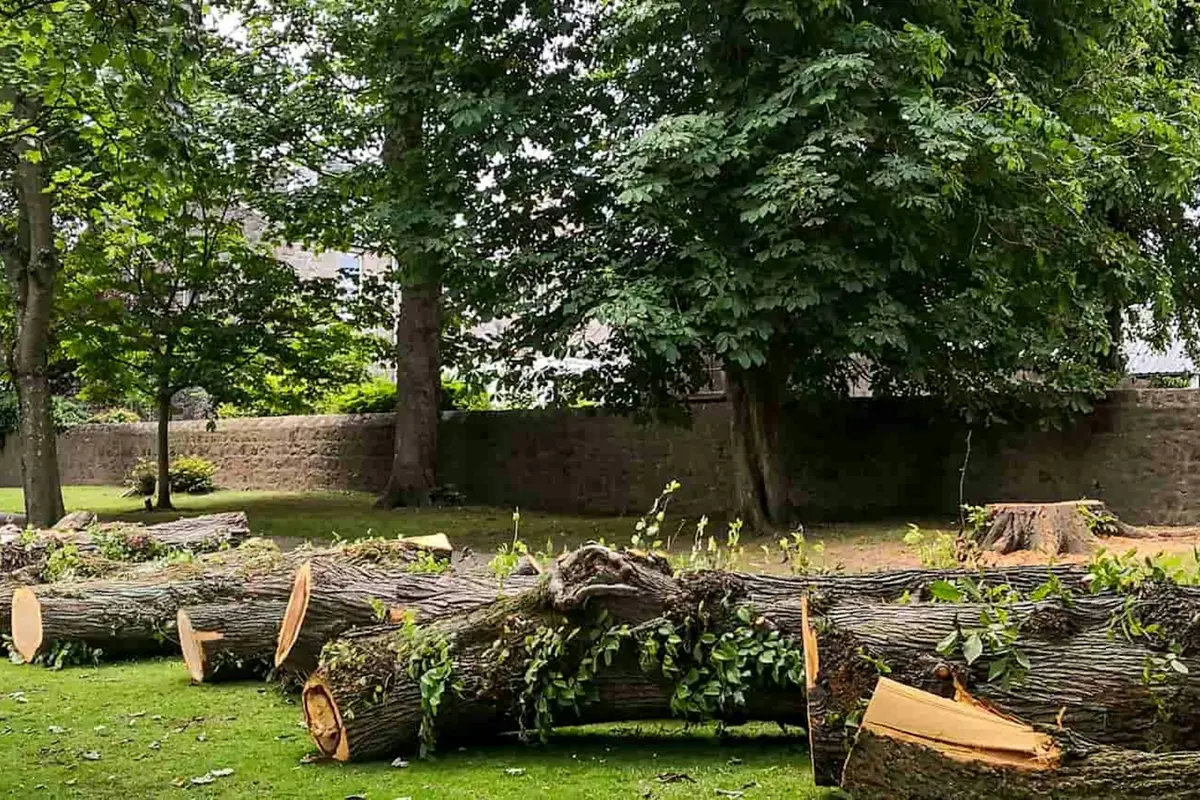
A removal generates far more volume than most people expect, because a standing canopy is deceptively compact. Brush is chipped, and trunk sections are cut to whatever length can be handled through the access available.
- Trunk wood is cut to a size the access will take rather than to the largest size the machine could handle.
- Long-unmanaged canopies carry more accumulated deadwood than expected, so the volume coming down on a first visit is often higher than on subsequent ones.
- Where a pool or enclosure sits beneath the work, keeping debris out of the water is part of the plan rather than an afterthought, and it usually means smaller cuts and more of them.
Hauled away, chipped on site, or stacked in an agreed position — all three are normal, and they are different amounts of work. Whichever you want should be stated in the scope before the day rather than settled afterwards.
Tree Removal in Largo: common questions
Does Largo require approval for removals?
The city has its own tree provisions and unincorporated Pinellas areas nearby are governed differently. Requirements can vary by property and jurisdiction, so confirm with the relevant local authority before work begins — and check park or association rules if applicable.
Why does a small tree take so long here?
Because working room, not trunk diameter, sets the pace. Where nothing can be dropped and everything is carried out through a narrow route, a modest tree can take most of a day.
Is a permit needed to remove a tree?
It depends entirely on where the property sits and what the tree is. Some Tampa Bay municipalities protect trees by species, size or location, and unincorporated county areas follow different rules again. Requirements can vary by property and jurisdiction, so confirm with the relevant local authority before work begins.
How much room does a crew actually need?
Less than most people expect for the cutting and more than most people expect for the material. The working area around the tree matters, but so does somewhere to put what comes down and a route to move it. Describing both when you call gets you a more useful answer than describing the tree alone.
The tree has not been touched in years. Where should it start?
Normally with deadwood and anything making direct contact with a structure, because those are the parts creating actual risk or damage. Shaping and reduction can follow once the tree's condition is clear. Trying to correct decades of growth in one visit tends to take more off the tree than is good for it.
Related tree services in Largo
Before committing to removal
Where the problem is clearance, deadwood or a rubbing limb, pruning usually solves it and keeps the tree. It is worth ruling that out first.
Compare tree removal with pruningWhat happens to the stump
Felling and grinding are separate operations with different equipment. If you want the stump gone, it has to be planned into the same visit.
Read about stump grindingIf condition is the reason
Where the removal is prompted by decay, a defect or a lean rather than by space or a planned change, the assessment comes first.
Read about hazardous tree assessmentRequest Tree Removal Information in Largo
Tell us the clearance around the tree and how wide the route to the street is. On a Largo lot that determines the method and the time.
- Phone: 877-269-2454
- Serving Tampa Bay, Florida
Information on this page is general guidance for property owners and managers in the Tampa Bay area. It is not an arboricultural assessment, a legal opinion, a permitting determination or an insurance decision. Tree condition and site risk can only be judged in person.