Keeping the tree
Tree Trimming and Pruning in Tampa Bay, FL
Pruning is a targeted operation, not a general tidy-up. It clears branches from structures and routes, removes dead and damaged material, and guides structure on younger trees. It cannot fix decay in a trunk, and it cannot make a tree fit a space that is fundamentally too small for its mature size.
- Tampa Bay, Florida
- Hillsborough · Pinellas · Pasco
- Residential & commercial
What this service covers
The single most useful thing to establish before any cut is the objective. Clearance over a roof, deadwood above a walkway, better light into a yard and correcting a lopsided canopy are four different jobs with four different sets of cuts. Pruning without a stated objective is how trees end up over-cut, and over-cutting is the most common avoidable problem in this work.
How much comes off matters as much as where. Removing a large share of living canopy in one visit stresses a tree and typically triggers a flush of fast, weakly attached regrowth — the opposite of what most people are trying to achieve. Where a substantial change is wanted, staging it across more than one visit gives a far better result.
Safety before anything else
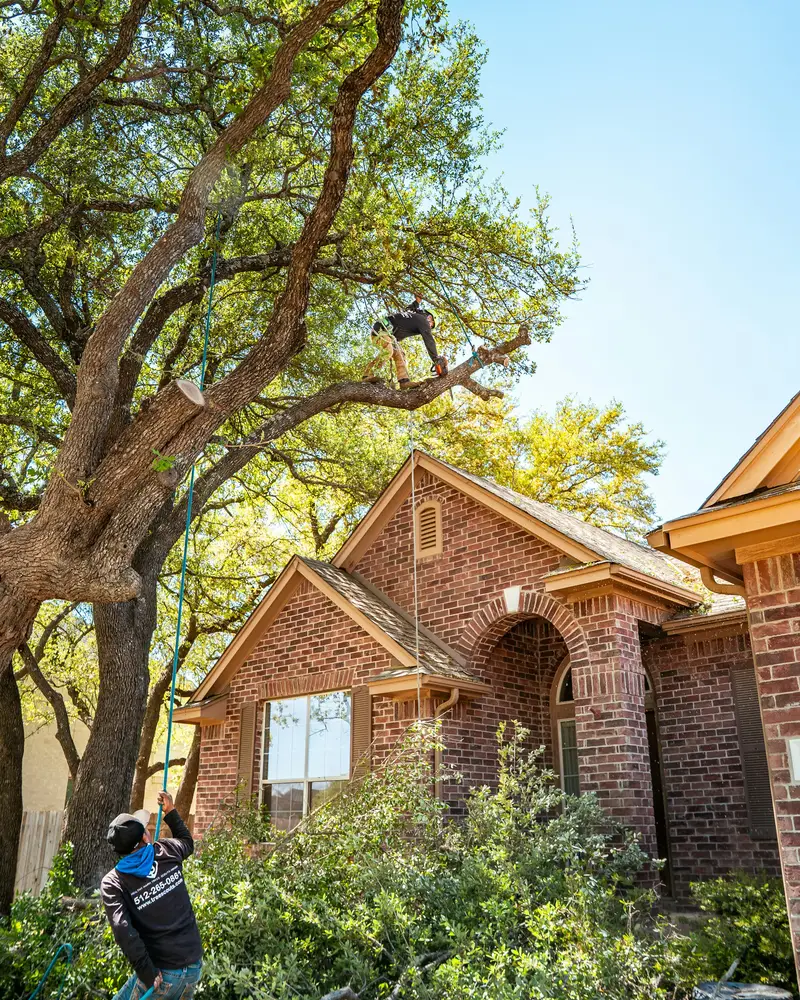
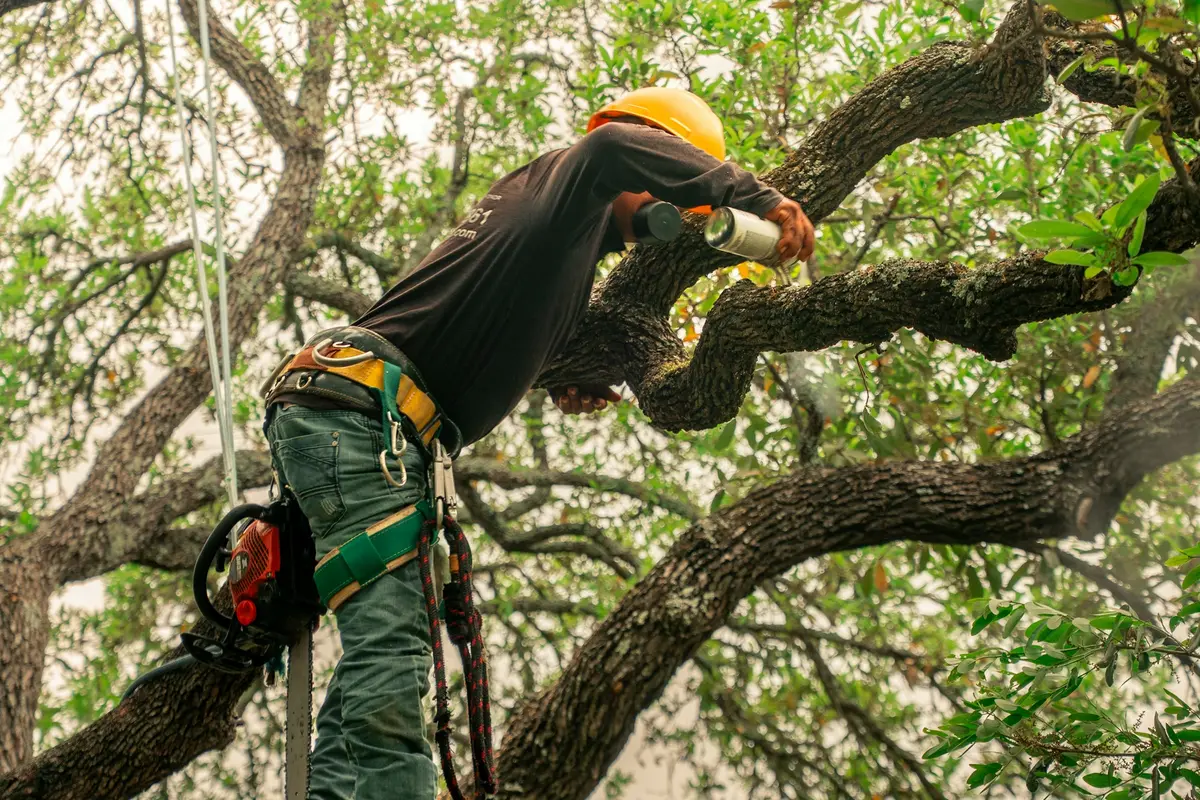
Most serious pruning injuries involve a fall or a dropped limb rather than the saw. Ladders leaned into a canopy are the common factor. If a cut cannot be reached safely from the ground, it is climbing or platform work, not a step-ladder-and-pole-saw job.
Never approach, move or work near a downed or sagging power line, and do not assume a line is inactive. Keep people, pets and vehicles well clear, and report the line to your electric utility or emergency services before anyone goes near the area.
Pruning in a subtropical climate
The growing season here is long, which cuts both ways. Trees recover from appropriate pruning readily, but they also regrow quickly, so clearance created by cutting back to the minimum needed will close up again sooner than a property owner expects. Planning for that interval is more useful than cutting harder to buy time.
Storm exposure shapes what sensible pruning looks like across the region. Removing dead, broken and poorly attached limbs reduces the amount of loose material available to come down, and correcting an obviously unbalanced canopy is reasonable maintenance. Topping a tree to stubs is a different thing entirely: it creates large wounds and produces regrowth that is attached more weakly than what it replaced, which does not help in wind.
Requirements can vary by property and jurisdiction. Property owners should confirm current requirements with the relevant local authority before work begins.
What pruning is usually asked to solve
The objective determines the cuts, so it is worth naming it precisely.
Residential situations
- Branches rubbing a roof, gutter, wall or window.
- Deadwood held above a driveway, path or seating area.
- Low limbs catching vehicles at a driveway entrance.
- A young tree with two competing leaders that should be corrected now.
Commercial and site situations
- Canopy blocking signage, lighting columns or camera sightlines.
- Clearance over pedestrian routes and accessible paths.
- Deadwood above parking bays where vehicles sit all day.
- Cyclical maintenance across a managed landscape.
Common reasons to prune
- Branches touching or rubbing a roof, gutter, wall or window.
- Dead limbs held in the canopy above a walkway, drive or seating area.
- Low growth over a driveway or footpath that catches vehicles and pedestrians.
- A canopy grown lopsided toward light, putting most of its weight on one side.
- Crossing and rubbing branches that are wounding each other where they meet.
- Sightline obstruction at a gate, driveway exit or security light.
- Sprouts and suckers from the base or along the main stem taking energy from the canopy.
- Storm-torn stubs that should be cut back to a proper point rather than left ragged.
- A young tree with two competing leaders that will become a weak union later.
- Vines climbing into the canopy and adding weight and wind load.
Pruning versus removal
Pruning solves branch problems. It does not solve trunk problems, and it cannot make a tree fit a space that is fundamentally too small for it.
Pruning is the right tool Branch-level issues
- Clearance can be achieved by removing a limited share of the canopy.
- The problems are dead, broken, crossing or poorly placed branches.
- The trunk and root flare are sound.
- The tree is young enough that structure can still be guided.
- The objective is sightlines, light or keeping growth off a building.
Pruning will not fix it Whole-tree issues
- Meeting the clearance goal would mean removing most of the living canopy.
- Decay is in the main stem or root flare, not in the branches.
- The tree's mature size is simply wrong for the position.
- Roots are in direct conflict with a slab, wall or drain.
- Repeated heavy cutting has already left a canopy of weakly attached regrowth.
How pruning work is normally approached
- Agree the objective
Clearance, deadwood, structure or sightlines. Pruning without a stated objective is how trees end up over-cut.
- Assess from the ground and in the canopy
Attachment points, decay, previous cuts and the tree's response to earlier work all change what is sensible now.
- Set the limit
How much live canopy comes off is decided before cutting starts, and kept modest. Removing too much at once weakens the tree and triggers stress regrowth.
- Work to the branch collar
Cuts are made at the right point so the wound can close properly, rather than leaving stubs or cutting flush into the stem.
- Deadwood and hazards first
Dead, broken and hanging material is taken out before any live reduction, since that is the part with an actual safety function.
- Balance the canopy
Where weight is one-sided, reduction is spread rather than concentrated, so the tree is not left with a new imbalance.
- Clear and check
Debris removed, cuts reviewed from the ground, and any follow-up interval discussed if the work is staged.
What sets the size of a pruning job
- Canopy size and the number of cuts needed to meet the objective.
- Height, and whether the work is reachable from a ladder, by climbing or from a lift.
- What is underneath — an open lawn allows dropping, a courtyard needs everything lowered.
- How long since the last prune, since neglected canopies need more work to bring back.
- Species growth habit, which affects both cut placement and how fast it will regrow.
- Whether the work is clearance over a structure or general canopy management.
- The volume of brush generated and how far it has to be carried to the chipper.
- Whether nearby beds and plantings need protection during the drop.
- Multiple trees in one visit, which usually works out more efficiently than single calls.
- Whether any part of the work overhangs a neighbouring property.
Decide these before the visit
- What outcome you actually want — more light, roof clearance, less deadwood, a tidier shape.
- Which specific branches concern you, so nothing gets missed and nothing extra gets cut.
- Whether any part of the canopy crosses a boundary.
- Whether there are cables, lights or fixtures within the canopy.
- Where brush can be staged while the chipper works.
- Whether beds, pots or delicate plantings need protecting underneath.
- Any recent change near the tree — trenching, grade change, new paving — that may be relevant.
- Whether you want the same trees revisited on a cycle or looked at once.
Debris and site finish
Pruning produces mostly light brush, which chips efficiently. The practical consideration is usually where the chipper can stand and how far material has to be dragged to reach it.
Chip can be taken away or left for use as mulch, which some property owners prefer. If you want it kept, decide where it goes before the day, since a chip pile in the wrong place is awkward to move later.
Cleanup normally includes clearing hard surfaces, raking the drop area and removing cut material. Small leaf litter continues to fall for a while after any canopy work — that is normal rather than incomplete cleanup.
Questions we are asked about this service
How much can be taken off at once?
Less than most people expect. Removing a large share of living canopy in one visit stresses a tree and often triggers weak, fast regrowth. Where a big change is wanted, staging it across more than one visit is usually the better route.
Is topping ever appropriate?
Cutting a canopy back to stubs is widely regarded as poor practice. It creates large wounds, produces weakly attached regrowth and generally leaves a tree less able to handle wind, not more. Reduction to appropriate lateral branches is the alternative.
When is the best time to prune?
Dead, broken and hazardous material can be removed at any time. Timing for structural work depends on the species and on what you are trying to achieve, and in a subtropical climate the growing season is long, so the window is wider than in colder regions.
Will pruning make my tree safer in a storm?
Removing dead limbs and correcting obvious structural defects is sensible and reduces the amount of loose material available to fall. It is not a guarantee — no pruning makes a tree storm-proof, and heavy-handed cutting can make things worse.
Can branches over my neighbour's property be cut?
There are rules about this and they vary. What is reasonable, and from which side, depends on local law and on the situation. It is worth agreeing with the neighbour before scheduling rather than discovering a disagreement mid-job.
How often should trees be pruned?
There is no fixed interval. Young trees benefit from light, regular structural attention; mature trees usually need less frequent work focused on deadwood and clearance. Growth rate and position matter more than the calendar.
Can pruning be done on a schedule?
Yes, and for managed properties a cycle is usually more effective than reactive calls. Young trees benefit from light, regular structural work; mature trees generally need less frequent attention focused on deadwood and clearance.
What if the tree has been topped before?
Previously topped trees need a different approach. The regrowth is weakly attached and often overloaded, and the work becomes about reducing that risk gradually rather than restoring an original form that is no longer achievable.
Set an objective, then prune to it
Tell us what you want to change — clearance, light, deadwood, shape — and which branches concern you. Being specific keeps the work targeted and stops trees being cut harder than they need.
- Phone: 877-269-2454
- Serving Tampa Bay, Florida
Information on this page is general guidance for property owners and managers in the Tampa Bay area. It is not an arboricultural assessment, a legal opinion, a permitting determination or an insurance decision. Tree condition and site risk can only be judged in person.