Valrico, Florida
Tree Removal in Valrico, FL
Valrico frequently offers what most of the region does not: a genuine drop zone. Where a tree has clear ground around it, felling is faster and safer than sectional dismantling, and on lots of this size that is often available. The planning question becomes the route in and what lies beneath it.
- Hillsborough County
- Former agricultural land
- Larger lots
What this means on Valrico properties
Old boundary trees are the removals that need more care than their setting suggests. Decades of unmanaged growth means large limbs at weak unions and frequently internal decay, so a tree that could theoretically be felled may need dismantling because it cannot be relied on to behave predictably. Wells, septic systems and irrigation across open ground are the other recurring constraint here.
Larger lots generally allow equipment closer to the tree, but long approaches, septic fields, wells and irrigation across open ground need locating before machinery crosses them.
Valrico is unincorporated, placing it under Hillsborough County provisions. Requirements can vary by property and jurisdiction. Property owners should confirm current requirements with the relevant local authority before work begins.
Reasons removal ends up being the right answer
For an old field-edge oak on a boundary with clear ground on one side, the decision is whether the stem is sound enough to fell or has to come apart from the top. That is judged at the tree and it changes the job considerably.
- Construction, an addition, a pool or a fence line that the tree sits directly in.
- A species that has outgrown the space it was planted in and cannot be reduced sensibly.
- Structural decay in the lower trunk or root flare, where there is no pruning fix.
- Old boundary or field-edge growth that was never managed as a garden tree.
- Ground at the base that has stayed soft, limiting what can be driven anywhere near the tree.
Removal or retention: how the decision is usually framed
Removal is permanent, so it is worth being clear about which problem it solves. A tree with a structural defect in the main stem is a different case to a healthy tree in an inconvenient place.
Points toward keeping the tree Reversible problems
- The tree provides shade or screening that would be difficult and slow to replace.
- Defects are limited to individual limbs rather than the trunk or root flare.
Points toward removal Structural or spatial
- The tree is simply too large for the space at maturity and always will be.
- Decay, cavity or fungal fruiting bodies at the base or on the main stem.
How the work is kept safe
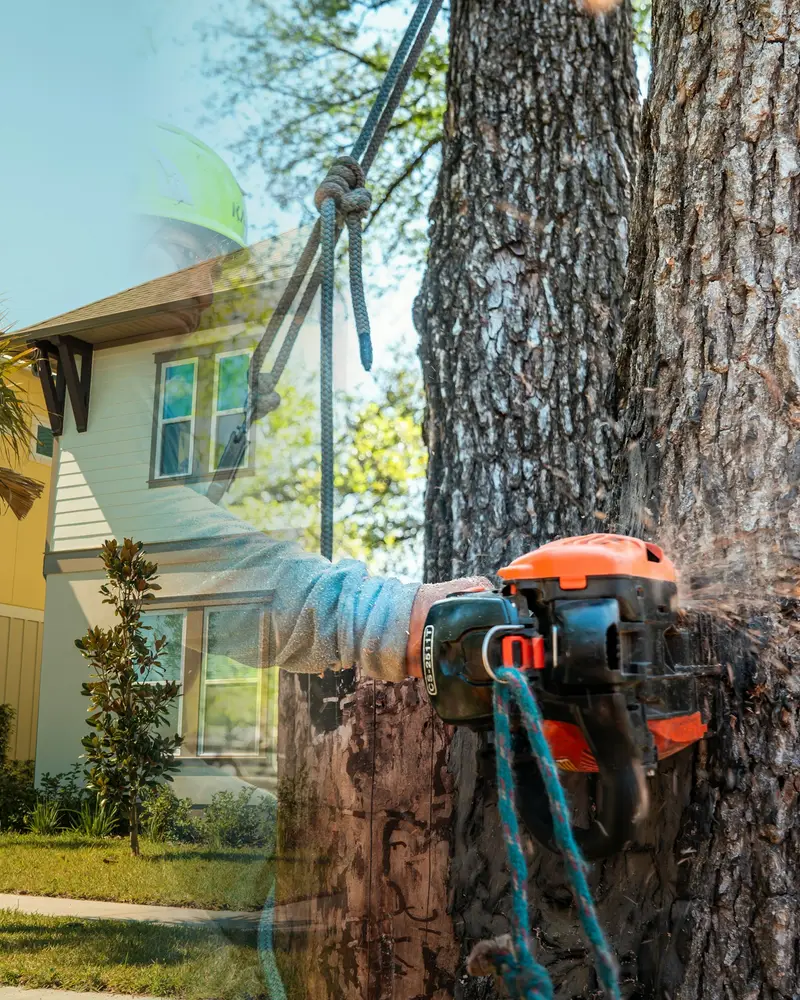
Before a saw starts, the area a section could reach has to be empty and stay empty. That includes the space people habitually cut through — a side gate, a bin store, a shortcut across a lawn. An exclusion zone that relies on everyone remembering is not an exclusion zone.
Never approach, move or work near a downed or sagging power line, and do not assume a line is inactive. Keep people, pets and vehicles well clear, and report the line to your electric utility or emergency services before anyone goes near the area.
How a planned removal usually runs
- Site walk and decision
The tree, its target zone and the access route are looked at together. Sometimes the outcome is that removal is not the best option.
- Method selection
Straight felling, sectional dismantling or a lift-assisted approach, chosen by what is underneath and how much room there is to drop material.
- Protect what stays
Beds, irrigation, paving, fencing and neighbouring plantings that could take incidental damage are identified and protected or worked around.
- Stump decision
Cut low, ground down, or left at a workable height for a later grind — this depends on what the space is going to become.
- Site finish
Material removed or staged, hard surfaces cleared, and the ground left in a state that matches what happens next on that spot.
What actually determines the work involved
- Trunk diameter and total height, which govern how much material there is to move.
- What sits under the canopy — open lawn is a completely different job to a courtyard.
- Proximity to a boundary and the need to work without encroaching on a neighbour.
- Whether the ground will carry the equipment. Soft or unmade approaches limit what can be driven in and sometimes rule out machine access entirely.
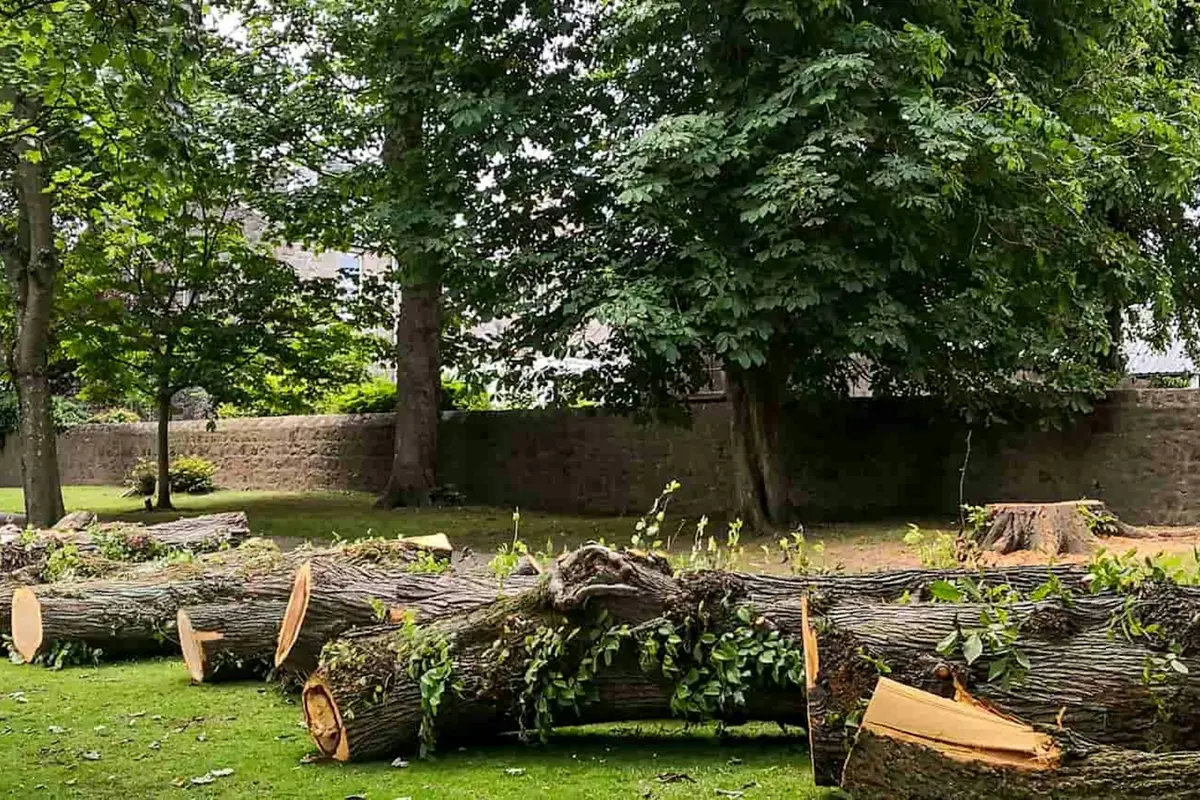
- Whether there is a genuine drop zone. Open ground is the one thing that makes tree work straightforward, and where it exists the method changes completely.
- Whether the tree is a planted landscape specimen or remnant growth from earlier land use. Old field-edge trees frequently carry structural defects that never mattered while nothing stood beneath them.
Questions worth answering before you call
- Whether any part of the canopy overhangs a neighbouring property.
- Where a truck and chipper could realistically park and work.
- What the space will be used for once the tree is gone.
- Say whether the approach is made-up surface or open ground, and whether it has stayed wet recently. It is the difference between driving to the tree and working off it.
- Say whether the tree was planted as part of the garden or was already there. It is a genuinely useful distinction — the two tend to have grown very differently.
- Walk the property before you call and count what actually needs attention, rather than describing the single tree that prompted it. Several trees in one visit is normally more efficient than separate calls.
Debris and cleanup
You can usually choose what happens to the wood. Full haul-away leaves the cleanest site; leaving rounds or chip on site reduces the volume that has to be carried out and can be useful if you have a use for it. It is worth deciding before the day rather than during it.
- Where ground conditions limit vehicle access, material is often staged nearer the road and loaded from there, which needs a position agreeing in advance.
- Larger parcels usually allow material to be staged near the working area, so the carry is short and the loading happens in one place.
- Where there is room, chip and trunk rounds can often be left in an agreed position rather than hauled, which reduces what has to be carried and loaded.
Hauled away, chipped on site, or stacked in an agreed position — all three are normal, and they are different amounts of work. Whichever you want should be stated in the scope before the day rather than settled afterwards.
Tree Removal in Valrico: common questions
Can a large tree on an acre just be felled?
Where there is a genuine drop zone clear of structures, boundaries and services, often yes. On an old unmanaged tree the additional question is whether the stem can be relied on, and that is assessed rather than assumed from lot size.
Do county or city rules apply?
Valrico is unincorporated, so Hillsborough County provisions apply rather than a city code. Requirements can vary by property and jurisdiction, so confirm with the relevant local authority before work begins.
Is a permit needed to remove a tree?
It depends entirely on where the property sits and what the tree is. Some Tampa Bay municipalities protect trees by species, size or location, and unincorporated county areas follow different rules again. Requirements can vary by property and jurisdiction, so confirm with the relevant local authority before work begins.
The trees along the boundary were here before the house. Does that matter?
It often does. Trees that grew as field-edge or hedgerow growth develop differently from planted specimens, and defects that were harmless in open ground become relevant once a building, a drive or a fence line arrives underneath. It is worth mentioning when you describe the tree.
The ground is soft where the tree is. Does the work have to wait?
Sometimes, and it is usually better than the alternative. Driving heavy equipment over saturated ground leaves damage that outlasts the tree work. Where waiting is not practical, the method shifts toward smaller equipment and more hand carrying, which takes longer but leaves the ground intact.
Related tree services in Valrico
Before committing to removal
Where the problem is clearance, deadwood or a rubbing limb, pruning usually solves it and keeps the tree. It is worth ruling that out first.
Compare tree removal with pruningWhat happens to the stump
Felling and grinding are separate operations with different equipment. If you want the stump gone, it has to be planned into the same visit.
Read about stump grindingIf condition is the reason
Where the removal is prompted by decay, a defect or a lean rather than by space or a planned change, the assessment comes first.
Read about hazardous tree assessmentRequest Tree Removal Information in Valrico
Tell us whether there is a clear drop zone, whether the tree is old boundary growth, and where the well and septic run. That sets a Valrico removal.
- Phone: 877-269-2454
- Serving Tampa Bay, Florida
Information on this page is general guidance for property owners and managers in the Tampa Bay area. It is not an arboricultural assessment, a legal opinion, a permitting determination or an insurance decision. Tree condition and site risk can only be judged in person.