Operating sites
Commercial Tree Removal in Tampa Bay, FL
On a commercial property the cutting is rarely the hard part. The planning problem is doing the work while the site keeps functioning: customers arriving, tenants trading, deliveries scheduled, parking in use and accessible routes that have to stay open.
- Tampa Bay, Florida
- Hillsborough · Pinellas · Pasco
- Commercial & land scope
What this service covers
That is why a commercial job starts with a site walk alongside whoever actually runs the property. Four answers shape the job more than the trees do. Which hours the work can occupy the site. How pedestrians will be routed around an exclusion zone. Which bays or aisles can go out of use, and for how long. And who has authority to change the plan on the day.
On larger sites, sequencing becomes the main lever. Work is ordered so that no more of the property is out of use at any one moment than necessary, with the exclusion zone moving across the site rather than covering all of it. Restricted working hours often lengthen the calendar considerably even when the tree work itself is modest, so it is worth raising early.
Safety before anything else
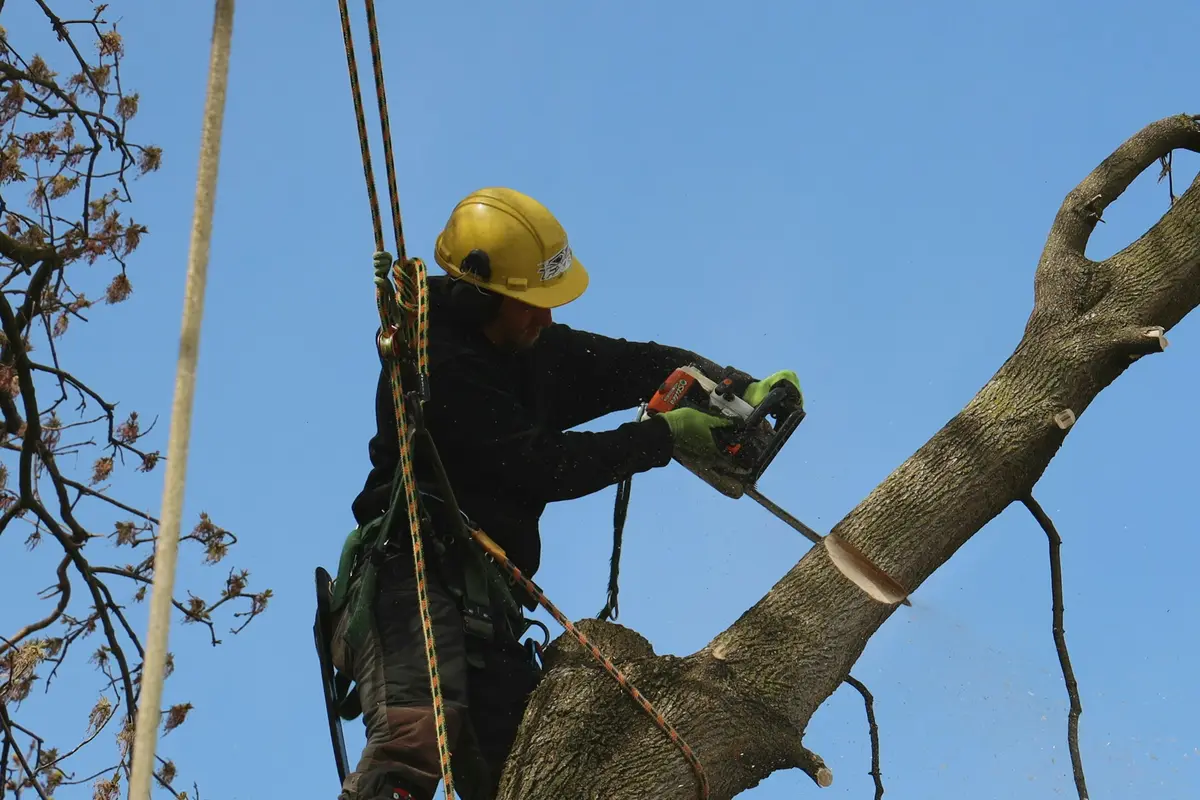
On a live site the people who need managing are the ones who did not read the signage. Barriers, a routed diversion and someone watching the boundary matter more than cones. The exclusion zone stays closed while work is active, not while it is convenient.
Never approach, move or work near a downed or sagging power line, and do not assume a line is inactive. Keep people, pets and vehicles well clear, and report the line to your electric utility or emergency services before anyone goes near the area.
Commercial tree work around Tampa Bay
Much of the region's commercial landscaping dates from the same era as its residential development, and it produces a recognisable set of problems. Parking island trees have outgrown their beds and are lifting kerbs. Canopies press on signage and lighting. Root systems sit under footpaths that were laid without room for them.
Multi-building and multi-tenant sites also concentrate storm impact. After a significant weather event, a managed property may have damage spread across several buildings and car parks at once, and handling that as one coordinated clear is usually more effective than a series of individual reactive visits.
Requirements can vary by property and jurisdiction. Property owners should confirm current requirements with the relevant local authority before work begins.
Commercial contexts this covers
Different property types put the constraint in different places.
Residential and managed property
- Multifamily and managed residential sites where residents need continuous access.
- Owner-occupied premises with fixed trading hours.
- Properties in a handover or sale process needing documented work.
- Sites where another trade is already programmed and timing has to align.
Commercial and site situations
- Retail and hospitality sites where customer access cannot be interrupted.
- Office parks with defined arrival and departure peaks.
- Industrial yards with heavy vehicle movements through the work area.
- Institutional and campus properties with pedestrian routes to manage.
Typical commercial triggers
- A tree in a parking area dropping limbs onto vehicles.
- Canopy interfering with signage, lighting or camera sightlines.
- Roots lifting a footpath, kerb or accessible route across a site.
- A declining tree within reach of a building entrance or a tenant unit.
- Landscaping installed decades ago that has outgrown its islands and beds.
- A tree obstructing a delivery route, service yard or refuse collection point.
- Storm damage across a multi-building site needing a single coordinated response.
- Trees flagged during a property condition report or a handover inspection.
- Canopy pressing on a roofline, parapet or rooftop unit.
- A boundary tree affecting a neighbouring commercial occupier.
Access and coordination questions that come first
- Which hours the work can occupy the site without disrupting trading or tenants.
- How pedestrians will be routed around an exclusion zone, and who signs off on that.
- Whether parking bays or drive aisles need to be taken out of use, and for how long.
- Whether deliveries, waste collection or emergency access run through the work area.
- Who on site holds keys, gate codes and authority to change the plan on the day.
- Whether adjoining tenants or neighbouring businesses need notice.
- Where a chipper and truck can stand without blocking a fire lane or loading area.
- Whether lighting, signage, cameras or overhead services sit within the drop zone.
In hours or out of hours?
On an operating site the cutting is rarely the constraint. What decides the plan is how much of the site can be out of use at once, and when the people who use it are not there.
Normal hours usually work Low-traffic footprint
- The tree sits away from entrances, accessible routes and delivery paths.
- Bays or aisles can be coned off without cutting the site's usable capacity.
- Pedestrians can be routed around the exclusion zone on an existing path.
- Nobody needs the affected area during the working day.
- The work is a single visit rather than a phased programme.
Out of hours earns its cost Access or occupancy pressure
- The only equipment position is a customer entrance or a fire route.
- Losing the bays during trading hours costs more than the out-of-hours premium.
- Tenants, residents or patients would be inside the noise footprint all day.
- The exclusion zone would cross the site's main pedestrian desire line.
- Several trees need doing and the site cannot lose them all at once.
How a commercial job is normally organised
- Site walk with the responsible person
Trees, access, service routes and operating constraints are reviewed together, so the plan reflects how the site actually runs.
- Define the working window
Early mornings, off-peak hours or closed days often cost less disruption than a mid-day start, and that is usually the deciding factor.
- Plan the exclusion zone
Where it sits, how it is signed, how pedestrians and vehicles get around it, and how it is opened and closed each day.
- Sequence multi-tree work
On larger sites the order is chosen so that no more of the site is out of use at once than necessary.
- Execute with the zone controlled
Work proceeds inside a maintained boundary, with the zone reduced or relocated as the job moves across the site.
- Stage debris out of circulation
Material is collected somewhere that does not obstruct fire lanes, loading or accessible routes while work continues.
- Hand the area back clean
Surfaces cleared, bays reopened, and the site walked with the responsible person before the crew leaves.
What drives cost and duration on commercial sites
- How much of the site has to remain in use while work happens.
- Restricted working hours, which lengthen the calendar even when the work is small.
- The number of trees and how spread out they are across the property.
- Whether hard surfaces need protection from equipment loads.
- Coordination with other trades already working on the site.
- Pedestrian management requirements at entrances and along accessible routes.
- Overhead services, lighting columns and rooftop equipment near the canopy.
- Whether debris can be staged on site or must leave with each load.
- Documentation and sign-off expected by a managing agent.
- Whether the work is one visit or part of a longer maintenance arrangement.
What speeds up a commercial quote
- A site plan or a marked-up aerial image showing the trees in question.
- The name and contact of the person who can authorise work and access.
- Permitted working hours and any restricted dates.
- Details of gates, barriers, height restrictions and access codes.
- Whether any bays or routes can be closed, and who arranges that.
- Notice requirements for tenants or adjoining occupiers.
- Any prior reports, inspections or contractor notes about the trees.
- Whether documentation is needed for a managing agent or owner's file.
Debris and site finish
On an operating site, debris handling is a logistics problem as much as a clearing one. Material is normally taken directly to the truck rather than piled, because a pile on a commercial property blocks something — a bay, a lane, an accessible route.
Where volume exceeds what can leave in a single load, a staging point is agreed in advance, sited away from fire lanes, hydrants, drainage and refuse collection. Agreeing it up front avoids a debate on the day.
Final clearing on commercial sites usually needs to be more thorough than on residential ones. Chip and sawdust on a footpath or a car park surface is a slip and complaint risk, so hard surfaces are blown and swept before handback.
Questions we are asked about this service
Can work be done outside business hours?
Often, and on trading sites it is frequently the better option. What is possible depends on noise expectations, site access outside hours and whether adjoining occupiers are affected. It is worth raising early, since it shapes the whole plan.
Who manages pedestrian safety during the work?
The exclusion zone around active tree work is managed by the crew. How people are routed around it on a wider site is a shared decision with whoever runs the property, since it affects entrances, accessible routes and signage.
Can several buildings be handled in one visit?
Usually yes, and it is normally more efficient than separate visits. The main planning question is sequencing, so that no more of the site is out of use at any moment than necessary.
Do you work with property managers and agents?
Yes. Multi-tenant and managed properties are a common context for this work. What we cannot do is make claims about credentials or approvals we have not documented, so please ask directly for whatever your process requires.
What about trees on a boundary with another business?
Those need agreement before work starts. Access, timing and responsibility all get more complicated across a commercial boundary, and it is much easier to resolve in advance than mid-job.
Will the car park surface be damaged?
Equipment loads on asphalt are a genuine consideration, particularly in hot weather and with heavier machines. Protection can be used, positioning can be adjusted, and where a surface is a concern it should be flagged during the site walk.
Can documentation be provided for an owner's file?
Tell us what your process requires and we will confirm what we can provide. We do not make claims about credentials or approvals we have not documented, so it is better to ask directly than to assume.
How is a multi-site portfolio usually handled?
Typically as a scoped programme rather than site-by-site calls, with the sequence set by condition and by operational constraints. The starting point is the same site walk, just repeated across the properties.
Start with the operating constraints
Permitted hours, access codes, who authorises changes, and which routes and bays can be closed. Those four things determine the plan — send them over and we can scope the work properly.
- Phone: 877-269-2454
- Serving Tampa Bay, Florida
Information on this page is general guidance for property owners and managers in the Tampa Bay area. It is not an arboricultural assessment, a legal opinion, a permitting determination or an insurance decision. Tree condition and site risk can only be judged in person.