Planned work
Tree Removal in Tampa Bay, FL
Removal is the right answer when the problem is the tree itself rather than its branches: decay in the trunk or root flare, a species that will always be too large for its position, or a root conflict that will keep escalating. Where the issue is clearance or deadwood, pruning usually solves it without losing the tree.
- Tampa Bay, Florida
- Hillsborough · Pinellas · Pasco
- Residential & commercial
What this service covers
Because removal is permanent, it is worth being explicit about which problem it solves. A great many trees are removed for clearance that could have been achieved with a properly planned prune, and a great many are pruned repeatedly when the honest answer was that they were planted in the wrong place forty years ago.
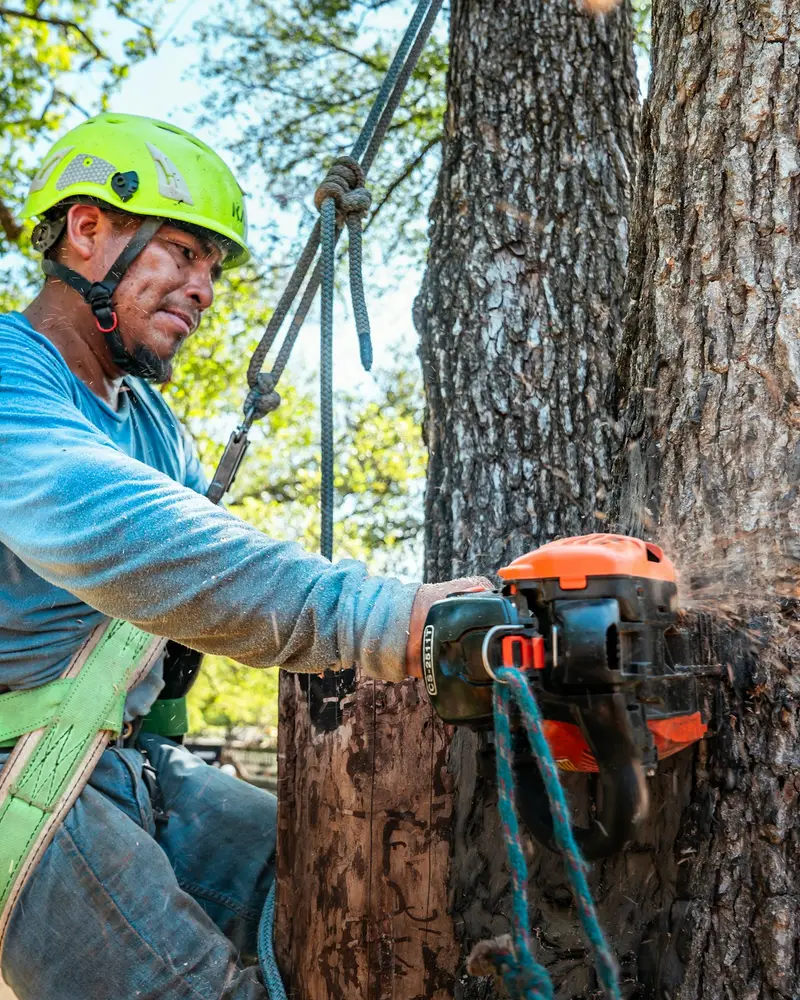
Once removal is decided, the method is usually determined by what sits underneath rather than by the size of the tree. An open lawn allows straight felling; a courtyard, a pool deck or a roofline means the tree is dismantled in sections and lowered under control. Access — gate width, overhead clearance, where a truck can stand — tends to influence the day more than trunk diameter does.
Safety before anything else
Before a saw starts, the area a section could reach has to be empty and stay empty. That includes the space people habitually cut through — a side gate, a bin store, a shortcut across a lawn. An exclusion zone that relies on everyone remembering is not an exclusion zone.
Never approach, move or work near a downed or sagging power line, and do not assume a line is inactive. Keep people, pets and vehicles well clear, and report the line to your electric utility or emergency services before anyone goes near the area.
What shapes removals across the region
Tampa Bay's residential building history creates a recognisable problem. Neighbourhoods built through the mid and late twentieth century were landscaped with trees selected for a new yard, and those trees have now reached mature size on lots that were never laid out for them. Canopies press against rooflines, roots reach under driveways and slabs, and the space available for the work is whatever is left between the house and the fence.
Rules differ across the region and this genuinely matters. Incorporated cities including Tampa, St. Petersburg, Clearwater, Largo, Dunedin and New Port Richey administer their own municipal codes, while unincorporated areas such as Brandon, Riverview, Carrollwood, Valrico, Apollo Beach, Town ’n’ Country, Palm Harbor, Wesley Chapel and Land O’ Lakes fall under county provisions. Requirements can vary by property and jurisdiction. Property owners should confirm current requirements with the relevant local authority before work begins.
Requirements can vary by property and jurisdiction. Property owners should confirm current requirements with the relevant local authority before work begins.
Common removal contexts
The reason behind a removal usually predicts how the work will be planned.
Residential situations
- A tree planted too close to the house whose canopy can no longer be kept off the roof.
- Root conflict lifting a driveway, walkway or slab.
- A declining tree that has not responded to changes in irrigation or grade.
- Clearing the footprint for a pool, an addition or a new fence line.
Commercial and site situations
- Parking island trees that have outgrown their beds and are lifting kerbs.
- Canopy interfering with signage, lighting or camera sightlines.
- Trees flagged in a property condition report ahead of a sale or handover.
- Landscape rationalisation across a managed multi-building site.
Reasons removal ends up being the right answer
- Structural decay in the lower trunk or root flare, where there is no pruning fix.
- A tree planted too close to a foundation, driveway or septic field for its mature size.
- Repeated limb failure from the same weak attachment despite previous pruning.
- A canopy that cannot be kept clear of a roof without cutting the tree back past what it can sustain.
- Roots lifting a walkway, slab or wall where the conflict will only worsen.
- A species that has outgrown the space it was planted in and cannot be reduced sensibly.
- Construction, an addition, a pool or a fence line that the tree sits directly in.
- Persistent decline that has not responded to changes in irrigation, grade or care.
- A tree shading a whole yard so heavily that nothing else will establish beneath it.
- Storm history that has left the tree with more wound than sound wood.
Removal or retention: how the decision is usually framed
Removal is permanent, so it is worth being clear about which problem it solves. A tree with a structural defect in the main stem is a different case to a healthy tree in an inconvenient place.
Points toward keeping the tree Reversible problems
- The issue is clearance, and pruning can create it without removing more than a modest share of the canopy.
- Defects are limited to individual limbs rather than the trunk or root flare.
- Decline followed a change in irrigation, grade or root-zone conditions that can be corrected.
- The conflict is with something movable — a shed, a bed, a path alignment.
- The tree provides shade or screening that would be difficult and slow to replace.
Points toward removal Structural or spatial
- Decay, cavity or fungal fruiting bodies at the base or on the main stem.
- The tree is simply too large for the space at maturity and always will be.
- Root conflict with a slab, foundation or drain that will keep escalating.
- Repeated failures from the same union, where pruning has already been tried.
- A planned build, pool or driveway occupies the space the tree stands in.
How a planned removal usually runs
- Site walk and decision
The tree, its target zone and the access route are looked at together. Sometimes the outcome is that removal is not the best option.
- Method selection
Straight felling, sectional dismantling or a lift-assisted approach, chosen by what is underneath and how much room there is to drop material.
- Protect what stays
Beds, irrigation, paving, fencing and neighbouring plantings that could take incidental damage are identified and protected or worked around.
- Canopy reduction
Limbs are removed in a planned order so the tree stays balanced as it comes apart, rather than becoming top-heavy on one side.
- Stem sectioning
The trunk is taken in lengths that suit the drop zone and what can be moved out through the available access.
- Stump decision
Cut low, ground down, or left at a workable height for a later grind — this depends on what the space is going to become.
- Site finish
Material removed or staged, hard surfaces cleared, and the ground left in a state that matches what happens next on that spot.
What actually determines the work involved
- Trunk diameter and total height, which govern how much material there is to move.
- What sits under the canopy — open lawn is a completely different job to a courtyard.
- Whether a chipper and truck can get within reach or everything must be carried out.
- Gate width and any overhead obstruction on the access route.
- Whether limbs can be dropped freely or have to be rigged down piece by piece.
- Species and wood density, which change cutting time and the weight of each section.
- Whether the stump is included and how deep the grind needs to be for the intended use.
- Slope, soft ground or drainage features that limit machine positioning.
- Proximity to a boundary and the need to work without encroaching on a neighbour.
- Whether the wood leaves the property or is cut and stacked on site.
Questions worth answering before you call
- What the space will be used for once the tree is gone.
- Whether you want the stump ground, and whether anything will be planted or built there.
- Where a truck and chipper could realistically park and work.
- The width of the narrowest gate or side path on the access route.
- Whether any part of the canopy overhangs a neighbouring property.
- Whether irrigation, low-voltage lighting or a septic system runs near the tree.
- Whether you want the wood removed entirely or some of it left cut on site.
- Any timing constraint — events, deliveries, other trades already booked.
Debris and site finish
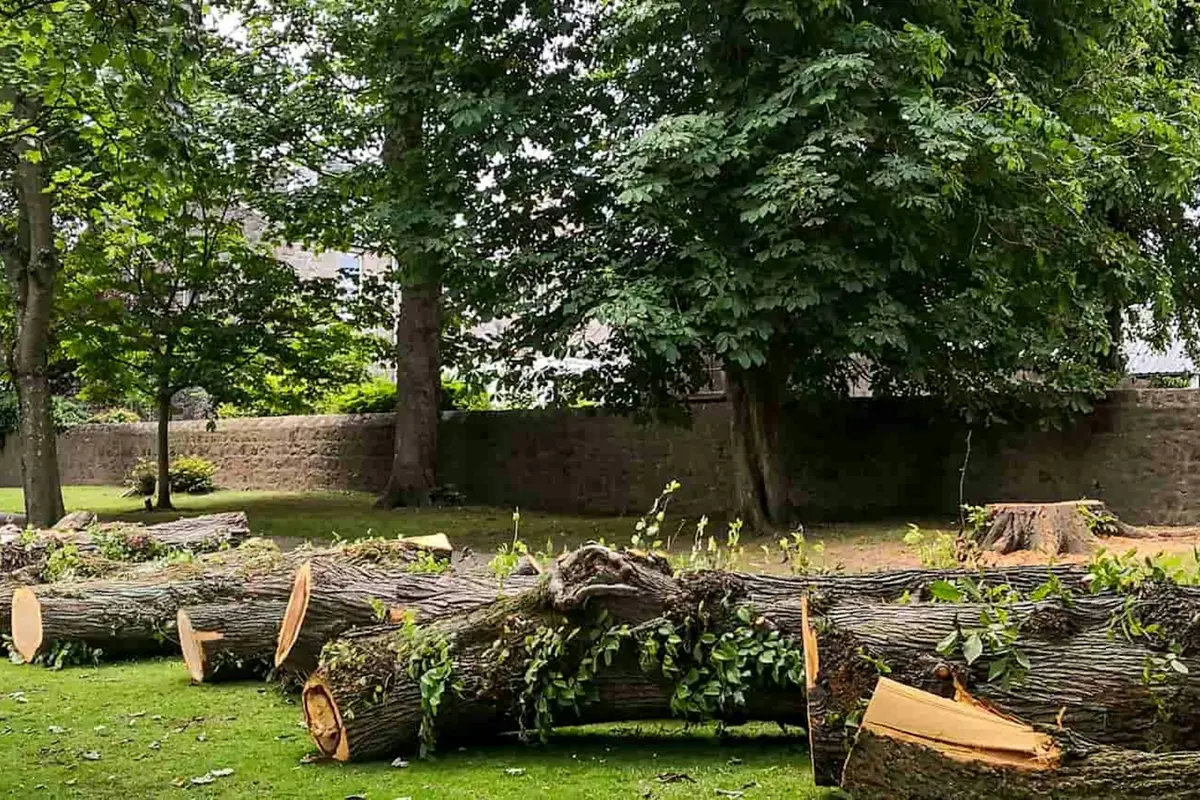
A removal generates far more volume than most people expect, because a standing canopy is deceptively compact. Brush is chipped, and trunk sections are cut to whatever length can be handled through the access available.
You can usually choose what happens to the wood. Full haul-away leaves the cleanest site; leaving rounds or chip on site reduces the volume that has to be carried out and can be useful if you have a use for it. It is worth deciding before the day rather than during it.
Cleanup normally means brush cleared, hard surfaces blown down and the drop zone raked. Some surface disturbance where heavy sections landed is normal on lawn, and grinding a stump always produces a chip pile that needs a decision of its own.
Questions we are asked about this service
Is a permit needed to remove a tree?
It depends entirely on where the property sits and what the tree is. Some Tampa Bay municipalities protect trees by species, size or location, and unincorporated county areas follow different rules again. Requirements can vary by property and jurisdiction, so confirm with the relevant local authority before work begins.
Does the stump come out with the tree?
Not automatically. Felling and stump grinding are separate operations using different equipment. If you want the stump gone, say so up front so the grind is planned into the same visit rather than a return trip.
Will the lawn be damaged?
Some marking is normal where heavy sections land or machinery tracks across grass, particularly on soft ground. It is usually cosmetic and recovers, and drop zones can be planned to keep the worst of it off the areas you care about most.
Can a tree be removed if it is close to the house?
Usually, but the method changes. Instead of felling, the tree is dismantled in sections and lowered under control. That takes longer, and where the drop zone is very tight a lift-assisted approach may be the sensible option.
What about a tree on the boundary?
Ownership and responsibility for boundary trees depend on where the trunk stands and on local rules, and the neighbour's position matters. It is worth resolving that before work is scheduled rather than after.
How long does a removal take?
Anything from part of a morning for a modest tree with open access to a full day or more where every piece has to be rigged out over a structure. Access is usually a bigger factor than the size of the tree.
Can a removal be scheduled around other work?
Usually, and it is often sensible. Tree removal before paving, fencing or a build avoids doing the same access damage twice, and it is much easier to remove a tree before a new structure is standing next to it.
Is it cheaper to remove several trees at once?
Generally the per-tree effort drops, because mobilisation, setup and access are shared. Whether that is true in a specific case depends on where the trees sit and whether they share an access route.
Talk through whether removal is the right call
Tell us what the tree is doing, what sits underneath it and what you want the space to become. Sometimes the answer is that pruning solves it — and that is a better outcome than a removal you did not need.
- Phone: 877-269-2454
- Serving Tampa Bay, Florida
Information on this page is general guidance for property owners and managers in the Tampa Bay area. It is not an arboricultural assessment, a legal opinion, a permitting determination or an insurance decision. Tree condition and site risk can only be judged in person.