Wesley Chapel, Florida
Tree Removal in Wesley Chapel, FL
A large share of Wesley Chapel removals are pines that were kept when a community was built. The decision is usually not about visible decline but about geometry: a tall, slender stem with a disturbed root zone standing within its own height of a house, where there is no pruning option that changes the risk.
- Pasco County
- Sandy soils
- Master-planned communities
What this means on Wesley Chapel properties
Community requirements add a step here that does not exist in unincorporated areas without them. Wesley Chapel is unincorporated so Pasco County provisions apply, and many developments have their own landscape rules and conservation easements behind rear lot lines. Requirements can vary by property and jurisdiction, so confirm with the relevant local authority — and your association — before work begins.
Community layouts generally allow reasonable vehicle access, but HOA-managed common areas, conservation easements behind lots and shared retention areas often complicate who authorises what.
Wesley Chapel is unincorporated, so Pasco County provisions apply, and community-level rules may apply on top of them. Requirements can vary by property and jurisdiction. Property owners should confirm current requirements with the relevant local authority before work begins.

Reasons removal ends up being the right answer
A tall pine close to a rear lot line, with a conservation easement behind it and a two-storey house within the fall radius, has limited options in either direction. Where sections can be put down is the first question.
- Repeated limb failure from the same weak attachment despite previous pruning.
- Persistent decline that has not responded to changes in irrigation, grade or care.
- Storm history that has left the tree with more wound than sound wood.
- Dead lower limbs on a tall stem, which shed as the tree grows.
- Clearance along a long driveway or approach where growth has closed in from both sides.
Removal or retention: how the decision is usually framed
Removal is permanent, so it is worth being clear about which problem it solves. A tree with a structural defect in the main stem is a different case to a healthy tree in an inconvenient place.
Points toward keeping the tree Reversible problems
- Defects are limited to individual limbs rather than the trunk or root flare.
- The issue is clearance, and pruning can create it without removing more than a modest share of the canopy.
Points toward removal Structural or spatial
- Root conflict with a slab, foundation or drain that will keep escalating.
- A planned build, pool or driveway occupies the space the tree stands in.
How the work is kept safe
A tree with genuine clear ground around it can often be felled in one piece, which is faster and safer. A tree with a roofline, cage or fence inside its reach has to come apart in sections that are lowered under control. Choosing the first method on a site that needs the second is where most avoidable property damage comes from.
Never approach, move or work near a downed or sagging power line, and do not assume a line is inactive. Keep people, pets and vehicles well clear, and report the line to your electric utility or emergency services before anyone goes near the area.
How a planned removal usually runs
- Site walk and decision
The tree, its target zone and the access route are looked at together. Sometimes the outcome is that removal is not the best option.
- Protect what stays
Beds, irrigation, paving, fencing and neighbouring plantings that could take incidental damage are identified and protected or worked around.
- Canopy reduction
Limbs are removed in a planned order so the tree stays balanced as it comes apart, rather than becoming top-heavy on one side.
- Stump decision
Cut low, ground down, or left at a workable height for a later grind — this depends on what the space is going to become.
- Site finish
Material removed or staged, hard surfaces cleared, and the ground left in a state that matches what happens next on that spot.
What actually determines the work involved
- What sits under the canopy — open lawn is a completely different job to a courtyard.
- Gate width and any overhead obstruction on the access route.
- Whether the stump is included and how deep the grind needs to be for the intended use.
- Whether the tree was retained through building work. Grading, trenching and compaction inside the root zone show in the canopy years later and change what the tree can be expected to do.
- Whether community-level requirements apply on top of county provisions, which can affect timing as much as scope.
- Whether there is height clearance for sections to be taken down the stem, since a tall stem over a house has little margin for error.
Questions worth answering before you call
- Whether you want the wood removed entirely or some of it left cut on site.
- Whether any part of the canopy overhangs a neighbouring property.
- What the space will be used for once the tree is gone.
- Check whether your community has its own requirements or approval process. Confirm those with the association directly — they sit on top of county provisions, not instead of them.
- Walk the property before you call and count what actually needs attention, rather than describing the single tree that prompted it. Several trees in one visit is normally more efficient than separate calls.
- Say roughly how tall the tree is against the house — two storeys, three, or well above the roofline. On a tall stem that estimate matters more than the trunk diameter.
Debris and cleanup
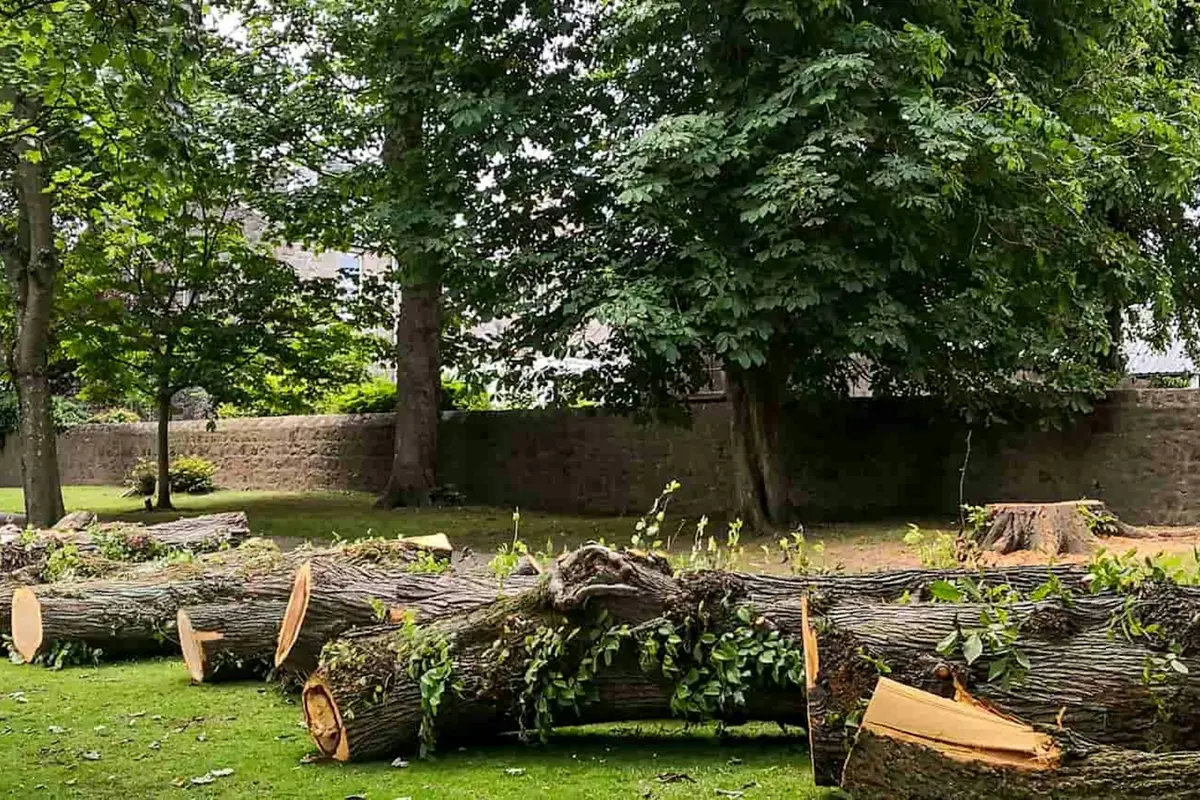
Cleanup normally means brush cleared, hard surfaces blown down and the drop zone raked. Some surface disturbance where heavy sections landed is normal on lawn, and grinding a stump always produces a chip pile that needs a decision of its own.
- Where there is room, chip and trunk rounds can often be left in an agreed position rather than hauled, which reduces what has to be carried and loaded.
- Where a community sets rules on where material may be placed or for how long, confirm those before a pile is built rather than after.
- Larger parcels usually allow material to be staged near the working area, so the carry is short and the loading happens in one place.
Hauled away, chipped on site, or stacked in an agreed position — all three are normal, and they are different amounts of work. Whichever you want should be stated in the scope before the day rather than settled afterwards.
Tree Removal in Wesley Chapel: common questions
Do I need HOA approval as well as county approval?
Quite possibly. Many Wesley Chapel communities have their own landscape provisions in addition to Pasco County requirements, and the two are separate. Requirements can vary by property and jurisdiction, so confirm both before work begins.
The tree is beside a conservation area. Does that restrict removal?
It can. Land designated as conservation or preserve within or behind a community is often subject to specific rules, and where the boundary sits matters. That needs establishing before anything is scheduled.
How long does a removal take?
Anything from part of a morning for a modest tree with open access to a full day or more where every piece has to be rigged out over a structure. Access is usually a bigger factor than the size of the tree.
The tree was left standing when the house was built. Is that a problem?
Not automatically, but it is worth knowing. Trees retained through construction often had root zones cut, compacted or regraded, and they were frequently sheltered by other trees that were cleared. Both show up years later rather than immediately, which is why the history is useful context for an assessment.
Is a tall pine handled differently from an oak?
Yes, in a way that matters. A pine carries most of its weight high on a comparatively slender stem and tends to fail as a whole stem rather than by shedding limbs, so the target assessment and the takedown sequence are both different. It is worth saying which you have when you call.
Related tree services in Wesley Chapel
Before committing to removal
Where the problem is clearance, deadwood or a rubbing limb, pruning usually solves it and keeps the tree. It is worth ruling that out first.
Compare tree removal with pruningWhat happens to the stump
Felling and grinding are separate operations with different equipment. If you want the stump gone, it has to be planned into the same visit.
Read about stump grindingIf condition is the reason
Where the removal is prompted by decay, a defect or a lean rather than by space or a planned change, the assessment comes first.
Read about hazardous tree assessmentRequest Tree Removal Information in Wesley Chapel
Tell us the tree's height and distance from the house, and whether a conservation area or easement is nearby. In Wesley Chapel those determine what is possible.
- Phone: 877-269-2454
- Serving Tampa Bay, Florida
Information on this page is general guidance for property owners and managers in the Tampa Bay area. It is not an arboricultural assessment, a legal opinion, a permitting determination or an insurance decision. Tree condition and site risk can only be judged in person.