Large and constrained
Crane-Assisted Tree Removal in Tampa Bay, FL
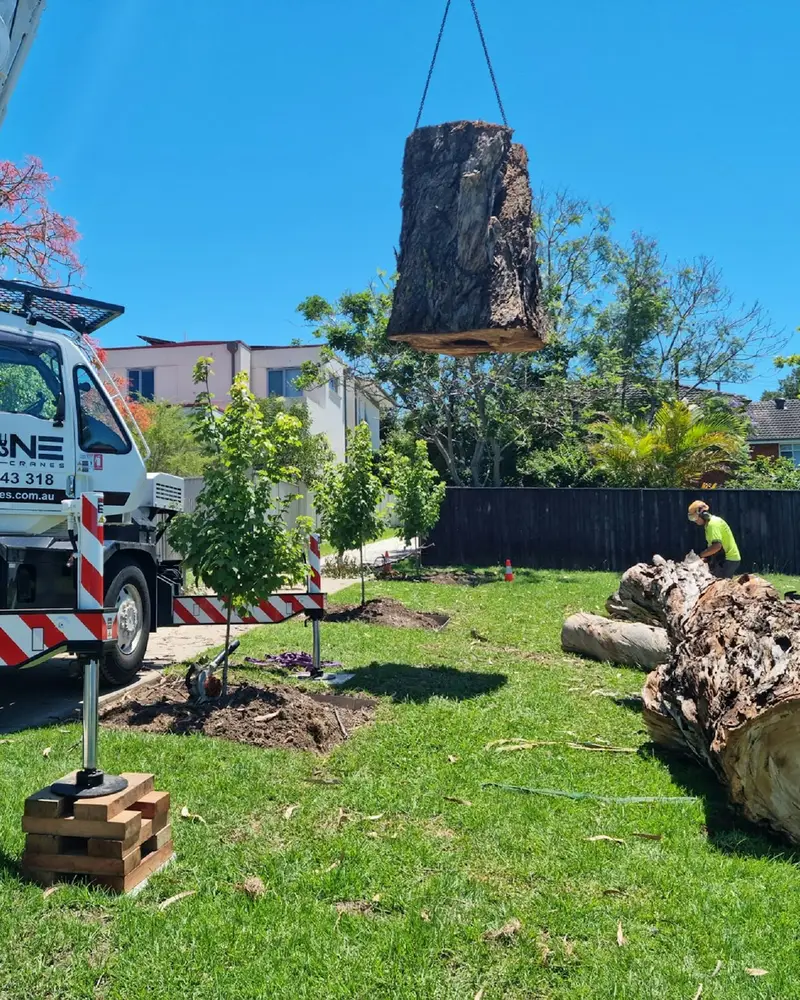
A crane is a tool for a specific problem, not a default for large trees. It becomes the sensible approach when there is nowhere safe to put material — a tree in a courtyard, spread over a pool cage, standing between two buildings — or when the stem is too compromised to climb or rig against.
- Tampa Bay, Florida
- Hillsborough · Pinellas · Pasco
- Residential & commercial
What this service covers
Plenty of very large trees are removed conventionally by dismantling and rigging, and where that can be done safely it is usually the better answer. The honest test is whether there is a workable drop zone and whether the tree can be worked from. If both are yes, added equipment mostly adds cost and setup rather than safety.
Where a lift is warranted, the planning is about the whole system rather than the tree. Five things get checked, and any one of them can rule the approach out. Where the machine can set up. Whether that ground will take the load. Whether the reach covers the tree from the only available position. What sits along the travel path. And where sections will be set down and processed.
Safety before anything else
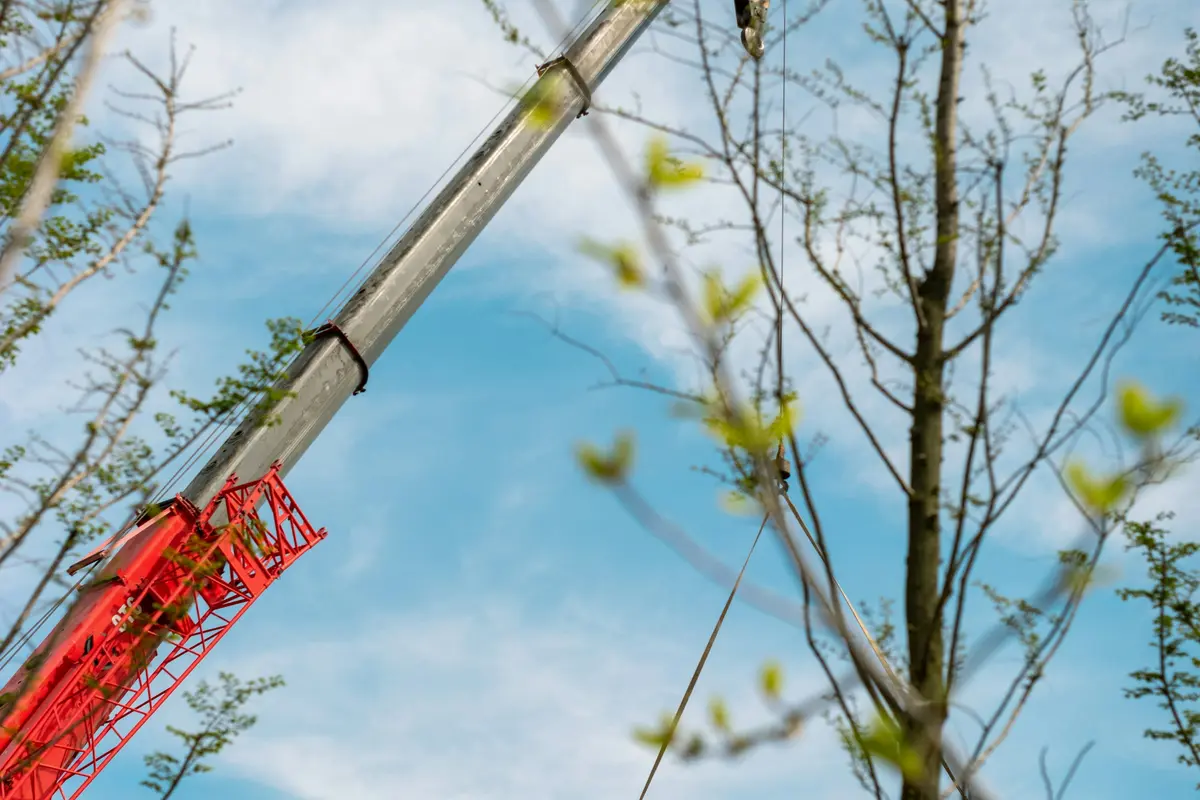
Ground bearing, overhead clearance and the swing path matter more than the tree does. A position that looks adequate can fail on soft ground or turn out to put the load over a structure. That assessment happens before anything is rigged, and it can rule the method out entirely.
Never approach, move or work near a downed or sagging power line, and do not assume a line is inactive. Keep people, pets and vehicles well clear, and report the line to your electric utility or emergency services before anyone goes near the area.
Access realities around Tampa Bay
Setup space is the constraint that most often decides this in the region. Waterfront and canal-front lots frequently have a house, a pool enclosure, a deck and a seawall occupying nearly the whole parcel, which leaves no viable position for a machine even when the tree plainly needs one. Older grid neighbourhoods present the opposite problem: a possible street position, but narrow frontages, parked vehicles and overhead lines along the approach.
Ground bearing is the second. Outrigger loads are highly concentrated, and driveways, pavers and soft or recently filled ground vary enormously in what they will take. Load spreading and ground protection are standard practice, and where a surface is questionable that needs to come up during the assessment rather than on the day.
Requirements can vary by property and jurisdiction. Property owners should confirm current requirements with the relevant local authority before work begins.
Situations that point toward a lift
These are the recurring reasons a conventional dismantle is not the right approach.
Residential situations
- A large canopy spread over a pool cage or conservatory with no free drop zone.
- A tree in a courtyard or between two structures with no room for material.
- A storm-damaged stem that cannot be trusted to hold a climber.
- A trunk large enough that sections exceed what can be rigged down by rope.
Commercial and site situations
- Trees over occupied buildings where nothing can be dropped free.
- Removals in car parks where the exclusion zone can be controlled but the drop zone cannot.
- Work needing to complete inside a single short closure window.
- Sites where a very long carry to the truck makes conventional handling impractical.
Situations where a lift usually enters the conversation
- There is no drop zone: everything under the canopy is structure, paving, cage or planting.
- The stem has decay or storm damage, so it cannot be trusted to hold a climber's rigging.
- Sections would be too heavy to lower by rope in the space available.
- The tree stands in a courtyard or side return with no route wide enough to carry material out.
- A pool enclosure, conservatory or glass roof sits directly beneath the canopy.
- The only workable position for equipment is on the far side of the building from the tree.
- Neighbouring property would be under the working radius for a conventional dismantle.
- Ground conditions will not take a wheeled machine close enough to reach.
- Several large stems need to come out of one confined space in a single visit.
- A previous attempt has already left the tree part-dismantled and awkward to finish.
Constraints that point toward a lift-assisted approach
- No usable drop zone — the tree stands in a courtyard, between buildings or over a pool.
- A canopy spread over a roof, pool cage or conservatory where nothing can be dropped free.
- Decay or storm damage that makes the stem unsafe to climb or to rig against.
- A trunk large enough that individual sections exceed what can be lowered by rope.
- Neighbouring structures close enough that a swinging section is unacceptable.
- Ground too soft or too congested for material to be handled where it lands.
- A very long carry from the tree to where a truck can stand.
- Overhead constraints that limit which direction sections can travel.
A lift, or climb and rig?
A crane is a tool, never a default. It buys you reach and controlled set-down, and it costs setup space, a load-bearing position and money — so the question is whether the site actually needs what it buys.
Climbing and rigging is the right method Reachable and sound
- The stem is sound enough to rig against with confidence.
- There is somewhere — even a small area — to lower sections into.
- Material can be carried or dragged out along an existing route.
- The canopy can be taken down in pieces light enough to handle by rope.
- No machine could be positioned close enough to help anyway.
A lift earns its place No drop zone or no trustworthy stem
- Sections have to travel up and over a structure rather than down through it.
- The stem's condition makes climbing it the wrong risk to take.
- There is a firm, load-bearing position within reach of the tree.
- Piece weight exceeds what can be lowered safely into the available space.
- Lifting out shortens the time the site is disrupted enough to justify the cost.
What has to be established before a lift is planned
- Where a crane could physically set up, and whether that ground will take the load.
- Whether the machine's reach covers the tree from the only available position.
- What sits between the setup point and the tree — lines, canopies, structures, kerbs.
- Section weights, and whether they fall within capacity at the required radius.
- Whether the street or drive can be partly closed and who authorises that.
- Where lifted sections will be set down and processed.
- Whether the tree is sound enough for a climber to attach picks, or whether another method is needed.
- Whether the same job could be completed conventionally with more time and less equipment.
How a lift-assisted removal is planned and run
- Site assessment
The tree, the setup area, the travel path and the landing zone are looked at as one system. Any of them can rule the approach out.
- Confirm the method is warranted
A crane is a tool, not a default. If the tree can be dismantled conventionally without unacceptable risk, that is usually the better answer.
- Plan setup and ground protection
Outrigger positions, load spreading and protection for driveways and turf are decided before the machine arrives.
- Establish the exclusion zone
The zone covers the swing path, not just the tree. It is closed for the duration and nobody works or stands beneath a suspended load.
- Pick sections in sequence
Each piece is rigged, cut and lifted clear in a planned order that keeps the remaining tree stable and predictable.
- Process at the landing zone
Sections are set down away from the structure and cut up there, which is faster and safer than processing in a confined space.
- Demobilise and finish
Ground protection lifted, surfaces inspected and cleared, and the stump handled as agreed.
What determines whether this approach is practical
- Available setup space and how far the machine has to reach.
- Section weight at the working radius, which is the real limiting number.
- Ground bearing capacity where the machine sets up.
- Whether a road, verge or shared drive is involved and who controls it.
- Overhead clearance along the whole lift path, not just above the tree.
- The size and accessibility of the landing zone.
- How much of the tree genuinely needs lifting versus conventional dismantling.
- The condition of the stem and whether it can be worked from at all.
- Whether neighbouring property access is needed and has been agreed.
- Time on site, since mobilisation is a significant part of this kind of job.
Information that makes planning realistic
- Photographs showing the tree, everything around its base and the route in from the street.
- Rough trunk diameter at chest height and an estimate of height against the building.
- The width of the driveway or street frontage and any height restriction on the approach.
- Whether a shared drive, verge or neighbouring property would be involved.
- The position of overhead lines anywhere near the tree or the approach.
- What is under the canopy — pool, cage, conservatory, deck, paving, planting.
- Any known soft ground, septic field or drainage feature near a possible setup point.
- Whether the stump is included and what the space becomes afterwards.
Debris and site finish
Lift-assisted removals concentrate the mess in one place. Sections are set down in a landing zone and processed there, which is usually cleaner for the property than cutting up material scattered across beds and lawn.
The landing zone does take a beating, so where it sits matters. A driveway with protection down, or a verge, is often preferable to a lawn — and it is worth agreeing before the machine arrives.
Because material is handled in larger pieces, volume leaves the site faster than in a conventional dismantle, but truck movements are heavier. Where those trucks can turn and park is part of the same planning conversation.
Questions we are asked about this service
Will my tree definitely need a crane?
Not necessarily, and it should not be assumed. Plenty of very large trees are removed conventionally by dismantling and rigging. A lift becomes the sensible choice when there is nowhere to put material, or when the stem cannot be trusted.
Is a crane removal faster?
Time on site is often shorter, because material leaves in large pieces. Total project time is not always shorter once setup, positioning and demobilisation are counted. The reason to use one is usually risk and access, not speed.
What if there is no room for a machine?
Then the approach changes. Conventional dismantling with more rigging and more time, or a smaller lift, or working from an adjacent position if access can be agreed. Occasionally there is no realistic mechanised route and the job is done piece by piece.
Can it work from the street?
Sometimes, and it depends on frontage width, overhead clearance, parked vehicles and who controls the roadway. Anything involving a public road needs to be arranged properly rather than assumed on the day.
Will my driveway be damaged?
That is a real consideration. Outrigger loads are concentrated, and driveways vary enormously in what they will take. Load spreading and ground protection are standard, and where a surface is questionable it should be discussed in the assessment.
Is this only for emergencies?
No. Plenty of planned removals use a lift because the tree sits over a pool, a courtyard or a roof. Emergency use happens too, but access and setup are harder to arrange at short notice.
How is it decided whether a lift is actually needed?
By walking the site. The tree, the setup area, the travel path and the landing zone are looked at as one system, and section weight at the required radius is the number that governs it. That cannot be settled from a photograph.
What if the only setup position is on the street?
Then it depends on frontage width, overhead clearance, parked vehicles and who controls the roadway. Anything involving a public road has to be arranged properly in advance rather than assumed on the day.
Send the site details and we will assess the approach
Photographs of the tree, its surroundings and the route in from the street, plus rough trunk diameter and what sits under the canopy. If a conventional dismantle will do the job, we will tell you that.
- Phone: 877-269-2454
- Serving Tampa Bay, Florida
Information on this page is general guidance for property owners and managers in the Tampa Bay area. It is not an arboricultural assessment, a legal opinion, a permitting determination or an insurance decision. Tree condition and site risk can only be judged in person.