
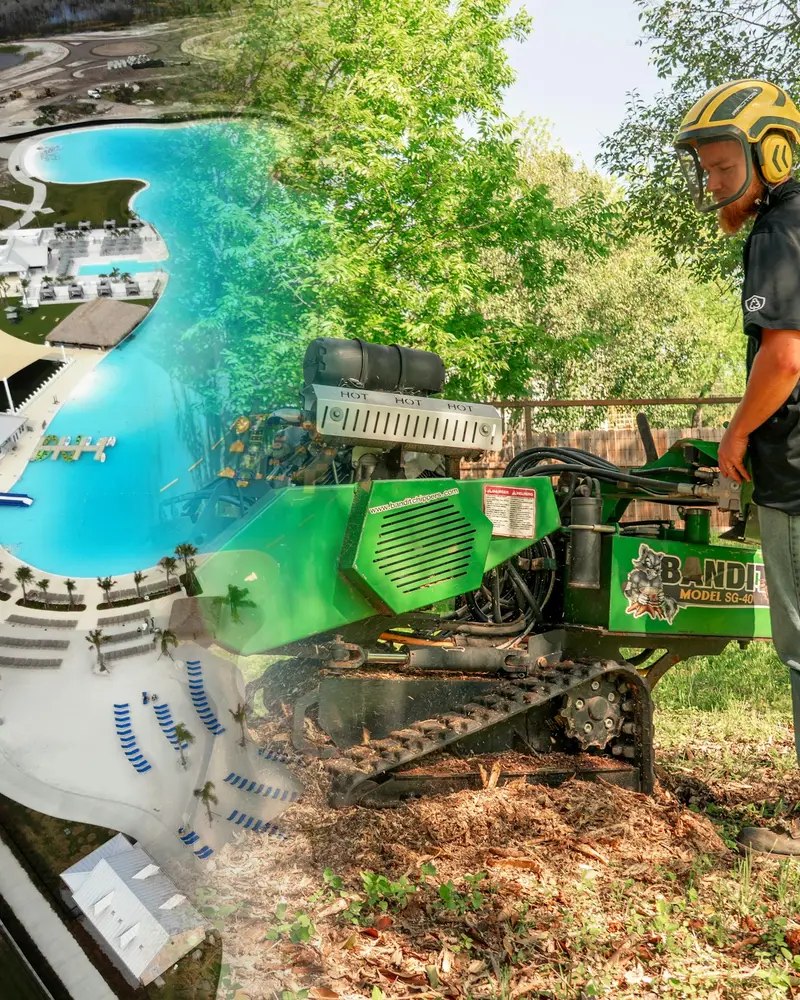
Wesley Chapel, Florida
Stump Grinding and Removal in Wesley Chapel, FL
Wesley Chapel's sandy soils grind cleanly, which makes the mechanical part of this work relatively predictable. The variables are what is buried nearby — irrigation and lighting installed at construction, generally shallow and generally close to planting positions — and what standard the finished area has to meet.
- Pasco County
- Sandy soils
- Master-planned communities
What this means on Wesley Chapel properties
In master-planned communities the finish matters more than in most places. Front-yard areas are often subject to landscape standards, so a ground stump usually needs the spoil removed and the level restored properly rather than left as a mounded backfill. It is worth agreeing that finish before the machine arrives.
Development has often taken place on land that was previously pine flatwoods or pasture, so properties commonly retain mature pines left standing through construction alongside young ornamental planting installed at build.
Wesley Chapel is unincorporated, so Pasco County provisions apply, and community-level rules may apply on top of them. Requirements can vary by property and jurisdiction. Property owners should confirm current requirements with the relevant local authority before work begins.

Grinding or full removal
These are different operations with different outcomes and different amounts of disturbance. Grinding is the usual choice; full extraction is occasionally necessary.
Stump grinding Most situations
- A machine reduces the stump and surface flare to chip, below grade.
- Leaves a chip-and-soil void that is backfilled or cleared.
Full stump removal Occasionally needed
- Leaves a substantial hole requiring fill and compaction.
- Not usually necessary for replanting, lawn or ordinary landscaping.
Reasons stumps get dealt with
In a community with landscape standards the finished level and turf restoration can matter as much as the grinding. Where an irrigation line runs close to the stump, locating it comes first.
- Surface roots radiating from it are lifting turf or paving.
- It is visible from the front of a property and looks unfinished.
- The property is being sold or handed over and should look resolved.
- Clearance along a long driveway or approach where growth has closed in from both sides.
- Growth crossing a common-area or shared boundary line, where the standard applied is the community's rather than yours.
What has to be checked before grinding
A stump grinder ejects chip, grit and small stone with real force. Windows, vehicles, pool water and anyone standing nearby need to be outside that arc or screened from it. This is one of the few operations where bystanders should be indoors rather than watching.
Never approach, move or work near a downed or sagging power line, and do not assume a line is inactive. Keep people, pets and vehicles well clear, and report the line to your electric utility or emergency services before anyone goes near the area.
How grinding is normally carried out
- Confirm what is underground
Buried utilities, irrigation lines and low-voltage cable near a stump are a real hazard to a grinder. Locating comes before cutting.
- Check access width
Grinders come in different sizes; the constraint is usually the narrowest gate or gap between a house and a fence on the route in.
- Clear the collar
Soil, rock and debris around the stump are cleared away, since grinding through embedded stone damages teeth and slows everything down.
- Grind the stump and the flare
The visible stump plus the buttress roots at the surface are reduced, since leaving the flare intact leaves an obvious ridge.
- Level and finish
The area is brought back to a grade that suits its next use, and the surrounding surface is cleared down.
What changes a stump job
- Nearby utilities, irrigation and cable that need locating and avoiding.
- Slope and whether the grinder can be positioned stably.
- How many stumps are being done in one visit.
- Whether there is height clearance for sections to be taken down the stem, since a tall stem over a house has little margin for error.
- Whether community-level requirements apply on top of county provisions, which can affect timing as much as scope.
- How many trees are actually involved. On a larger parcel the answer is frequently more than the one that prompted the call, and doing them together shares the mobilisation.
Worth sorting before the grinder arrives
- Decide whether grindings stay as backfill or are taken away.
- Mark irrigation heads, valve boxes, lighting cable and any known service runs.
- Say if the area needs to be usable immediately afterwards.
- Decide whether material can stay on the property. On a larger lot that is often a genuinely useful option, and it changes what the work involves.
- Mention any construction, trenching, paving or grade change near the tree in recent years, even if it looked harmless at the time. Root damage shows up slowly.
- Say roughly how tall the tree is against the house — two storeys, three, or well above the roofline. On a tall stem that estimate matters more than the trunk diameter.
Debris and cleanup
Grinding produces more spoil than people expect — a stump ground below grade yields a mound of chip and soil considerably larger than the stump looked. It has to go somewhere, and that is a decision worth making in advance.
- Larger parcels usually allow material to be staged near the working area, so the carry is short and the loading happens in one place.
- Where a community sets rules on where material may be placed or for how long, confirm those before a pile is built rather than after.
- Where there is room, chip and trunk rounds can often be left in an agreed position rather than hauled, which reduces what has to be carried and loaded.
Hauled away, chipped on site, or stacked in an agreed position — all three are normal, and they are different amounts of work. Whichever you want should be stated in the scope before the day rather than settled afterwards.
Stump Grinding and Removal in Wesley Chapel: common questions
Does the area need restoring to a community standard?
Often, and that changes the scope. Where a front yard is subject to landscape provisions, the practical answer is usually removing the spoil, backfilling with soil and leaving it ready for turf rather than mounding grindings.
Do pine stumps grind differently?
They are generally straightforward, though resinous wood can load a machine more than expected. The compact sandy soil around them here usually makes access and positioning the easier part.
Will the stump grow back?
The stump itself will not, but some species sucker vigorously from remaining roots after the top is removed. Where that happens, the sprouts need dealing with separately rather than being a sign the grind failed.
Can several trees across the property be looked at in one visit?
Usually, and it is generally the more efficient way to do it because the setup, the access and the equipment move are shared. Whether it works in practice depends on whether the trees sit on the same access route or need separate positioning.
Does the community need to approve this?
Possibly. Some communities operate their own requirements in addition to county provisions, and they can cover what may be removed and when work may take place. Requirements can vary by property and jurisdiction, so confirm with the association and the relevant local authority before work begins.
Related tree services in Wesley Chapel
If the tree is still standing
Felling and grinding are separate operations, and planning them together saves a second mobilisation.
Read about tree removalIf there are several across the property
Multiple stumps, or an area being cleared for a change of use, is scoped by area rather than per stump.
Read about land and lot clearingFor the spoil it produces
Grinding generates a chip-and-soil pile noticeably larger than the stump looked.
See how debris removal worksAsk About Stump Grinding in Wesley Chapel
Tell us what the finished area needs to look like, whether irrigation runs nearby and what goes in that spot. That covers Wesley Chapel stump work.
- Phone: 877-269-2454
- Serving Tampa Bay, Florida
Information on this page is general guidance for property owners and managers in the Tampa Bay area. It is not an arboricultural assessment, a legal opinion, a permitting determination or an insurance decision. Tree condition and site risk can only be judged in person.