Town ’n’ Country, Florida
Fallen Tree Removal in Town ’n’ Country, FL
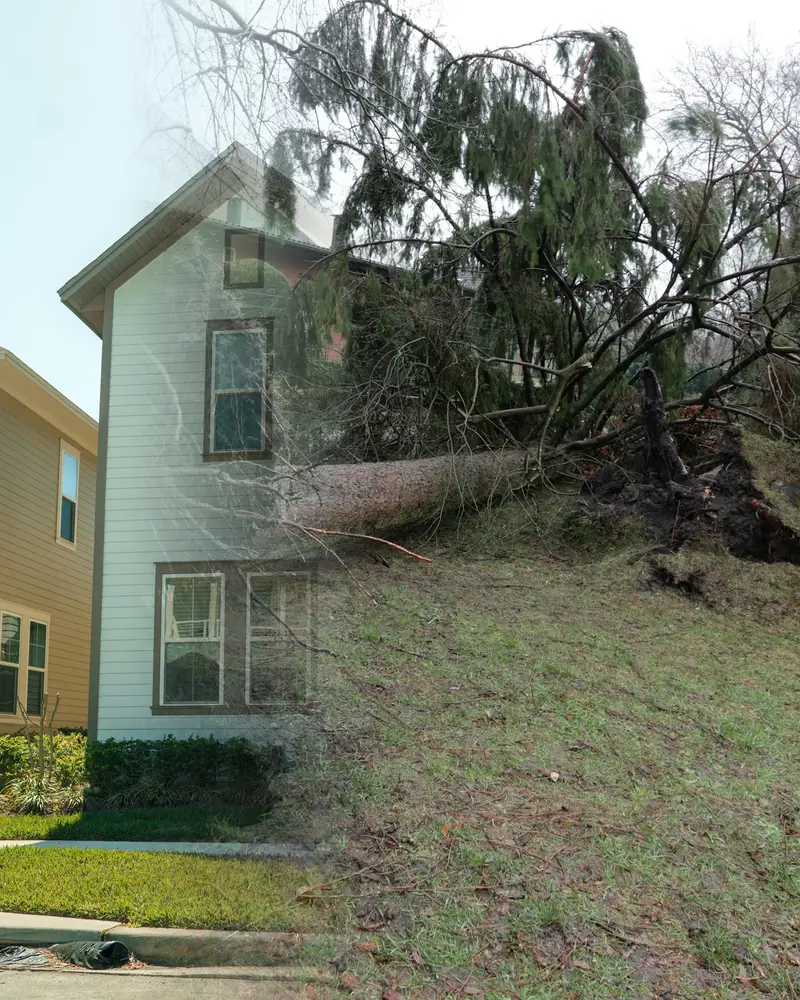
A downed tree here has almost always landed on something light. Carport roofs, screen enclosure frames and aluminium awnings crush rather than resist, which means the tree has partly collapsed the structure and is now resting in a way that is both unstable and awkward to work around.
- Hillsborough County
- Near Old Tampa Bay
- Low elevation
If the tree is threatening people, an occupied building or your only access, call straight away rather than waiting.
What this means on Town ’n’ Country properties
The instability is the point. A crushed carport or a distorted screen frame is a support that has already partly failed, and cutting weight off it in the wrong order can cause the rest to come down. On saturated ground the tree itself may also still be settling, which compounds it.
Lots are regular and generally accessible, but low rooflines and screen enclosures sit close under canopies, which restricts where material can be dropped even when the yard itself looks open.
Town ’n’ Country is unincorporated, so Hillsborough County provisions apply. Requirements can vary by property and jurisdiction. Property owners should confirm current requirements with the relevant local authority before work begins.
Before anyone goes near it
The dangerous part of a downed tree is not its weight, it is where that weight is held. Trunks bridging between two supports snap upward or downward when cut in the wrong place, and limbs pinned beneath a stem can whip sideways with real force when released. This is the situation that injures the most well-intentioned property owners.
Never approach, move or work near a downed or sagging power line, and do not assume a line is inactive. Keep people, pets and vehicles well clear, and report the line to your electric utility or emergency services before anyone goes near the area.
Things that make a downed tree more complicated than it looks
Where a stem lands across a screen enclosure with the frame folded on one side and the trunk resting on the remaining uprights, those uprights are holding load. A vehicle parked under an adjoining carport should be moved only if that can be done without passing beneath.
- The trunk is bridging between two points, so the middle is under bending load.
- The failure crossed a boundary and material lies on two properties.
- A second tree was struck on the way down and is now leaning against something.
- A tree newly exposed because whatever sheltered it has gone.
- A tree that has reached the roofline or the fence line decades after being planted for a smaller space.
A tree is down: what you can clear and what needs equipment
Plenty of a fallen tree is genuinely a homeowner job. The part that is not is the part holding load, and telling the two apart is what keeps this from turning into an injury or a bigger repair bill.
Reasonable to handle yourself Loose and light
- Small brush and leaf litter that lifts freely off the ground.
- Material well clear of the trunk, fences, vehicles and any line.
Leave for equipment and rigging Bearing weight or under tension
- Sections you would need to stand underneath in order to cut.
- Limbs pinned or bent under the weight of the tree above them.
How a downed tree is normally cleared
- Read the load path
Before any cut, the crew works out what is holding what. Which end is bearing, where the bend is, and what will move when the first section comes off.
- Take weight off structures first
Where the tree lies on a building, fence or vehicle, sections are lifted or lowered away rather than dragged, so the object is not damaged further on the way out.
- Section the main stem
The trunk is cut into lengths that can be moved with the equipment and access available, working from the free end where possible.
- Deal with the root plate
A tipped plate is either cut free and removed or laid back into the hole, depending on what the ground needs to become.
- Clear and finish
Brush chipped, wood removed or staged, and access surfaces cleared so the property works normally again.
What makes one fallen tree a bigger job than another
- Whether it landed on open ground or on something that has to be protected as it comes off.
- How much of the property has to stay usable while work is happening.
- Whether the root plate lifted and how large the resulting void is.
- Whether material can be lowered clear of the enclosure or has to be taken out in pieces small enough to be handled over it.
- Whether machinery can reach the working position without leaving ruts that outlast the tree work.
- Whether the tree stands sheltered or exposed. A tree that grew up inside surrounding canopy carries wind very differently once that shelter is gone.
Helpful before clearing starts
- Have someone available who can authorise decisions about the stump and the root plate.
- Confirm whether any part of the tree or its canopy sits on a neighbouring property.
- Keep the fall zone closed to people and pets until the crew has assessed it.
- Decide whether the objective is storm preparation or general maintenance. They lead to different work on the same tree.
- Say whether the area around the tree holds water after heavy rain. It affects the timing, the equipment and occasionally the assessment itself.
- Note whether anything nearby has been removed or thinned recently — a tree that was sheltered and is now exposed is worth flagging.
Debris and cleanup
Where the tree fell on a structure, clearing and repair are two different trades. The clearing work aims to get the load off without adding damage; assessing and fixing what is underneath is for the relevant contractor once the tree is clear.
- Long-unmanaged canopies carry more accumulated deadwood than expected, so the volume coming down on a first visit is often higher than on subsequent ones.
- On ground that holds water, staging is normally kept to firm surfaces such as a drive or path rather than lawn, which sometimes lengthens the carry.
- Where a pool or enclosure sits beneath the work, keeping debris out of the water is part of the plan rather than an afterthought, and it usually means smaller cuts and more of them.
Hauled away, chipped on site, or stacked in an agreed position — all three are normal, and they are different amounts of work. Whichever you want should be stated in the scope before the day rather than settled afterwards.
Fallen Tree Removal in Town ’n’ Country: common questions
Should I move the car out first?
If you can do it without going under the tree or the damaged structure, yes. If it means walking beneath either, leave it — a vehicle is replaceable and the load path is not predictable.
Can the screen frame be saved?
Sometimes partly, depending on how much folded. The clearing method aims to avoid adding damage, but whether the structure is repairable is for the relevant contractor once it is clear.
The tree is already down. Is it still urgent?
Often yes, but for different reasons than a standing hazard. Urgency comes from what it is blocking, what it is resting on, and whether the failure left something else unstable — a split stem, a hung-up limb, a lifted plate.
Can branches over the roof be removed without cutting the whole tree back?
Usually, yes. Clearance work targets the specific limbs creating the problem and leaves the rest of the canopy intact, which is both better for the tree and less work than a general reduction. What it cannot do is create clearance that the tree will not simply regrow into, so it is worth agreeing how much you want and how often you would accept revisiting it.
The ground around the tree stays wet. Does that make it less stable?
It can. Saturated soil holds a root plate less firmly, which is why trees with no visible defect sometimes move during sustained wet weather rather than during the strongest wind. Whether it applies to a particular tree needs someone at the base of it — soil movement is one of the few things that genuinely cannot be judged from a photograph.
Related tree services in Town ’n’ Country
If anything is still under load
A trunk resting on a structure, a blocked sole access or material overhead is not a scheduled job.
See what counts as urgentFor what is left once it is cut
Cutting and hauling are different scopes, and the second is easy to underestimate.
See how debris hauling worksFor what remains at ground level
A failed tree usually leaves a stump and a disturbed root plate behind it.
Read about stump grindingGet a Fallen Tree Cleared in Town ’n’ Country
Tell us what it landed on, what is bearing load and whether anything is parked underneath. Leave the structure and the tree exactly as they are.
- Phone: 877-269-2454
- Serving Tampa Bay, Florida
Information on this page is general guidance for property owners and managers in the Tampa Bay area. It is not an arboricultural assessment, a legal opinion, a permitting determination or an insurance decision. Tree condition and site risk can only be judged in person.