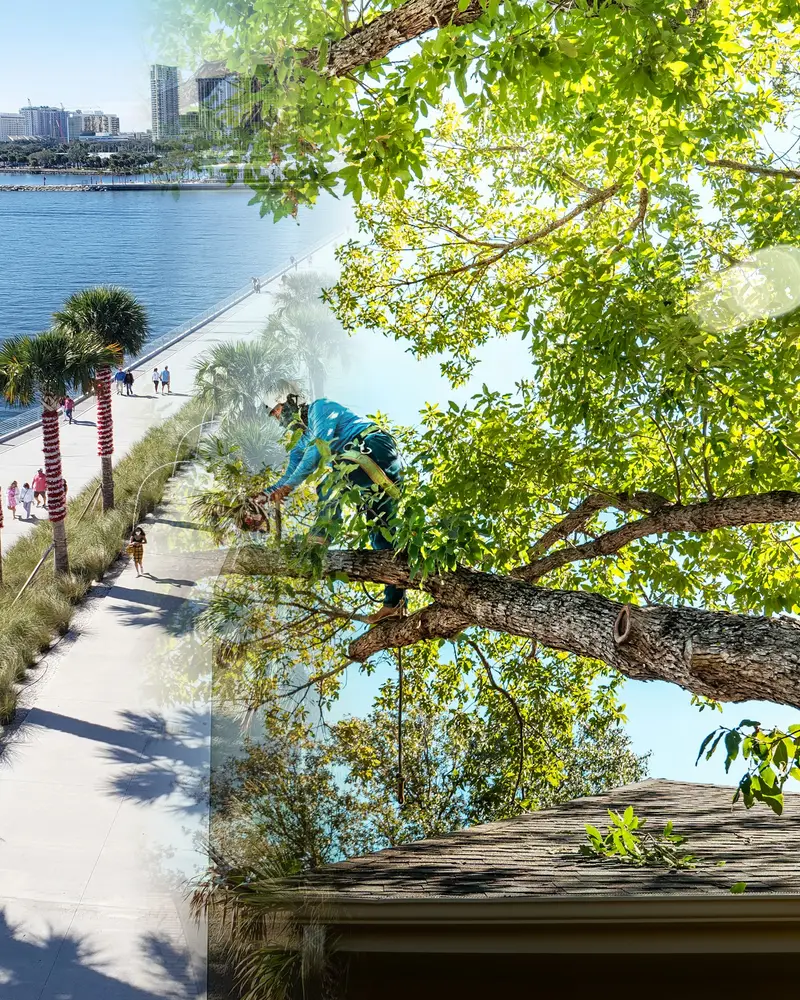
St. Petersburg, Florida
Emergency Tree Removal in St. Petersburg, FL
Urgent calls on the St. Petersburg peninsula share a pattern: the tree has moved rather than fallen, and it is now leaning toward a house that sits eight or ten feet away. With that little separation, a tree that has shifted has already used up most of the margin, and the sensible immediate step is emptying the rooms and the ground beneath it.
- Pinellas County
- Peninsula city
- Coastal exposure
If the tree is threatening people, an occupied building or your only access, call straight away rather than waiting.
Before anyone goes near it
A chainsaw cut into a trunk or limb that is holding weight changes where that weight goes. Trees resting on roofs, fences and vehicles frequently move in an unexpected direction when the first cut is made. If the tree is bearing load, leave it for equipment and rigging rather than hand tools.
Never approach, move or work near a downed or sagging power line, and do not assume a line is inactive. Keep people, pets and vehicles well clear, and report the line to your electric utility or emergency services before anyone goes near the area.
What this means on St. Petersburg properties
Wind reaches this peninsula from more than one direction depending on a system's track, and much of the city is within a couple of miles of open water either side. A tree that has stood through decades of weather can move in a single event once the canopy that used to shelter it has been thinned by an earlier storm.
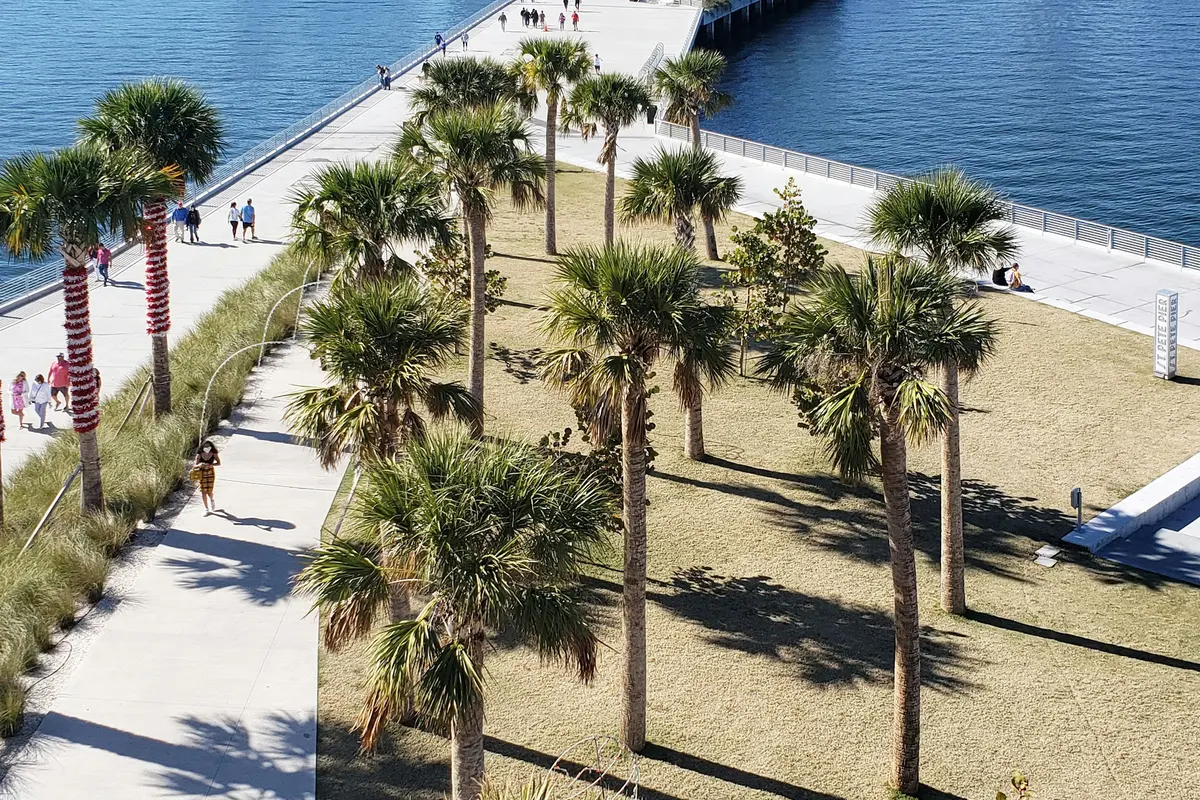
St. Petersburg occupies the lower Pinellas peninsula with Tampa Bay on one side and the Gulf approaches on the other, which means a large share of the city is within a few miles of open water in at least one direction.
St. Petersburg is an incorporated Pinellas County city administering its own code provisions for trees. Requirements can vary by property and jurisdiction. Property owners should confirm current requirements with the relevant local authority before work begins.
Situations that are usually treated as urgent
A mature tree in a side yard leaning toward a neighbouring wall, with soil visibly cracked on the opposite side of the base, has moved. Nothing has failed yet, and that is precisely why it is urgent.
- A split has opened where two stems join, and the two halves are moving independently in the wind.
- Debris is holding a gate, meter, panel or utility connection under pressure.
- A tree is leaning toward a bedroom, occupied unit or work area rather than open ground.
- A tree that has reached the roofline or the fence line decades after being planted for a smaller space.
- Growth over a street frontage or footpath where vehicles and pedestrians pass beneath.
Is this actually an emergency, or can it be scheduled?
Calling it an emergency when it is not costs you money; calling it routine when it is not can cost a great deal more. The dividing line is not how alarming the tree looks — it is what sits underneath it and whether anything is still moving.
Can reasonably be scheduled Serious, but stable
- A lean the owner has known about for years, with no fresh soil movement at the base.
- Deadwood high in a canopy that nobody walks or parks under.
Should not wait Load, access or occupancy
- A lean pointing at a bedroom or an occupied room rather than at open ground.
- The only vehicle access to the property is blocked.
How an urgent call usually proceeds
- Describe the hazard by phone
Location, what the tree is touching, whether anyone is inside the affected part of the building, and whether access is blocked. This determines how the visit is prioritised.
- Confirm the utility picture
If any line is involved, sagging or down, that becomes the utility's call first. Work does not begin around an unconfirmed line.
- On-site hazard assessment
The crew reads lean, load, tension in bent limbs, ground condition and what sits underneath before choosing a method.
- Set up the work zone
Exclusion area, drop zone, access route and rigging points are set before cutting starts, and the zone stays closed while work is active.
- Clear access, then finish the site
Blocked routes are usually opened first so the property can function again, followed by the remaining cut-up and cleanup.
Useful to have ready when you call
- Whether the driveway is blocked and whether there is a second way in.
- Whether there is a gate, code, dog or parking restriction the crew needs to know about.
- Who will be on site, and who can authorise work if the owner is not present.
- If the tree has not been worked on for some years, say so. The first visit after a long gap is usually a bigger job than the ones that follow, and it is better to know that upfront.
- Measure the narrowest gate or gap on the route to the tree and have that figure ready. It answers more questions than almost anything else you can tell us.
- Have a think about where a truck and chipper could stand near the property, and whether that space can be kept clear on the day.
What changes the shape of an emergency job
- Time of day and available light, which affect what can be done safely in one visit.
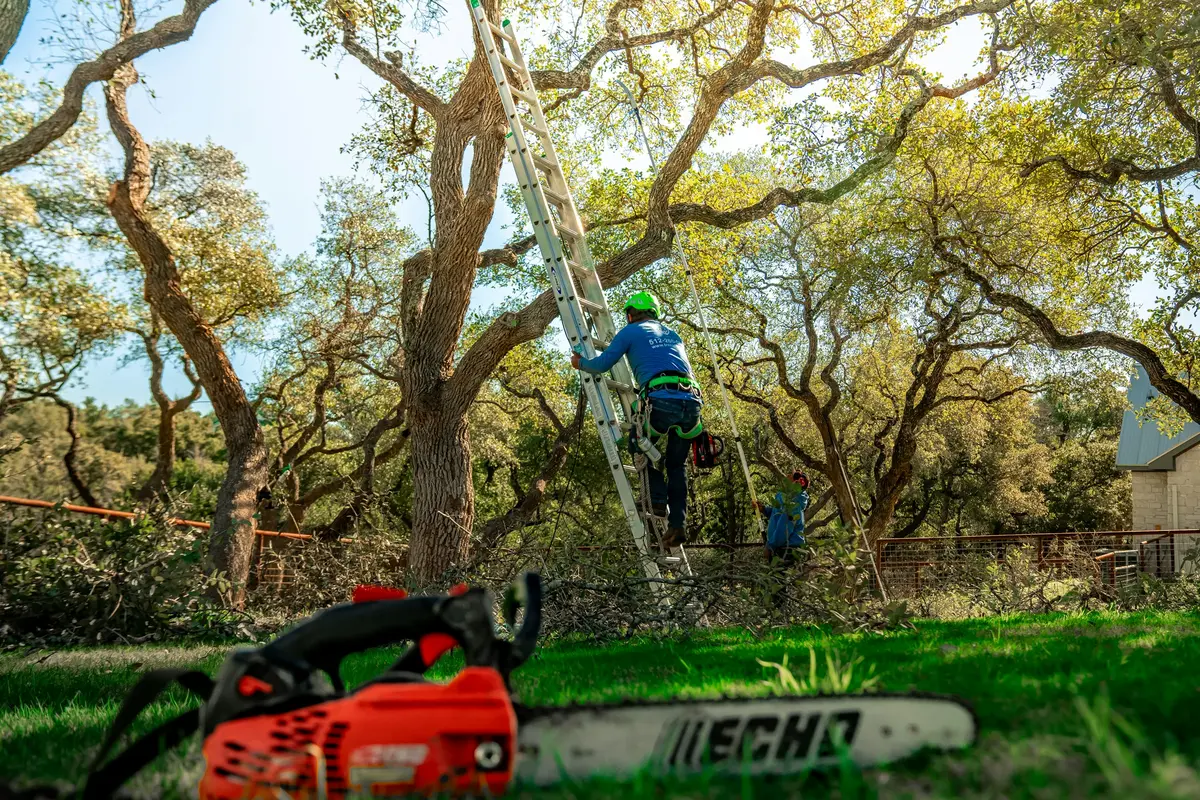
- Whether a machine can reach the tree or every piece has to be lowered by rope.
- Whether the tree is resting on something, and how much of its weight has already transferred.
- Overhead clearance along the approach as well as above the tree — a route that works at ground level does not always work with a chipper behind a truck.
- Whether the work needs any pedestrian or vehicle management on the street side, which has to be planned rather than improvised.
- Whether the ground around the root plate has been saturated recently, which affects both stability and what can be driven across the site.
Debris and cleanup
Where a full haul-away in one visit is not practical, material is normally staged in an agreed spot away from traffic and drainage, and removed as a scheduled follow-up. Agreeing that staging point up front avoids debris ending up somewhere it blocks a gate or a swale.
- Where the vehicle has to stand away from the property, everything is carried to it, so the distance between the tree and the kerb is a real part of the cleanup time.
- Trunk wood is cut to a size the access will take rather than to the largest size the machine could handle.
- Long-unmanaged canopies carry more accumulated deadwood than expected, so the volume coming down on a first visit is often higher than on subsequent ones.
Hauled away, chipped on site, or stacked in an agreed position — all three are normal, and they are different amounts of work. Whichever you want should be stated in the scope before the day rather than settled afterwards.
Emergency Tree Removal in St. Petersburg: common questions
The tree has not fallen. Should I still treat this as urgent?
If it has moved, yes. A root plate that lifted once will usually keep moving while the ground is still soft, and there is no reliable way to predict when. Keeping the lean direction clear of people and vehicles is the immediate protection.
Can you work if the alley behind my house is the only access?
Often yes. Alleys serve much of the older St. Petersburg grid and can be the better route, but they range from clear to completely blocked. Telling us the condition of yours means we arrive with equipment that fits.
Can work happen after dark?
What is possible at night is limited. Some hazards can be made safe with lighting, but complex rigging over a structure generally needs daylight. Calling early gives more options than waiting until the situation has been sitting for a day.
How much room does a crew actually need?
Less than most people expect for the cutting and more than most people expect for the material. The working area around the tree matters, but so does somewhere to put what comes down and a route to move it. Describing both when you call gets you a more useful answer than describing the tree alone.
Is rear alley access better than working from the street?
Sometimes considerably, and sometimes not at all — a rear alley can be the shortest route to the tree or too narrow and too congested to use. It is worth telling us it exists either way, so the approach can be decided before a truck is committed to a street position.
Related tree services in St. Petersburg
If the tree is already down
Material on the ground is still holding load, and the first cut is a reading problem before it is a cutting problem.
Read about fallen tree clearingIf several trees are involved
Damage across a property after a storm is triaged differently from a single failure.
Read about storm damage responseOnce the hazard is cleared
What remains on the ground afterwards is usually a larger volume than it looks.
See how debris hauling worksDiscuss a Dangerous Tree in St. Petersburg
Describe how the tree has changed and what sits in the lean direction. On a St. Petersburg lot the gap between house and boundary is usually the number that matters most.
- Phone: 877-269-2454
- Serving Tampa Bay, Florida
Information on this page is general guidance for property owners and managers in the Tampa Bay area. It is not an arboricultural assessment, a legal opinion, a permitting determination or an insurance decision. Tree condition and site risk can only be judged in person.