Riverview, Florida
Emergency Tree Removal in Riverview, FL
The urgent calls that come out of Riverview are disproportionately about movement rather than breakage. Trees here sit on ground that holds water. After sustained rain a root plate can begin to lift on a tree with no fault in the trunk at all. That is why 'it looks fine but it has tilted' is a genuine emergency description.
- Hillsborough County
- Alafia River corridor
- Rapid growth
If the tree is threatening people, an occupied building or your only access, call straight away rather than waiting.
Before anyone goes near it
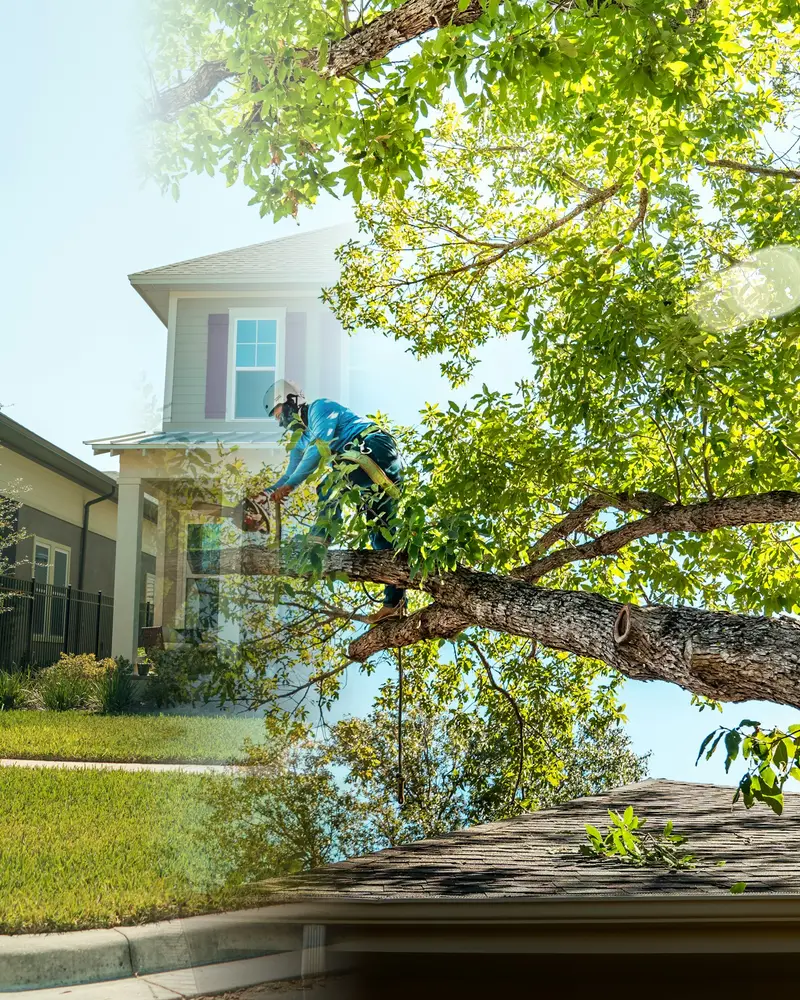
Treat a loaded tree as unstable even if it looks settled. A limb bent under tension can release without warning when it is disturbed, and a trunk resting on a structure can slide when the surface it is pressing against gives way. Stay out from under the canopy and out of the direction of lean until someone qualified has assessed it.
Never approach, move or work near a downed or sagging power line, and do not assume a line is inactive. Keep people, pets and vehicles well clear, and report the line to your electric utility or emergency services before anyone goes near the area.
What this means on Riverview properties
Low-lying ground along and back from the Alafia River drains slowly, and soil that has been saturated for days offers much less resistance to a root plate than the same soil in a dry spell. A tree that shifted during a storm frequently keeps shifting afterwards, so the situation does not stabilise simply because the weather has.
The contrast is unusually sharp here: recently built communities with young planting on small lots, next to long-held properties carrying substantial mature trees and, in places, unmanaged understorey along parcel edges.
Riverview is unincorporated, placing it under Hillsborough County provisions. Requirements can vary by property and jurisdiction. Property owners should confirm current requirements with the relevant local authority before work begins.
Situations that are usually treated as urgent
A mature tree visibly out of line with the fence behind it after a wet week, with a raised pad of soil on the far side of the base, has moved at the root plate. That can continue while the ground is still soft.
- Debris is holding a gate, meter, panel or utility connection under pressure.
- A tree has shifted since the last time you looked at it, or new cracks have opened in the soil around its base.
- Roots have lifted on one side, leaving a raised pad of soil or a visible gap at the base.
- Thinning or dieback on a tree that was retained through building work.
- Clearance along a long driveway or approach where growth has closed in from both sides.
Is this actually an emergency, or can it be scheduled?
Calling it an emergency when it is not costs you money; calling it routine when it is not can cost a great deal more. The dividing line is not how alarming the tree looks — it is what sits underneath it and whether anything is still moving.
Can reasonably be scheduled Serious, but stable
- Storm debris already on the ground, with nothing left suspended above it.
- A dead or declining tree over open lawn, with nothing beneath it that people use.
Should not wait Load, access or occupancy
- The only vehicle access to the property is blocked.
- Material suspended in a canopy over a driveway, walkway or doorway in daily use.
How an urgent call usually proceeds
- Describe the hazard by phone
Location, what the tree is touching, whether anyone is inside the affected part of the building, and whether access is blocked. This determines how the visit is prioritised.
- Confirm the utility picture
If any line is involved, sagging or down, that becomes the utility's call first. Work does not begin around an unconfirmed line.
- Set up the work zone
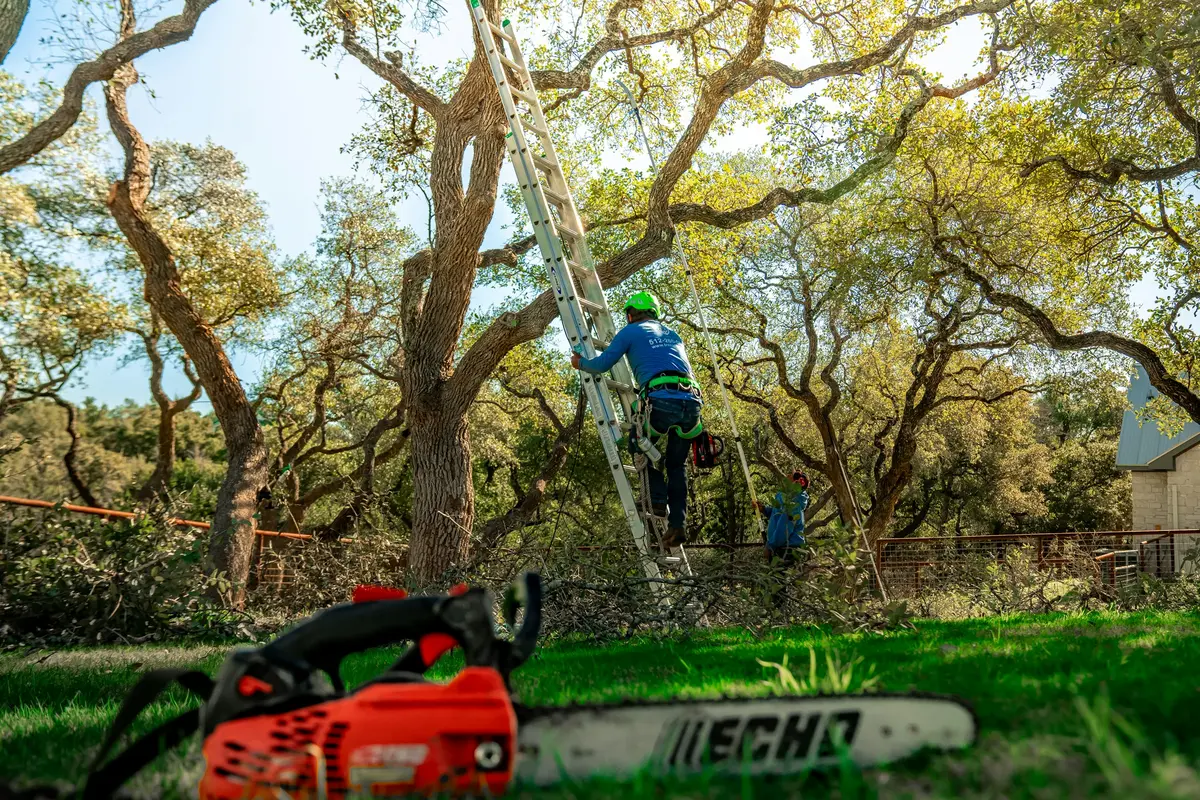
Exclusion area, drop zone, access route and rigging points are set before cutting starts, and the zone stays closed while work is active.
- Release load in a controlled sequence
Weight is taken off in stages so the remaining structure does not shift unpredictably onto what it is resting against.
- Clear access, then finish the site
Blocked routes are usually opened first so the property can function again, followed by the remaining cut-up and cleanup.
Useful to have ready when you call
- Approximate trunk diameter and height, even as a rough comparison to the building.
- Whether the driveway is blocked and whether there is a second way in.
- The property address and the closest cross street or gate a truck should use.
- Note anything fixed on the route — an air-conditioning unit, meter box, irrigation head or low wall — that cannot simply be stepped over.
- Say whether the approach is made-up surface or open ground, and whether it has stayed wet recently. It is the difference between driving to the tree and working off it.
- Say whether the area around the tree holds water after heavy rain. It affects the timing, the equipment and occasionally the assessment itself.
What changes the shape of an emergency job
- Time of day and available light, which affect what can be done safely in one visit.
- Whether the priority is restoring access, protecting a structure, or both in sequence.
- How much material has to leave the property versus what can be staged temporarily.
- Whether material can be dropped at all, or whether every piece has to be rigged and lowered into a small space — the difference between those two is substantial.
- Whether the ground around the root plate has been saturated recently, which affects both stability and what can be driven across the site.
- How many trees are actually involved. On a larger parcel the answer is frequently more than the one that prompted the call, and doing them together shares the mobilisation.
Debris and cleanup
Cleanup after an urgent removal is graded by need. Hard surfaces people walk and drive on get cleared properly; lawn areas are usually raked to a reasonable finish rather than restored, since the priority in the first visit is removing risk.
- Where there is room, chip and trunk rounds can often be left in an agreed position rather than hauled, which reduces what has to be carried and loaded.
- Where the carry is long or the route is narrow, brush is normally cut into smaller pieces than strictly necessary, because handling size matters more than trips.
- Larger parcels usually allow material to be staged near the working area, so the carry is short and the loading happens in one place.
Hauled away, chipped on site, or stacked in an agreed position — all three are normal, and they are different amounts of work. Whichever you want should be stated in the scope before the day rather than settled afterwards.
Emergency Tree Removal in Riverview: common questions
The trunk looks perfectly sound. Can it still be a problem?
Yes, and this is the situation people most often underestimate. Where the failure is at the root plate rather than in the stem, the tree can look entirely healthy right up until it moves. Cracked or lifted soil at the base is the signal worth acting on.
Can equipment get across wet ground?
That is often the limiting factor here. Saturated ground restricts what can be driven onto a property, and sometimes the practical answer is a lighter approach with more hand work rather than waiting for the ground to dry.
Will the whole tree have to come out?
Not always. Sometimes the failed section is removed and the remaining tree is reassessed once the load is off. Where the root plate has lifted or the main stem has split, full removal is usually the realistic outcome.
Can several trees across the property be looked at in one visit?
Usually, and it is generally the more efficient way to do it because the setup, the access and the equipment move are shared. Whether it works in practice depends on whether the trees sit on the same access route or need separate positioning.
How much room does a crew actually need?
Less than most people expect for the cutting and more than most people expect for the material. The working area around the tree matters, but so does somewhere to put what comes down and a route to move it. Describing both when you call gets you a more useful answer than describing the tree alone.
Related tree services in Riverview
If the tree is already down
Material on the ground is still holding load, and the first cut is a reading problem before it is a cutting problem.
Read about fallen tree clearingIf several trees are involved
Damage across a property after a storm is triaged differently from a single failure.
Read about storm damage responseOnce the hazard is cleared
What remains on the ground afterwards is usually a larger volume than it looks.
See how debris hauling worksDiscuss a Dangerous Tree in Riverview
Tell us whether the tree has moved, what the soil looks like at the base and how wet the ground is. In Riverview those details usually matter more than the tree's size.
- Phone: 877-269-2454
- Serving Tampa Bay, Florida
Information on this page is general guidance for property owners and managers in the Tampa Bay area. It is not an arboricultural assessment, a legal opinion, a permitting determination or an insurance decision. Tree condition and site risk can only be judged in person.