Riverview, Florida
Tree Debris Removal and Hauling in Riverview, FL
The Riverview debris variable is whether a truck can get near the pile. On soft low-lying ground the answer is often no, which means the material is carried to a hard surface first — and that carry, not the volume, is what determines the job.
- Hillsborough County
- Rapid growth
- Alafia River corridor
What this means on Riverview properties
Riverview is unincorporated, so Hillsborough County collection arrangements apply rather than a city programme, with temporary instructions commonly issued after major events. On newer small lots there is also very little room to stage material, so piles tend to end up at the kerb sooner and stay there longer than the owner intended.
River corridor and low-lying ground hold water after sustained rain. Saturated soil around a root plate is one of the more common contributors to trees moving in wind, and it also limits what machinery can be driven across a yard.
Riverview is unincorporated, placing it under Hillsborough County provisions. Requirements can vary by property and jurisdiction. Property owners should confirm current requirements with the relevant local authority before work begins.

Situations this covers
A pile at the rear of a lot after a wet spell often cannot be reached by truck across the lawn at all, which turns the volume question into a carry-distance question.
- Storm material staged at a kerb that now needs removing privately.
- Cleared vegetation from a lot that needs to go before the next trade starts.
- A pile that has become a harbourage concern close to a building.
- Ground at the base that has stayed soft, limiting what can be driven anywhere near the tree.
- Clearance along a long driveway or approach where growth has closed in from both sides.
What determines how a haul-out runs
- Whether a chipper can be positioned near the material or has to stay at the kerb.
- Ground conditions along the carry route after rain.
- How far the material sits from where a truck can actually stand.
- Whether anything non-woody has ended up in the pile.
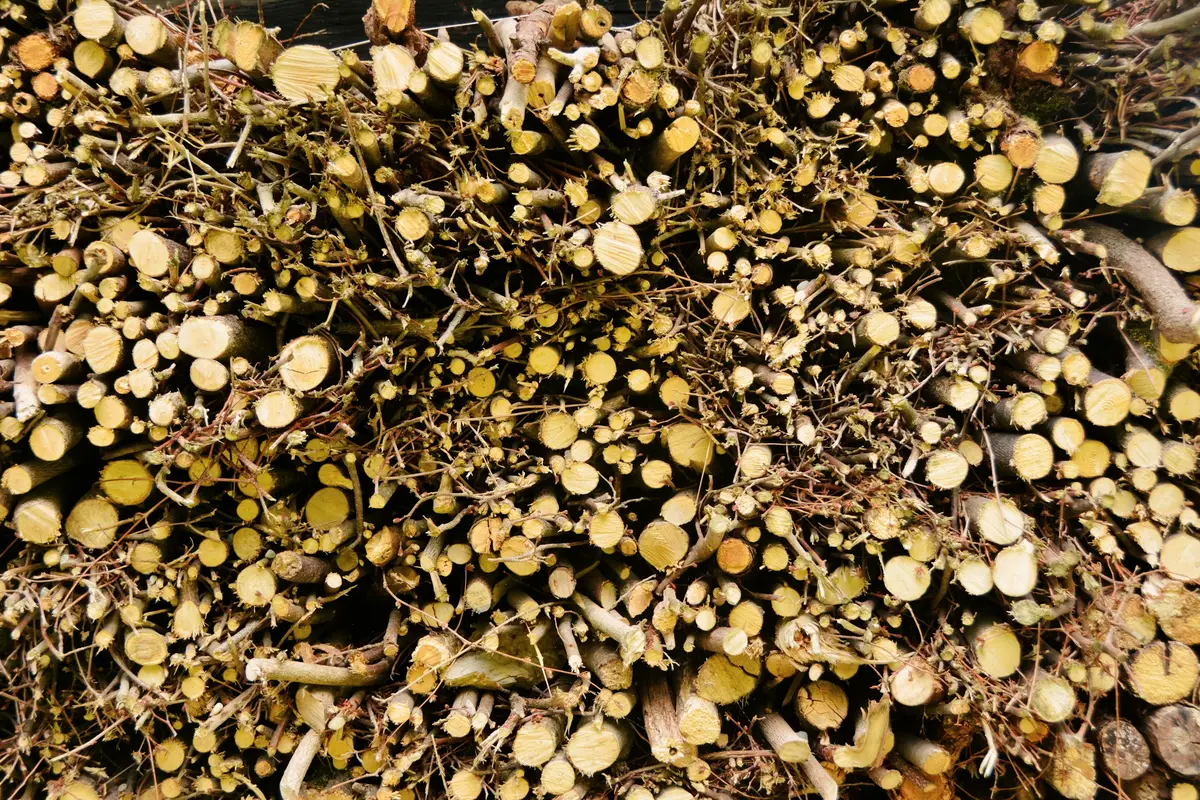
- Whether the pile is loose brush, cut rounds, or a mixed heap of both.
Is this a hauling job, or does something still need cutting?
This service moves material that is already on the ground. If anything is still standing, still suspended or still holding load, that is tree work first and hauling afterwards — and the two are priced and planned differently.
A haul-away job Already down and safe to handle
- Chip or rounds left on site from earlier work.
- Woody material separated from soil, rubble and general waste.
Needs cutting before hauling Still loaded or still standing
- A trunk still bearing on a fence, structure or vehicle.
- Anything still attached to a standing tree.
Handling a settled pile safely
If any part of a pile is in contact with a power, phone or cable line, nothing moves until the utility has confirmed it is safe. That applies to material that looks harmless — the contact point is not always visible from where you are standing.
Never approach, move or work near a downed or sagging power line, and do not assume a line is inactive. Keep people, pets and vehicles well clear, and report the line to your electric utility or emergency services before anyone goes near the area.
How a haul-out is normally handled
- Sight the pile
Volume from a photograph is unreliable — piles compress and tangle. Where possible the material is looked at, or described in terms of area and height rather than 'a few branches'.
- Plan the carry
Where the truck and chipper stand, and how material travels from pile to truck, is the main determinant of how long the job takes.
- Protect the route
Turf, paving and irrigation along the carry path are considered before repeated trips start wearing a track into them.
- Load heavy sections
Rounds and trunk wood are cut to a handleable size and loaded separately from chip.
- Clear the ground
The footprint of the pile is raked and blown down, since a long-standing pile leaves a mat of decomposed material behind it.
What sets the size of a debris job
- Actual volume, which is usually more than it looks from one angle.
- Carry distance from the pile to the truck.
- Whether the work has to fit around site operations or trading hours.
- How many trees are actually involved. On a larger parcel the answer is frequently more than the one that prompted the call, and doing them together shares the mobilisation.
- Whether material can be dropped at all, or whether every piece has to be rigged and lowered into a small space — the difference between those two is substantial.
- How far cut material has to be carried to reach the truck or chipper. Carry distance is often a bigger factor than the size of the tree.
Debris and cleanup
Volume is almost always underestimated. A pile that looks like one truckload from the driveway frequently turns out to be two or three once it is pulled apart, because branch material interlocks and hides its own depth.
- Larger parcels usually allow material to be staged near the working area, so the carry is short and the loading happens in one place.
- Where there is room, chip and trunk rounds can often be left in an agreed position rather than hauled, which reduces what has to be carried and loaded.
- Where the carry is long or the route is narrow, brush is normally cut into smaller pieces than strictly necessary, because handling size matters more than trips.
Hauled away, chipped on site, or stacked in an agreed position — all three are normal, and they are different amounts of work. Whichever you want should be stated in the scope before the day rather than settled afterwards.
Makes the visit quicker
- Confirm where a truck can park without blocking access.
- Estimate the footprint in feet and the height at the tallest point.
- Photograph the pile from two angles, ideally with something for scale.
- Decide whether material can stay on the property. On a larger lot that is often a genuinely useful option, and it changes what the work involves.
- Look at the ground at the base of the tree and mention anything unusual — cracking, lifting, or soil that has moved in an arc on one side.
- Note anything fixed on the route — an air-conditioning unit, meter box, irrigation head or low wall — that cannot simply be stepped over.
Tree Debris Removal and Hauling in Riverview: common questions
Can the truck come onto the lawn?
On dry ground sometimes; on saturated ground usually not, because the damage outweighs the time saved. Where it cannot, material is carried to a hard surface and loaded there.
Why was my kerbside pile not collected?
Usually because non-woody material is mixed in. Check the current county instructions for your address, and if a pile has been declined, a private haul-out is the practical route.
Can you take debris another contractor left?
Yes. Material left behind after other work is a common reason for this call. It helps to know what is in the pile — whether it is clean woody material or has fencing, soil and general waste mixed through it.
There is no vehicle access to the back garden. Does that stop the work?
No, but it changes how it is done and how long it takes. Material comes out along whatever route exists, usually in smaller sections and by hand. Where a fence panel or a gate post can come out temporarily, that is sometimes faster overall — worth raising rather than assuming either way.
Can several trees across the property be looked at in one visit?
Usually, and it is generally the more efficient way to do it because the setup, the access and the equipment move are shared. Whether it works in practice depends on whether the trees sit on the same access route or need separate positioning.
Related tree services in Riverview
If the pile came from a storm
Material still suspended in a canopy matters more than the pile at ground level.
Read about storm damage responseIf a stump is part of it
Grinding spoil is a separate volume from brush and trunk wood.
Read about stump grindingIf it is an area rather than a pile
Larger volumes across a parcel are scoped by area rather than by load.
Read about land and lot clearingArrange Debris Removal in Riverview
Tell us where the pile is, how wet the ground is and how far it is to a hard surface. In Riverview those set the job.
- Phone: 877-269-2454
- Serving Tampa Bay, Florida
Information on this page is general guidance for property owners and managers in the Tampa Bay area. It is not an arboricultural assessment, a legal opinion, a permitting determination or an insurance decision. Tree condition and site risk can only be judged in person.