Tampa, Florida
Dead and Hazardous Tree Removal in Tampa, FL
A large share of declining trees in Tampa have a site history behind them. Trenching for services, new paving over a root zone, fill piled against a trunk during a build next door — root damage does its work quietly and the canopy shows it several years later, by which point the cause is no longer obvious.
- Hillsborough County
- Urban and inner-suburban
- Mature street canopy
If the tree is threatening people, an occupied building or your only access, call straight away rather than waiting.
Before anyone goes near it
While a tree is waiting to be assessed, the practical protection is keeping people and property out from under it. Move parking, relocate play equipment and furniture, and avoid the area in wind. A decayed tree that has stood for years can fail in a single gust, and there is no reliable way to predict the day.
Never approach, move or work near a downed or sagging power line, and do not assume a line is inactive. Keep people, pets and vehicles well clear, and report the line to your electric utility or emergency services before anyone goes near the area.
What this means on Tampa properties
That matters here because infill redevelopment is widespread across the city's older neighbourhoods. A tree that stood untroubled for fifty years can start to decline after the lot beside it is rebuilt. Species matters too. Laurel oaks are widely planted across Tampa's established streets, and they are known for shorter useful lifespans and more decay than live oaks of similar age.
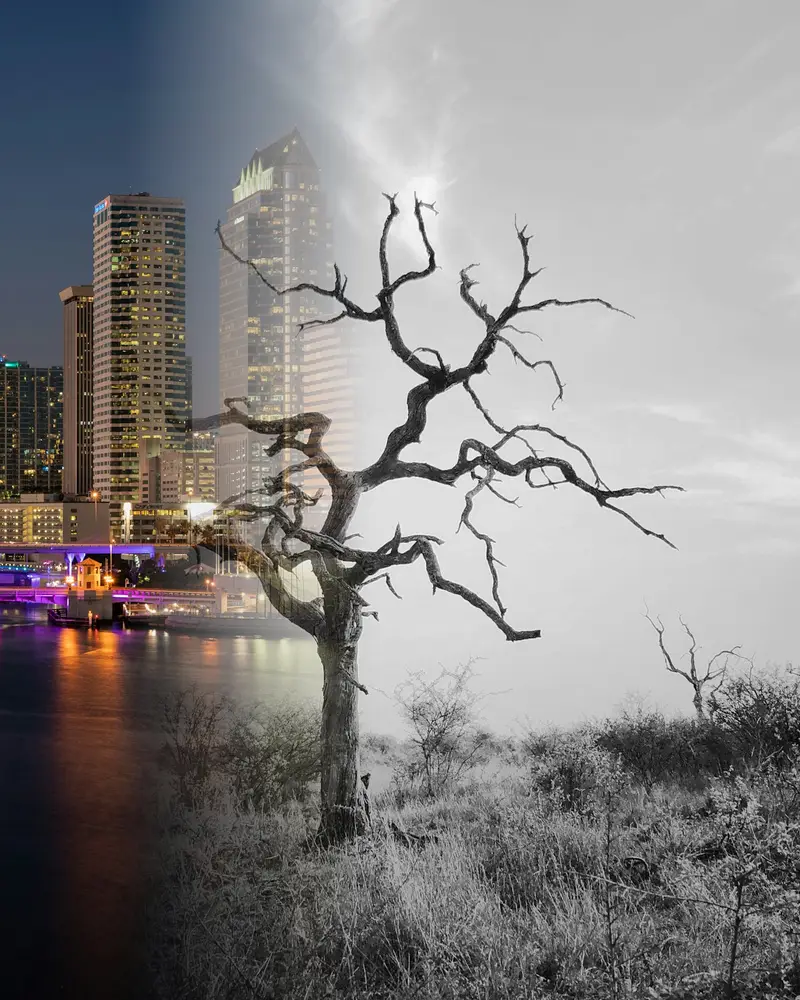
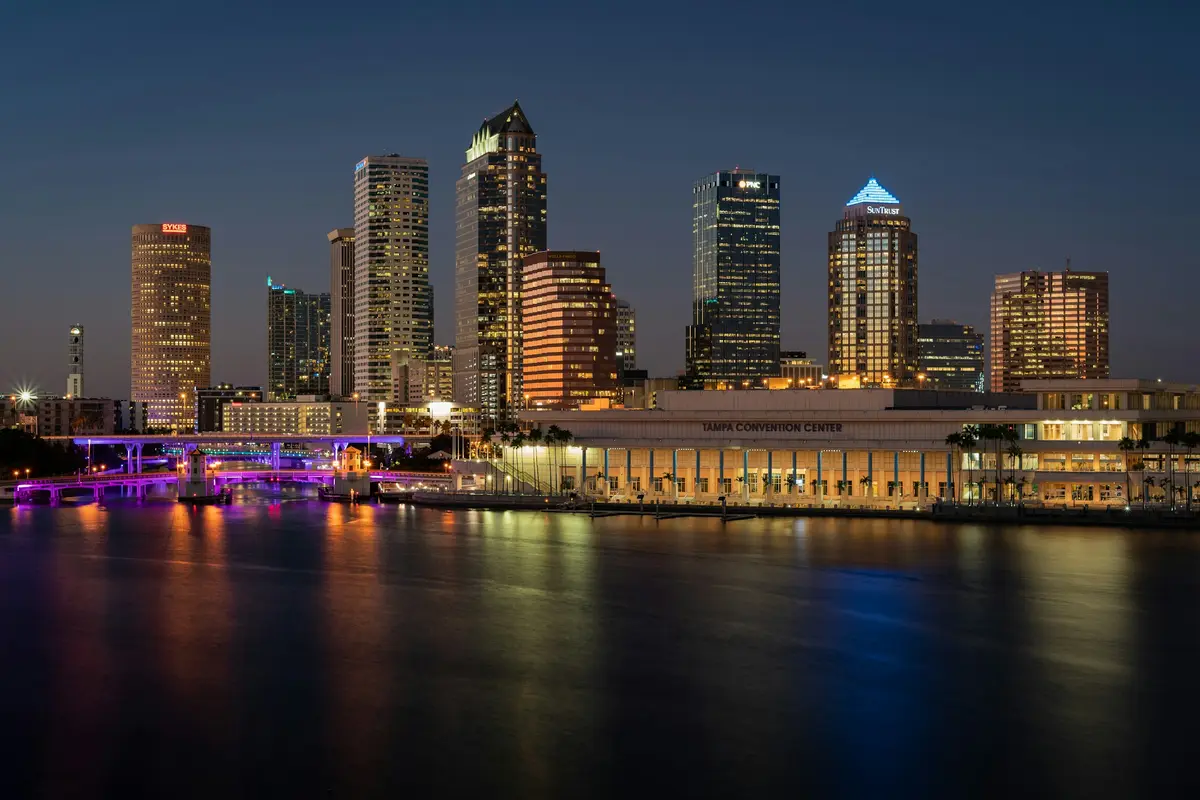
Tampa spans a dense urban core on the Hillsborough River and a wide ring of established residential neighbourhoods, so tree work here ranges from downtown-adjacent sites with almost no working room to older streets with deep front setbacks.
Tampa is an incorporated city with its own municipal code, and its tree provisions are not the same as those applying in unincorporated Hillsborough County. Requirements can vary by property and jurisdiction. Property owners should confirm current requirements with the relevant local authority before work begins.
Observable indicators worth taking seriously
Thinning upper canopy and a fungal body at the base, on a tree with a driveway or patio installed across part of its root zone in the last decade, are frequently related. The construction history is useful context for an assessment.
- Leaves noticeably smaller, sparser or off-colour compared with previous seasons.
- Mushrooms, conks or bracket fungi growing at the base, on the root flare or from the trunk.
- A vertical crack or seam running any significant distance up the trunk.
- Growth closing in over a narrow side route that is the only way in or out.
- Growth into a rear alley or shared access that other properties also depend on.
What an on-site assessment actually looks at
- Whether the defect can be managed by reducing the canopy or only by removal.
- Branch attachments, especially unions where two stems of similar size meet.
- The proportion of dead to live canopy, and where the dead wood sits.
- Whether the tree is a suitable candidate for monitoring rather than immediate action.
- The main stem, checked for cavities, cracks, included bark and old wound response.
Remove it, or keep watching it?
Not every defective tree needs to come down, and removing a tree that could have been managed is a loss. Risk is a combination of how likely a failure is and what would be underneath it — both halves have to be looked at, in person.
Monitoring can be reasonable Defect present, target absent
- The defect is real but nothing valuable or occupied sits within falling distance.
- There is a documented starting point, so any change can actually be noticed.
Removal is the honest answer Stem, base or repeated failure
- Movement at the base — a lean that has changed, or soil lifted in an arc.
- Extensive dieback from the top of the canopy downward.
From concern to resolution
- Describe what you are seeing
Which part of the tree, how long it has looked that way, and what has changed recently. Change over time is often more informative than a single symptom.
- On-site inspection
Base, stem, unions and canopy are examined in person. Photographs help a phone conversation but do not substitute for standing under the tree.
- Weigh the target
Risk is a combination of likelihood of failure and what is underneath. The same defect means different things over a shed and over a driveway.
- Plan the takedown
Compromised trees are dismantled differently, since a decayed stem cannot be assumed to hold a climber or take rigging loads.
- Complete and reassess
The stump is dealt with as agreed, and any neighbouring tree showing similar signs is noted.

Factors that shape a hazardous removal
- Proximity to structures, boundaries and services.
- Whether other trees nearby show the same decline and are worth including.
- The extent of decay at the base, which affects how predictable the fall direction is.
- Overhead clearance along the approach as well as above the tree — a route that works at ground level does not always work with a chipper behind a truck.
- Whether the site is reached from a rear alley or the street frontage, and whether that route is wide enough and clear enough to use on the day.
- Whether adjacent trees have to be protected while this one is worked, which slows rigging but is usually cheaper than repairing what gets hit.
Useful information to gather
- How long the symptoms have been visible and whether they are getting worse.
- Whether the tree has failed before, and which part failed.
- What sits within the potential fall zone and how often people are there.
- Measure the narrowest gate or gap on the route to the tree and have that figure ready. It answers more questions than almost anything else you can tell us.
- Say whether the area around the tree holds water after heavy rain. It affects the timing, the equipment and occasionally the assessment itself.
- Note which limbs actually concern you. Under a dense crown it is easy to point at the wrong tree from the ground.
Debris and cleanup
Grinding the stump of a decayed tree often reveals more deterioration below grade than was visible above it. That is normal, and it sometimes means the void is larger than expected and needs more fill.
- Where an alley is the only route, material is loaded as it comes down rather than staged, because there is usually nowhere to stage it.
- Trunk wood is cut to a size the access will take rather than to the largest size the machine could handle.
- Long-unmanaged canopies carry more accumulated deadwood than expected, so the volume coming down on a first visit is often higher than on subsequent ones.
Hauled away, chipped on site, or stacked in an agreed position — all three are normal, and they are different amounts of work. Whichever you want should be stated in the scope before the day rather than settled afterwards.
Dead and Hazardous Tree Removal in Tampa: common questions
Building work happened next door and now my tree looks poor. Is that connected?
It can be. Root severance, compaction and grade changes during nearby construction are common causes of decline that appears years afterwards. What was done, and how close to the tree, is genuinely useful information for an assessment.
The tree is over the sidewalk. Does that change the urgency?
It changes the target. A defect over a route the public uses is weighed differently from the same defect over a private back yard, because you cannot simply close the area while you think about it.
Can you tell me if my tree is dangerous from photos?
No, and we would not. Photographs help decide whether a visit is warranted, but the key indicators — the root flare, stem soundness, soil movement — need to be examined in person.
There is no vehicle access to the back garden. Does that stop the work?
No, but it changes how it is done and how long it takes. Material comes out along whatever route exists, usually in smaller sections and by hand. Where a fence panel or a gate post can come out temporarily, that is sometimes faster overall — worth raising rather than assuming either way.
Can dead limbs high in a dense canopy be seen from the ground?
Often not reliably. Under a heavy interlocking crown, dead material thirty or forty feet up is genuinely difficult to identify from below, and it tends to be held in place rather than falling clear. That is a reasonable reason to have someone look rather than to guess.
Related tree services in Tampa
If the assessment points to removal
What a removal involves on a constrained property, and why access decides the method more often than the size of the tree.
Read about tree removalIf the defect turns out to be branch-level
Deadwood and poorly attached limbs can often be addressed without losing the tree. That is a better outcome where the stem is sound.
Compare with pruningIf it has already moved
A tree that has shifted, or soil that has lifted at the base, is not something to schedule around.
See what counts as urgentHave a Declining Tree Assessed in Tampa
Tell us how long the symptoms have been visible and what has been built, dug or paved near the tree. Keep people and vehicles out from under it while it waits to be seen.
- Phone: 877-269-2454
- Serving Tampa Bay, Florida
Information on this page is general guidance for property owners and managers in the Tampa Bay area. It is not an arboricultural assessment, a legal opinion, a permitting determination or an insurance decision. Tree condition and site risk can only be judged in person.