Tampa, Florida
Emergency Tree Removal in Tampa, FL
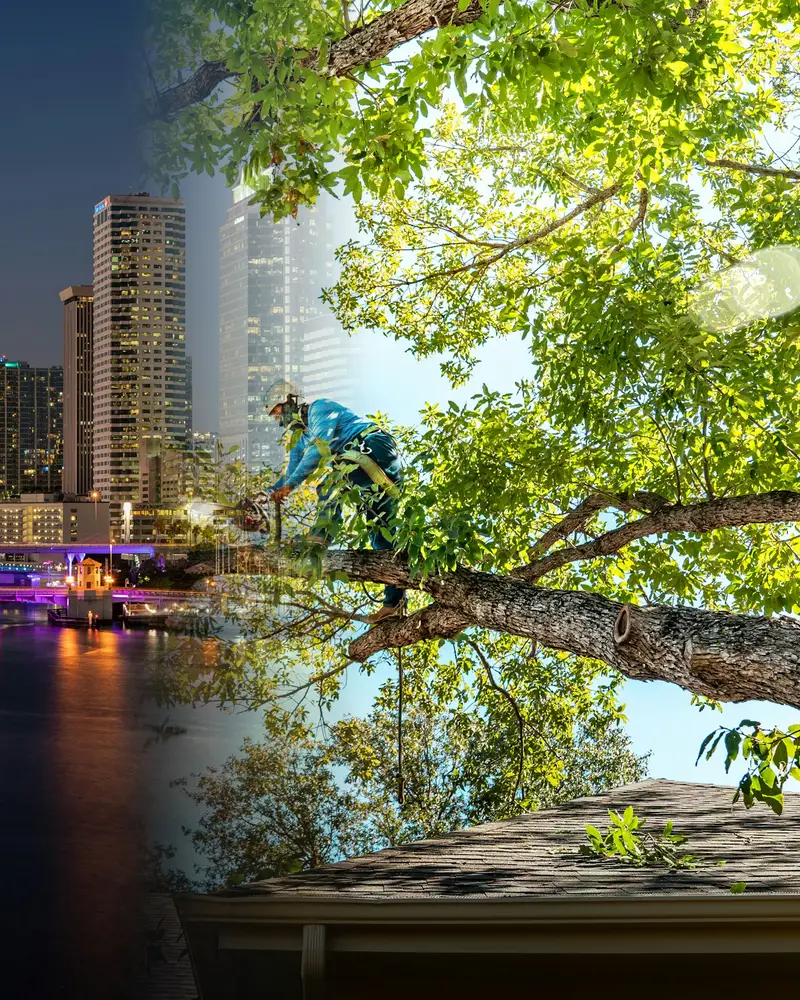
In Tampa the first question on an urgent call is usually not how big the tree is, but whether anything can get to it. A limb across a driveway on a narrow inner-city lot can strand a household entirely, because there is no second way out and the street frontage is already full of parked cars.
- Hillsborough County
- Mature street canopy
- Urban and inner-suburban
If the tree is threatening people, an occupied building or your only access, call straight away rather than waiting.
Before anyone goes near it
The most common avoidable injuries in this situation happen to people who walk under a hanging limb to look at it, or who try to pull debris away from a fence or gate. Keep children and pets indoors, park vehicles elsewhere, and rope off or block the affected route rather than relying on people to remember to avoid it.
Never approach, move or work near a downed or sagging power line, and do not assume a line is inactive. Keep people, pets and vehicles well clear, and report the line to your electric utility or emergency services before anyone goes near the area.
What this means on Tampa properties
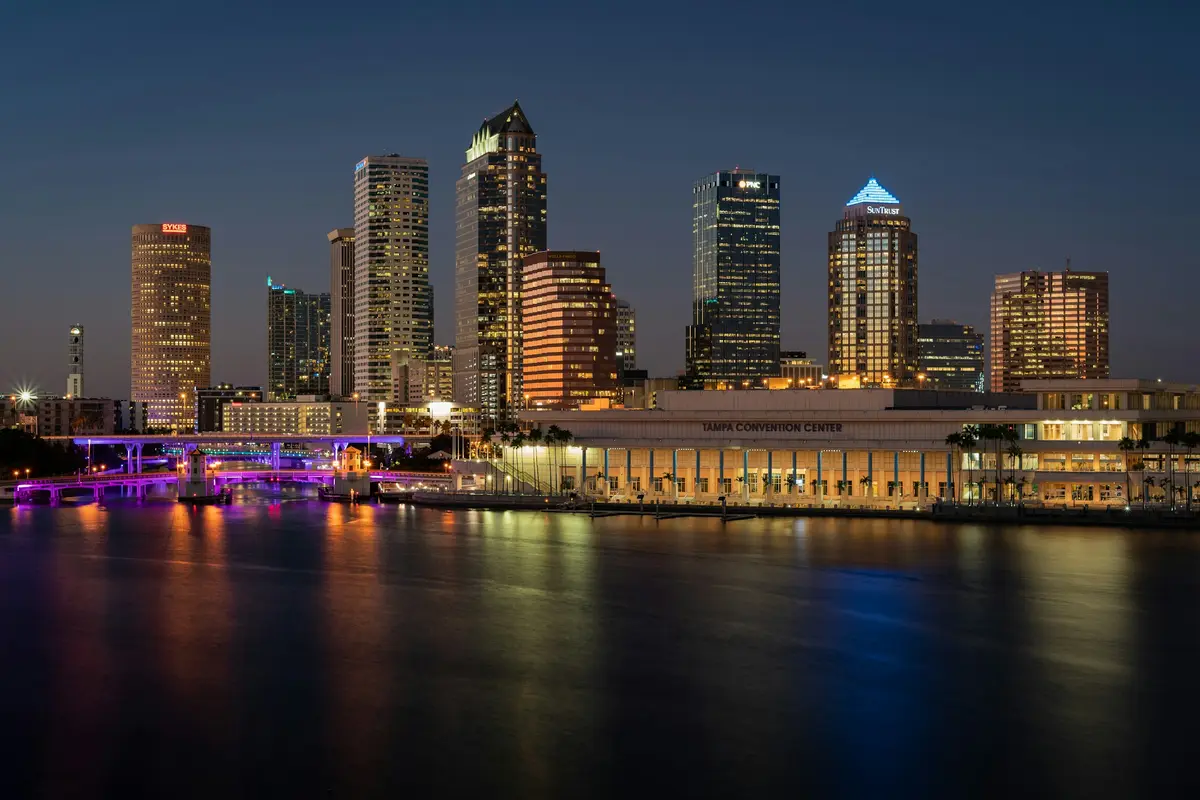
Tampa's older residential grid — Seminole Heights, Tampa Heights, the streets running off Bayshore — combines large mature canopy with lots that were platted long before anyone parked two vehicles at a house. Rear alleys serve many of these blocks and can be the only viable route for a truck, or completely unusable depending on what is stored along them. Knowing which applies at your address saves real time on an urgent call.
The city sits at the head of Tampa Bay with the Hillsborough River running through it, so low-lying areas and riverside properties can hold water after heavy rain, and saturated ground changes both tree stability and equipment access.
Tampa is an incorporated city with its own municipal code, and its tree provisions are not the same as those applying in unincorporated Hillsborough County. Requirements can vary by property and jurisdiction. Property owners should confirm current requirements with the relevant local authority before work begins.
Situations that are usually treated as urgent
On a single-access bungalow lot with one drive and a large oak over it, a limb across that drive blocks everything the household needs to do. Restoring access is normally handled before the rest of the clearing.
- Roots have lifted on one side, leaving a raised pad of soil or a visible gap at the base.
- A trunk or major limb is resting on a roof, wall, carport or fence and the load has not been released.
- Storm damage left a stub or torn branch suspended in the canopy rather than on the ground.
- Ground at the base that has been under water, or has stayed saturated after rain.
- Growth over a street frontage or footpath where vehicles and pedestrians pass beneath.
Is this actually an emergency, or can it be scheduled?
Calling it an emergency when it is not costs you money; calling it routine when it is not can cost a great deal more. The dividing line is not how alarming the tree looks — it is what sits underneath it and whether anything is still moving.
Can reasonably be scheduled Serious, but stable
- Storm debris already on the ground, with nothing left suspended above it.
- A tree touching a roofline without bearing weight on it.
Should not wait Load, access or occupancy
- Material suspended in a canopy over a driveway, walkway or doorway in daily use.
- Any tree or limb resting on an occupied structure, a vehicle or a boundary fence.
How an urgent call usually proceeds
- Describe the hazard by phone
Location, what the tree is touching, whether anyone is inside the affected part of the building, and whether access is blocked. This determines how the visit is prioritised.
- Establish a safe distance
Move people, pets and vehicles out from under the affected canopy and away from the fall path before anyone inspects further.
- On-site hazard assessment
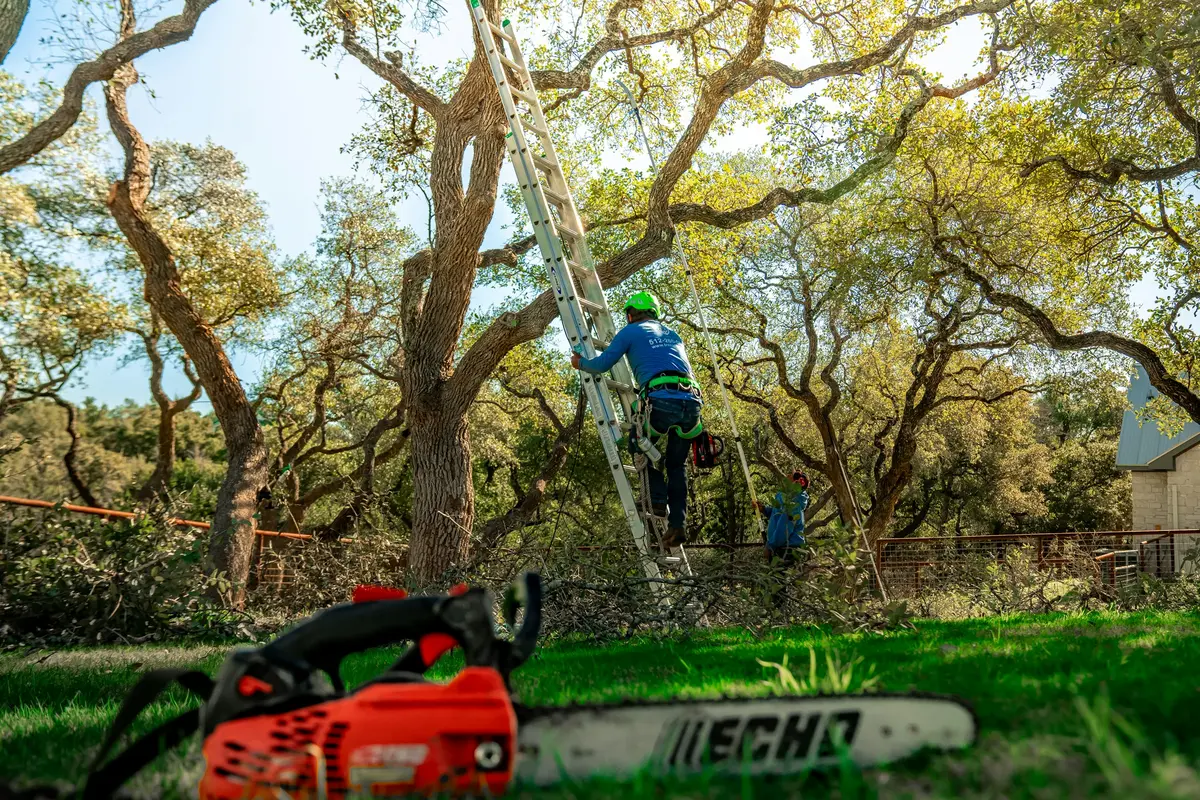
The crew reads lean, load, tension in bent limbs, ground condition and what sits underneath before choosing a method.
- Release load in a controlled sequence
Weight is taken off in stages so the remaining structure does not shift unpredictably onto what it is resting against.
- Clear access, then finish the site
Blocked routes are usually opened first so the property can function again, followed by the remaining cut-up and cleanup.
Useful to have ready when you call
- Approximate trunk diameter and height, even as a rough comparison to the building.
- The property address and the closest cross street or gate a truck should use.
- What the tree is touching right now, and whether that part of the building is occupied.
- Have a think about where a truck and chipper could stand near the property, and whether that space can be kept clear on the day.
- Note anything fixed on the route — an air-conditioning unit, meter box, irrigation head or low wall — that cannot simply be stepped over.
- If the tree has not been worked on for some years, say so. The first visit after a long gap is usually a bigger job than the ones that follow, and it is better to know that upfront.
What changes the shape of an emergency job
- How much material has to leave the property versus what can be staged temporarily.
- Ground conditions after rain, which affect what equipment can be brought in.
- How close the failure is to a wall, roof edge, pool cage, meter or fence line.
- How much deadwood is held aloft rather than having fallen out. Dense canopy retains dead limbs, so the volume coming down is often larger than it looks from below.
- Whether adjacent trees have to be protected while this one is worked, which slows rigging but is usually cheaper than repairing what gets hit.
- Overhead clearance along the approach as well as above the tree — a route that works at ground level does not always work with a chipper behind a truck.
Debris and cleanup
Urgent visits usually separate two things: opening what has to be usable again, and clearing everything else. Access routes, doorways and driveways are typically cleared first, with the remaining trunk sections and brush handled once the immediate hazard is down.
- Overlapping canopies tend to produce more brush than expected, because material caught in a neighbouring crown comes down as well as the material that was cut.
- Where the carry is long or the route is narrow, brush is normally cut into smaller pieces than strictly necessary, because handling size matters more than trips.
- Long-unmanaged canopies carry more accumulated deadwood than expected, so the volume coming down on a first visit is often higher than on subsequent ones.
Hauled away, chipped on site, or stacked in an agreed position — all three are normal, and they are different amounts of work. Whichever you want should be stated in the scope before the day rather than settled afterwards.
Emergency Tree Removal in Tampa: common questions
Can a crew get down my alley?
Sometimes, and it varies block by block. Alleys in Tampa's older neighbourhoods range from clear and usable to blocked by bins, fencing and parked vehicles. Telling us whether yours is passable, and roughly how wide, changes what equipment we bring.
The tree is between my house and the neighbour's. Does that complicate things?
It usually does. Where there is no clear drop zone on either side, material has to be lowered in small sections rather than dropped, which takes longer. It also means we may need to talk to the neighbour about working room before starting.
Can work happen after dark?
What is possible at night is limited. Some hazards can be made safe with lighting, but complex rigging over a structure generally needs daylight. Calling early gives more options than waiting until the situation has been sitting for a day.
There is nowhere obvious to park a truck. Is that a problem?
It is a planning question rather than a blocker. What matters is whether a chipper can be positioned within a workable carry of the tree, and whether that position can be held for the day. Tell us what the street is like when you call and it can be worked out beforehand rather than on arrival.
The ground around the tree stays wet. Does that make it less stable?
It can. Saturated soil holds a root plate less firmly, which is why trees with no visible defect sometimes move during sustained wet weather rather than during the strongest wind. Whether it applies to a particular tree needs someone at the base of it — soil movement is one of the few things that genuinely cannot be judged from a photograph.
Related tree services in Tampa
If the tree is already down
Material on the ground is still holding load, and the first cut is a reading problem before it is a cutting problem.
Read about fallen tree clearingIf several trees are involved
Damage across a property after a storm is triaged differently from a single failure.
Read about storm damage responseOnce the hazard is cleared
What remains on the ground afterwards is usually a larger volume than it looks.
See how debris hauling worksDiscuss a Dangerous Tree in Tampa
Tell us the cross street, whether the alley is usable and what the tree is resting on — in Tampa those three details usually determine how fast we can be productive on site.
- Phone: 877-269-2454
- Serving Tampa Bay, Florida
Information on this page is general guidance for property owners and managers in the Tampa Bay area. It is not an arboricultural assessment, a legal opinion, a permitting determination or an insurance decision. Tree condition and site risk can only be judged in person.