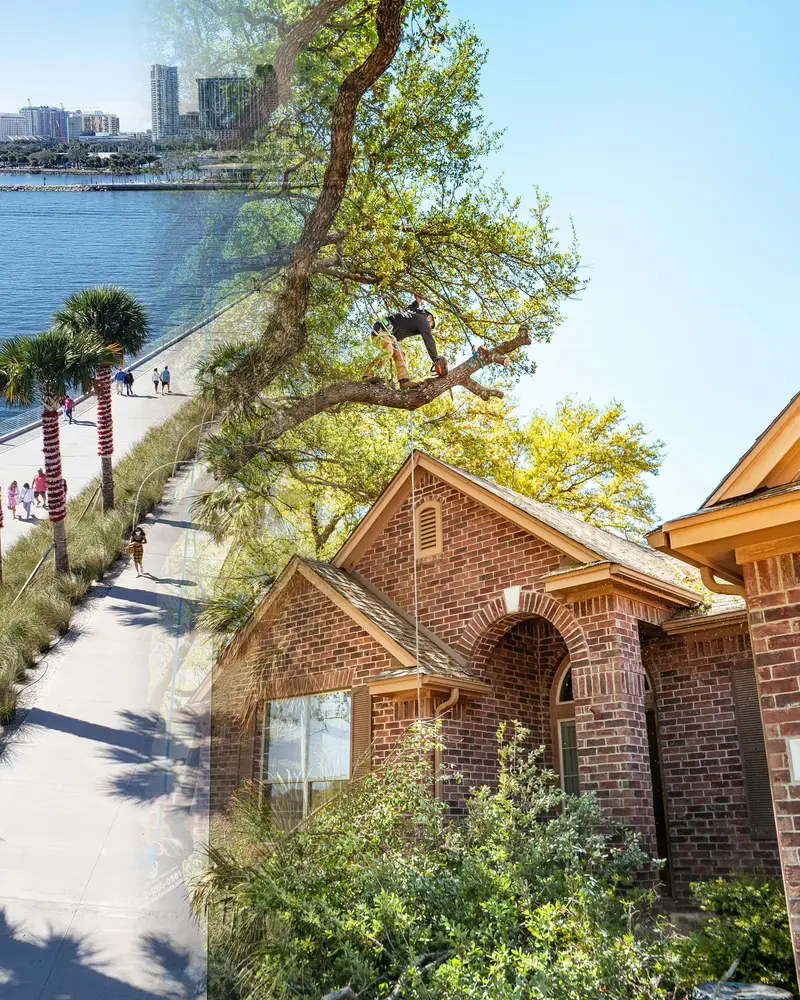
St. Petersburg, Florida
Tree Trimming and Pruning in St. Petersburg, FL
Pruning on the peninsula has to hold a line between two mistakes. Leaving dead and poorly attached limbs in a canopy gives the next system loose material to work with; stripping a canopy out in the name of wind resistance removes the tree's own structure and produces weak regrowth that is worse in wind, not better.
- Pinellas County
- Coastal exposure
- Peninsula city
What this means on St. Petersburg properties
Trees along this coast have grown into their exposure over decades, developing wood where the load is. Heavy thinning undoes that adaptation quickly and the tree's response — a flush of fast, weakly attached shoots — is exactly the material you did not want in a storm. Removing deadwood and correcting obvious defects is the useful work here; hollowing out a canopy is not.
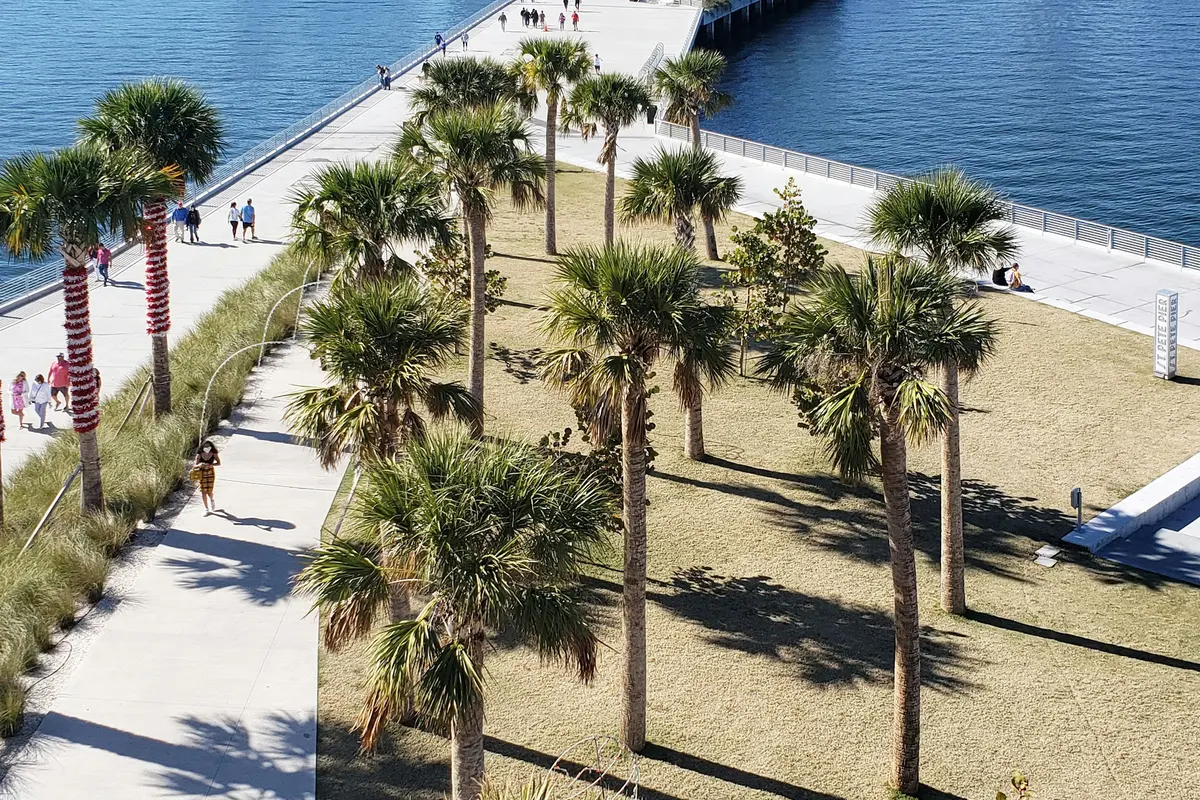
Wind exposure is a genuine planning factor across the peninsula. Trees that have grown up sheltered by neighbouring canopy can become suddenly exposed when that shelter is removed, and low-lying coastal ground drains slowly after storm rain.
St. Petersburg is an incorporated Pinellas County city administering its own code provisions for trees. Requirements can vary by property and jurisdiction. Property owners should confirm current requirements with the relevant local authority before work begins.
Common reasons to prune
Thin it out for hurricane season is a common request and usually the wrong specification. Deadwood removal, correcting an unbalanced side and clearing the roof address the real risks; reducing canopy density generally does not.
- Vines climbing into the canopy and adding weight and wind load.
- A young tree with two competing leaders that will become a weak union later.
- Dead limbs held in the canopy above a walkway, drive or seating area.
- Growth over a street frontage or footpath where vehicles and pedestrians pass beneath.
- A tree that has reached the roofline or the fence line decades after being planted for a smaller space.
Pruning versus removal
Pruning solves branch problems. It does not solve trunk problems, and it cannot make a tree fit a space that is fundamentally too small for it.
Pruning is the right tool Branch-level issues
- The tree is young enough that structure can still be guided.
- The trunk and root flare are sound.
Pruning will not fix it Whole-tree issues
- Meeting the clearance goal would mean removing most of the living canopy.
- Decay is in the main stem or root flare, not in the branches.
Working aloft, and why it is the risk
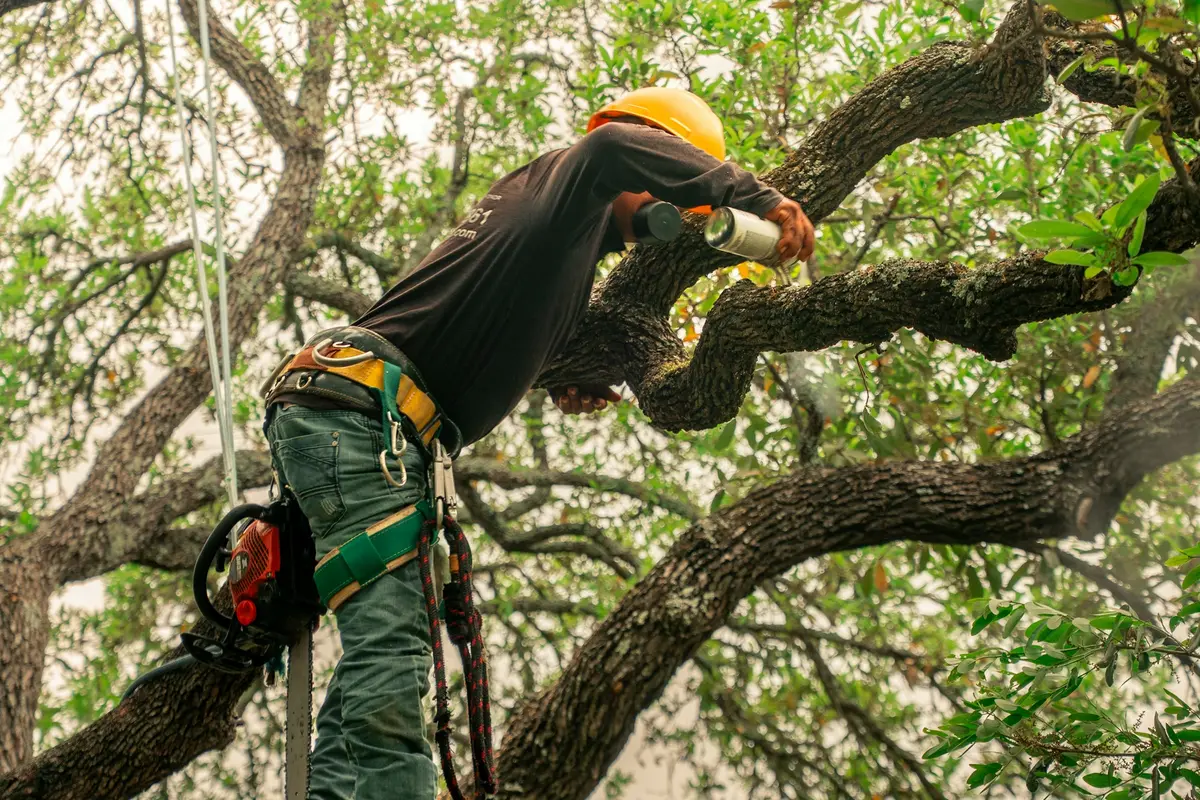
Deadwood is lighter than live wood but far more brittle, and it breaks rather than bends. A dead limb being removed can shed pieces sideways instead of dropping where you expect, so the area below stays clear for the whole operation rather than just for the final cut.
Never approach, move or work near a downed or sagging power line, and do not assume a line is inactive. Keep people, pets and vehicles well clear, and report the line to your electric utility or emergency services before anyone goes near the area.
How pruning work is normally approached
- Agree the objective
Clearance, deadwood, structure or sightlines. Pruning without a stated objective is how trees end up over-cut.
- Set the limit
How much live canopy comes off is decided before cutting starts, and kept modest. Removing too much at once weakens the tree and triggers stress regrowth.
- Work to the branch collar
Cuts are made at the right point so the wound can close properly, rather than leaving stubs or cutting flush into the stem.
- Balance the canopy
Where weight is one-sided, reduction is spread rather than concentrated, so the tree is not left with a new imbalance.
- Clear and check
Debris removed, cuts reviewed from the ground, and any follow-up interval discussed if the work is staged.
What sets the size of a pruning job
- The volume of brush generated and how far it has to be carried to the chipper.
- Whether the work is clearance over a structure or general canopy management.
- Height, and whether the work is reachable from a ladder, by climbing or from a lift.
- The width of the narrowest point on the route in. A side gate frequently decides which machine can be used, and machine size then decides how long the work takes.
- Whether machinery can reach the working position without leaving ruts that outlast the tree work.
- Whether the work needs any pedestrian or vehicle management on the street side, which has to be planned rather than improvised.
Decide these before the visit
- Whether there are cables, lights or fixtures within the canopy.
- Whether beds, pots or delicate plantings need protecting underneath.
- Whether you want the same trees revisited on a cycle or looked at once.
- If the tree has not been worked on for some years, say so. The first visit after a long gap is usually a bigger job than the ones that follow, and it is better to know that upfront.
- Decide whether the objective is storm preparation or general maintenance. They lead to different work on the same tree.
- Note anything fixed on the route — an air-conditioning unit, meter box, irrigation head or low wall — that cannot simply be stepped over.
Debris and cleanup
Chip can be taken away or left for use as mulch, which some property owners prefer. If you want it kept, decide where it goes before the day, since a chip pile in the wrong place is awkward to move later.
- Long-unmanaged canopies carry more accumulated deadwood than expected, so the volume coming down on a first visit is often higher than on subsequent ones.
- Where the carry is long or the route is narrow, brush is normally cut into smaller pieces than strictly necessary, because handling size matters more than trips.
- Trunk wood is cut to a size the access will take rather than to the largest size the machine could handle.
Hauled away, chipped on site, or stacked in an agreed position — all three are normal, and they are different amounts of work. Whichever you want should be stated in the scope before the day rather than settled afterwards.
Tree Trimming and Pruning in St. Petersburg: common questions
Does thinning a canopy make it safer in wind?
Not reliably, and heavy thinning can make things worse. Removing dead and poorly attached limbs reduces the loose material available to fall. Stripping interior growth removes structure the tree has built up in response to its own exposure.
What about trees close to a seawall or open water?
Exposure is higher and the margin for error is smaller, so the case for careful, conservative pruning is stronger rather than weaker. The objective is removing what is genuinely defective, not reducing the tree in general.
Is topping ever appropriate?
Cutting a canopy back to stubs is widely regarded as poor practice. It creates large wounds, produces weakly attached regrowth and generally leaves a tree less able to handle wind, not more. Reduction to appropriate lateral branches is the alternative.
Can a tree be pruned to make it safer in a storm?
Selective work can reduce specific risks — removing deadwood, addressing a poorly attached limb, clearing material from directly above something that matters. What it cannot do is make a tree storm-proof, and heavy topping generally makes a tree less stable rather than more. Anyone promising a storm-proof tree is overstating what pruning does.
There is nowhere obvious to park a truck. Is that a problem?
It is a planning question rather than a blocker. What matters is whether a chipper can be positioned within a workable carry of the tree, and whether that position can be held for the day. Tell us what the street is like when you call and it can be worked out beforehand rather than on arrival.
Related tree services in St. Petersburg
When pruning will not be enough
Where the concern is in the trunk or the root flare rather than the branches, pruning cannot resolve it. This is the comparison worth making before booking either.
Compare pruning with tree removalIf the tree looks unwell rather than overgrown
Fungal growth at the base, a cavity, dieback at the top of the canopy or a lean that has changed are condition questions, not clearance questions.
Read about hazardous tree assessmentIf it is mostly the brush you want gone
Where material is already on the ground from earlier work or a storm, hauling is a separate job from cutting.
See how debris removal is handledDiscuss Trimming Your Trees in St. Petersburg
Tell us what you actually want — clearance, deadwood, or a specific branch dealt with. Naming the objective keeps a St. Petersburg canopy from being cut harder than it should be.
- Phone: 877-269-2454
- Serving Tampa Bay, Florida
Information on this page is general guidance for property owners and managers in the Tampa Bay area. It is not an arboricultural assessment, a legal opinion, a permitting determination or an insurance decision. Tree condition and site risk can only be judged in person.