Largo, Florida
Stump Grinding and Removal in Largo, FL
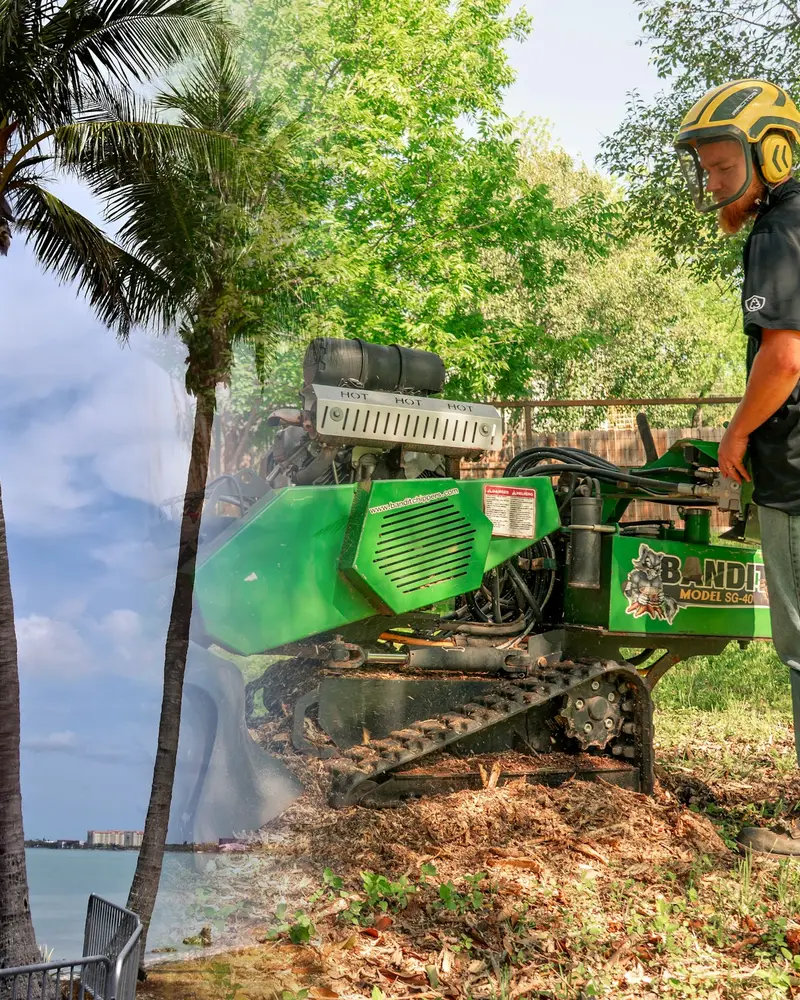
In Largo the constraint is almost always the route. Getting a grinder to a stump means passing between structures with only a few feet of clearance, and the narrowest point on that route determines the machine size — which in turn determines how long the job takes.
- Pinellas County
- Densely built
- Mid-peninsula city
What this means on Largo properties
On community properties there is a further limit: the working position. Stumps close to a unit skirt, a concrete pad or a neighbouring structure leave a machine only one approach angle, and the flare on the constrained side may not be fully reachable. Where paving or a pad is going in over the area, that is worth establishing before the work.
Compact lots, a high proportion of single-storey housing, and a large number of manufactured and mobile home communities give the area a distinctive profile: modest setbacks, closely spaced structures and limited working room around most trees.
Largo is an incorporated Pinellas County city administering its own code, and adjacent unincorporated areas are governed differently. Requirements can vary by property and jurisdiction. Property owners should confirm current requirements with the relevant local authority before work begins.
Grinding or full removal
These are different operations with different outcomes and different amounts of disturbance. Grinding is the usual choice; full extraction is occasionally necessary.
Stump grinding Most situations
- Far less disturbance to surrounding soil, turf and paving.
- Deeper roots stay in the ground and break down over time.
Full stump removal Occasionally needed
- Heavier equipment and much more disruption to the surrounding area.
- Typically driven by construction, deep excavation or utility work.
Reasons stumps get dealt with
Where a stump sits between a unit and a fence with only a few feet of clearance, the smallest machine may be the only one that reaches it, and the flare on the fence side may not be fully removable. That is worth knowing before rather than after.
- It sits in a lawn and catches the mower every time.
- Sprouts keep coming from the stump or from roots around it.
- The property is being sold or handed over and should look resolved.
- Growth closing in over a narrow side route that is the only way in or out.
- Material overhanging a screened enclosure or pool deck, which cannot take anything that lands on it.
What has to be checked before grinding
Grinding converts solid wood into a loose chip-and-soil mix that occupies noticeably more volume than the stump appeared to. If it is being left on site, agree where it goes beforehand; if it is being removed, that is loading work in its own right.
Never approach, move or work near a downed or sagging power line, and do not assume a line is inactive. Keep people, pets and vehicles well clear, and report the line to your electric utility or emergency services before anyone goes near the area.
How grinding is normally carried out
- Confirm what is underground
Buried utilities, irrigation lines and low-voltage cable near a stump are a real hazard to a grinder. Locating comes before cutting.
- Check access width
Grinders come in different sizes; the constraint is usually the narrowest gate or gap between a house and a fence on the route in.
- Clear the collar
Soil, rock and debris around the stump are cleared away, since grinding through embedded stone damages teeth and slows everything down.
- Set the target depth
Depth is chosen for the intended use — lawn, planting bed, or something that will be built on. Deeper costs more time and produces more spoil.
- Level and finish
The area is brought back to a grade that suits its next use, and the surrounding surface is cleared down.
What changes a stump job
- Required depth, which is much greater for a planting hole or a slab than for lawn.
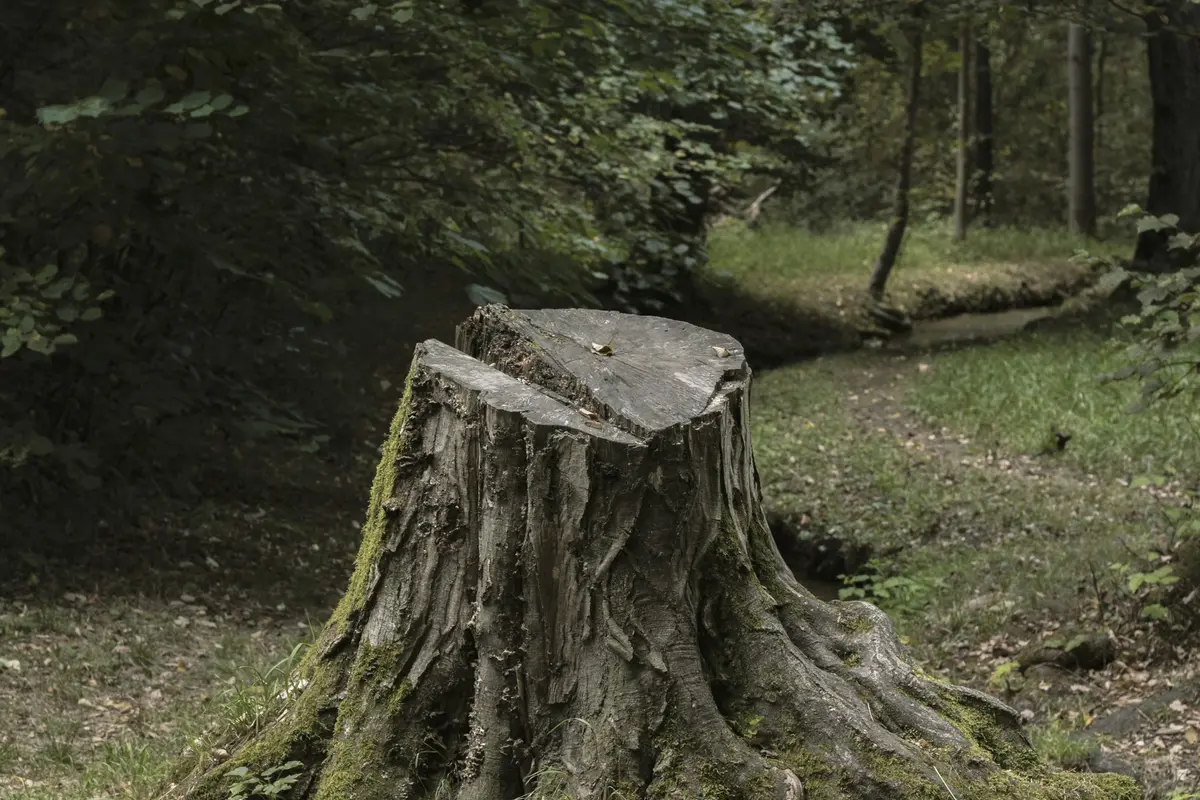
- Stump diameter measured at ground level, which is usually wider than the trunk above.
- The spread of surface roots, since these often matter more than the stump itself.
- Whether the tree has outgrown the space it was planted in. Landscape trees chosen for a new plot frequently reach the roofline and the fence line decades later, and that is a different problem from a defect.
- How close the canopy sits to the roofline, gutters and any carport. Low single-storey roofs sit well inside the fall radius of limbs that look comfortably clear from the ground.
- Whether roof or gutter clearance is part of the objective, which is a different scope from general canopy work.
Worth sorting before the grinder arrives
- Confirm whether surface roots should be taken out as well as the stump.
- Say if the area needs to be usable immediately afterwards.
- Know what the space will become — lawn, bed, paving or a structure.
- Measure the narrowest gate or gap on the route to the tree and have that figure ready. It answers more questions than almost anything else you can tell us.
- Note whether anything nearby has been removed or thinned recently — a tree that was sheltered and is now exposed is worth flagging.
- If the tree has not been worked on for some years, say so. The first visit after a long gap is usually a bigger job than the ones that follow, and it is better to know that upfront.
Debris and cleanup
Grinding produces more spoil than people expect — a stump ground below grade yields a mound of chip and soil considerably larger than the stump looked. It has to go somewhere, and that is a decision worth making in advance.
- In closely spaced communities the staging position often has to be agreed with the site as well as with you, so it is worth checking who authorises it.
- Long-unmanaged canopies carry more accumulated deadwood than expected, so the volume coming down on a first visit is often higher than on subsequent ones.
- Trunk wood is cut to a size the access will take rather than to the largest size the machine could handle.
Hauled away, chipped on site, or stacked in an agreed position — all three are normal, and they are different amounts of work. Whichever you want should be stated in the scope before the day rather than settled afterwards.
Stump Grinding and Removal in Largo: common questions
What if only a very small machine fits?
Then the job takes longer, and on a large stump considerably longer. It is still generally achievable — it is worth knowing the time implication in advance rather than assuming a quick visit.
Can a stump right against a concrete pad be ground?
Partly. The machine needs a position, so the flare on the pad side may not be fully reachable. If the pad is being extended over that spot, raise it beforehand.
Do all the roots come out?
No. Grinding removes the stump and the surface flare. Lateral and deeper roots remain and decay slowly. That is fine for lawn and most planting, but it matters if you are excavating or building.
Can a tree be pruned to make it safer in a storm?
Selective work can reduce specific risks — removing deadwood, addressing a poorly attached limb, clearing material from directly above something that matters. What it cannot do is make a tree storm-proof, and heavy topping generally makes a tree less stable rather than more. Anyone promising a storm-proof tree is overstating what pruning does.
How much room does a crew actually need?
Less than most people expect for the cutting and more than most people expect for the material. The working area around the tree matters, but so does somewhere to put what comes down and a route to move it. Describing both when you call gets you a more useful answer than describing the tree alone.
Related tree services in Largo
If the tree is still standing
Felling and grinding are separate operations, and planning them together saves a second mobilisation.
Read about tree removalIf there are several across the property
Multiple stumps, or an area being cleared for a change of use, is scoped by area rather than per stump.
Read about land and lot clearingFor the spoil it produces
Grinding generates a chip-and-soil pile noticeably larger than the stump looked.
See how debris removal worksAsk About Stump Grinding in Largo
Measure the narrowest point on the route and tell us what surrounds the stump. On Largo properties access decides the approach.
- Phone: 877-269-2454
- Serving Tampa Bay, Florida
Information on this page is general guidance for property owners and managers in the Tampa Bay area. It is not an arboricultural assessment, a legal opinion, a permitting determination or an insurance decision. Tree condition and site risk can only be judged in person.