Carrollwood, Florida
Tree Trimming and Pruning in Carrollwood, FL
Pruning is the main ongoing work in Carrollwood, and for good reason — the trees here are worth keeping. The recurring objectives are deadwood removal from high in dense canopy, clearance from rooflines and pool cages, and managing limbs that extend well over a neighbour's property.
- Hillsborough County
- Lake Carroll area
- Established canopy
What this means on Carrollwood properties
Deadwood matters more in this neighbourhood than in most. Under a dense interlocking canopy, dead limbs are held aloft rather than falling clear, and they sit above patios, pools and driveways that are in daily use. Systematic deadwood removal is genuinely the highest-value pruning available here, ahead of any shaping or reduction work.
Mature landscaping is itself an access problem. Established beds, walls, screening hedges and lakeside setbacks frequently leave no clear route for equipment to the tree that needs work.
Carrollwood is unincorporated, so Hillsborough County provisions apply; some neighbourhoods additionally operate their own association rules. Requirements can vary by property and jurisdiction. Property owners should confirm current requirements with the relevant local authority before work begins.
Common reasons to prune
Where several mature canopies overlap a lot, deadwood clearance and roof or cage clearance are normally planned as one visit. Canopies that interlock cannot sensibly be treated separately, and reaching one means moving through the others anyway.
- Sprouts and suckers from the base or along the main stem taking energy from the canopy.
- Branches touching or rubbing a roof, gutter, wall or window.
- Crossing and rubbing branches that are wounding each other where they meet.
- Growth crossing a common-area or shared boundary line, where the standard applied is the community's rather than yours.
- Dead material held aloft in an interlocking canopy rather than falling clear, above areas that are in daily use.
Pruning versus removal
Pruning solves branch problems. It does not solve trunk problems, and it cannot make a tree fit a space that is fundamentally too small for it.
Pruning is the right tool Branch-level issues
- The objective is sightlines, light or keeping growth off a building.
- The trunk and root flare are sound.
Pruning will not fix it Whole-tree issues
- Roots are in direct conflict with a slab, wall or drain.
- Decay is in the main stem or root flare, not in the branches.
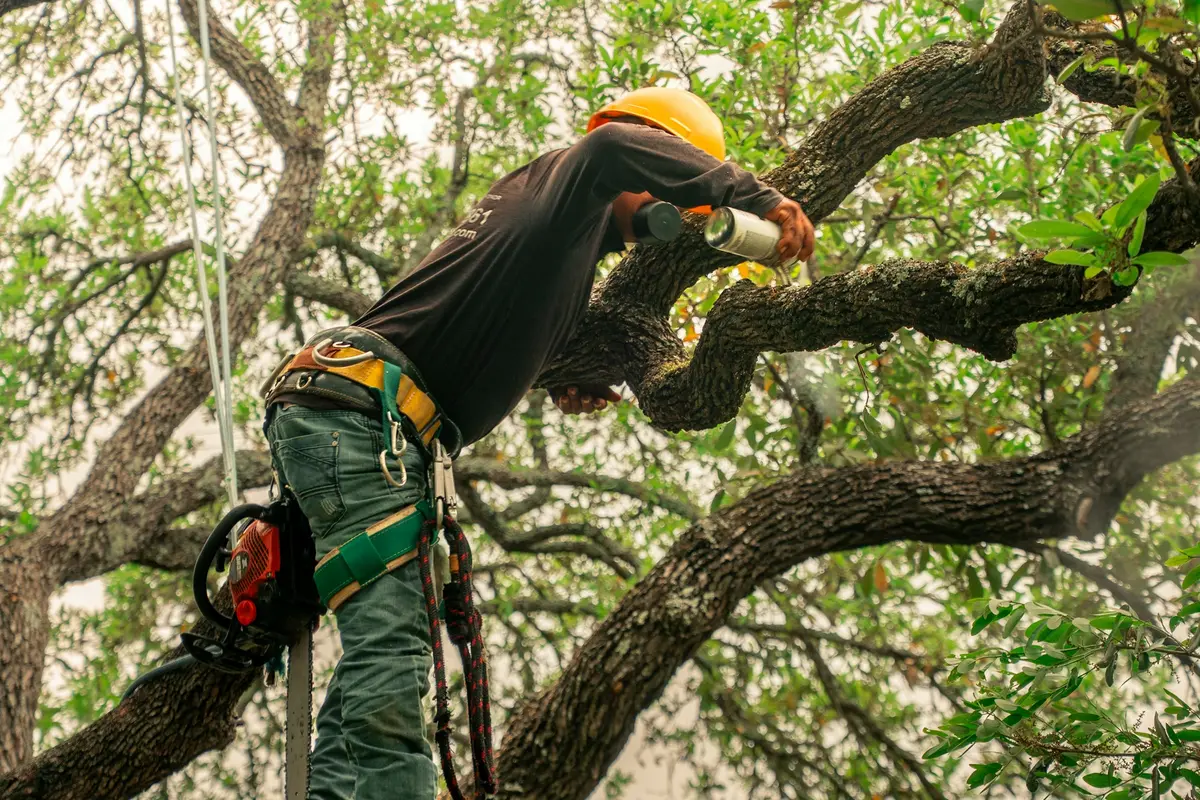
Working aloft, and why it is the risk
Stripping a canopy back hard produces a flush of weakly attached regrowth, which is exactly what fails in the next strong wind. It also removes the leaf area the tree needs. Restraint here is a safety decision as much as an arboricultural one.
Never approach, move or work near a downed or sagging power line, and do not assume a line is inactive. Keep people, pets and vehicles well clear, and report the line to your electric utility or emergency services before anyone goes near the area.
How pruning work is normally approached
- Agree the objective
Clearance, deadwood, structure or sightlines. Pruning without a stated objective is how trees end up over-cut.
- Assess from the ground and in the canopy
Attachment points, decay, previous cuts and the tree's response to earlier work all change what is sensible now.
- Set the limit
How much live canopy comes off is decided before cutting starts, and kept modest. Removing too much at once weakens the tree and triggers stress regrowth.
- Deadwood and hazards first
Dead, broken and hanging material is taken out before any live reduction, since that is the part with an actual safety function.
- Clear and check
Debris removed, cuts reviewed from the ground, and any follow-up interval discussed if the work is staged.
What sets the size of a pruning job
- Species growth habit, which affects both cut placement and how fast it will regrow.
- What is underneath — an open lawn allows dropping, a courtyard needs everything lowered.
- Multiple trees in one visit, which usually works out more efficiently than single calls.
- Whether the tree has outgrown the space it was planted in. Landscape trees chosen for a new plot frequently reach the roofline and the fence line decades later, and that is a different problem from a defect.
- Whether neighbouring canopies overlap the tree being worked on — where they interlock, material cannot always fall clear and has to be lowered instead of dropped.
- How much of the work is correcting years of growth rather than routine maintenance — the first visit to a long-unmanaged tree is normally the largest.
Decide these before the visit
- Any recent change near the tree — trenching, grade change, new paving — that may be relevant.
- Whether beds, pots or delicate plantings need protecting underneath.
- Which specific branches concern you, so nothing gets missed and nothing extra gets cut.
- Note which limbs actually concern you. Under a dense crown it is easy to point at the wrong tree from the ground.
- Identify which plants in the surrounding area you would not want damaged, and which you would accept being crossed. That single answer changes the route and often the method.
- Establish who owns the tree before booking anything. Where it sits on common ground or a shared boundary, the association usually has to authorise the work rather than the resident.
Debris and cleanup
Pruning produces mostly light brush, which chips efficiently. The practical consideration is usually where the chipper can stand and how far material has to be dragged to reach it.
- Where a crown extends over a boundary, agree in advance which side brush will be brought down to — dragging it back under the tree is often the slower option.
- Where the work is close to water, catching material before it enters is part of the method, and it normally means smaller sections and more rigging than the same tree inland.
- Where the route out runs through planted areas, material is usually carried in smaller pieces rather than dragged, which takes longer but avoids scraping through beds.
Hauled away, chipped on site, or stacked in an agreed position — all three are normal, and they are different amounts of work. Whichever you want should be stated in the scope before the day rather than settled afterwards.
Tree Trimming and Pruning in Carrollwood: common questions
My limbs extend over the neighbour's garden. Can they be pruned?
There are rules about this and they vary, including on what is reasonable and from which side. In a neighbourhood with this much overlap it is worth agreeing with the neighbour before scheduling rather than discovering a disagreement mid-job.
Is deadwood removal worth doing regularly?
In Carrollwood, yes. Dense canopy holds dead limbs rather than letting them fall clear, and they accumulate above areas people use. It is straightforward, high-value work compared with reshaping a mature oak.
When is the best time to prune?
Dead, broken and hazardous material can be removed at any time. Timing for structural work depends on the species and on what you are trying to achieve, and in a subtropical climate the growing season is long, so the window is wider than in colder regions.
Will the surrounding planting be damaged?
That is planned for rather than hoped for — sections are lowered into agreed positions and protection goes down where it is needed. In a genuinely tight space some contact is occasionally unavoidable, which is why it helps to say beforehand what matters most to you.
Does the community need to approve this?
Possibly. Some communities operate their own requirements in addition to county provisions, and they can cover what may be removed and when work may take place. Requirements can vary by property and jurisdiction, so confirm with the association and the relevant local authority before work begins.
Related tree services in Carrollwood
When pruning will not be enough
Where the concern is in the trunk or the root flare rather than the branches, pruning cannot resolve it. This is the comparison worth making before booking either.
Compare pruning with tree removalIf the tree looks unwell rather than overgrown
Fungal growth at the base, a cavity, dieback at the top of the canopy or a lean that has changed are condition questions, not clearance questions.
Read about hazardous tree assessmentIf it is mostly the brush you want gone
Where material is already on the ground from earlier work or a storm, hauling is a separate job from cutting.
See how debris removal is handledDiscuss Trimming Your Trees in Carrollwood
Tell us which canopies are involved and what sits underneath. In Carrollwood deadwood over used areas is usually the work worth doing first.
- Phone: 877-269-2454
- Serving Tampa Bay, Florida
Information on this page is general guidance for property owners and managers in the Tampa Bay area. It is not an arboricultural assessment, a legal opinion, a permitting determination or an insurance decision. Tree condition and site risk can only be judged in person.