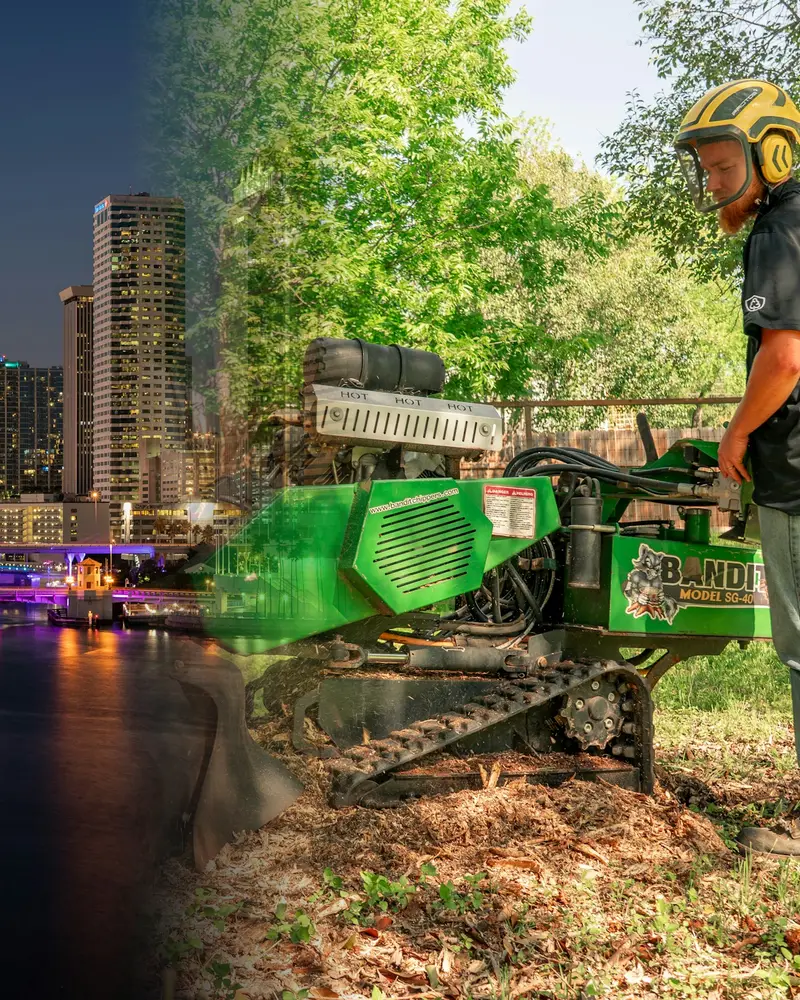
Tampa, Florida
Stump Grinding and Removal in Tampa, FL
In Tampa the stump itself is rarely the difficulty. Getting a grinder to it is. On older lots the route runs through a side gate between the house and a fence, and the width at the narrowest point — including the gate posts, not the opening — decides which machine can be used and therefore how the job goes.
- Hillsborough County
- Urban and inner-suburban
- Mature street canopy
What this means on Tampa properties
Two things turn up repeatedly on Tampa properties. Buried irrigation and low-voltage lighting run close to established plantings, and older lots frequently have rubble, old concrete or fill around a stump from previous work on the site. Both are worth flagging: a grinder finds them very efficiently, and neither is a good discovery mid-job.
Access is the recurring constraint: narrow rear alleys, on-street parking, closely spaced structures and overhead lines along older corridors frequently determine method before tree size does.
Tampa is an incorporated city with its own municipal code, and its tree provisions are not the same as those applying in unincorporated Hillsborough County. Requirements can vary by property and jurisdiction. Property owners should confirm current requirements with the relevant local authority before work begins.

Grinding or full removal
These are different operations with different outcomes and different amounts of disturbance. Grinding is the usual choice; full extraction is occasionally necessary.
Stump grinding Most situations
- Deeper roots stay in the ground and break down over time.
- Leaves a chip-and-soil void that is backfilled or cleared.
Full stump removal Occasionally needed
- Typically driven by construction, deep excavation or utility work.
- The stump and major root mass are excavated out of the ground.
Reasons stumps get dealt with
Where a stump is reachable only through a gate around three feet wide, the machine size is decided for you. An irrigation line running past it and a paved patio a few feet away both have to come through the work unmarked.
- It has begun to decay and is attracting insects near a structure.
- It sits in a lawn and catches the mower every time.
- The property is being sold or handed over and should look resolved.
- A tree that has reached the roofline or the fence line decades after being planted for a smaller space.
- Growth closing in over a narrow side route that is the only way in or out.
What has to be checked before grinding
Grinding converts solid wood into a loose chip-and-soil mix that occupies noticeably more volume than the stump appeared to. If it is being left on site, agree where it goes beforehand; if it is being removed, that is loading work in its own right.
Never approach, move or work near a downed or sagging power line, and do not assume a line is inactive. Keep people, pets and vehicles well clear, and report the line to your electric utility or emergency services before anyone goes near the area.
How grinding is normally carried out
- Confirm what is underground
Buried utilities, irrigation lines and low-voltage cable near a stump are a real hazard to a grinder. Locating comes before cutting.
- Check access width
Grinders come in different sizes; the constraint is usually the narrowest gate or gap between a house and a fence on the route in.
- Clear the collar
Soil, rock and debris around the stump are cleared away, since grinding through embedded stone damages teeth and slows everything down.
- Handle the spoil
Grindings are a mix of wood chip and soil. They are either removed, or backfilled into the void and topped, depending on what you want.
- Level and finish
The area is brought back to a grade that suits its next use, and the surrounding surface is cleared down.
What changes a stump job
- Proximity to a wall, fence or paving that limits how the machine can be worked.
- Whether the grindings stay on site or are hauled away.
- Rock, rubble or old concrete around the base.
- Whether the ground around the root plate has been saturated recently, which affects both stability and what can be driven across the site.
- Whether the tree has outgrown the space it was planted in. Landscape trees chosen for a new plot frequently reach the roofline and the fence line decades later, and that is a different problem from a defect.
- Whether the work needs any pedestrian or vehicle management on the street side, which has to be planned rather than improvised.
Worth sorting before the grinder arrives
- Decide whether grindings stay as backfill or are taken away.
- Clear pots, furniture and ornaments from around the stump.
- Measure the narrowest point on the access route, gate posts included.
- Where kerbside space is shared or contested, letting immediate neighbours know in advance usually prevents the awkward conversation happening mid-job.
- If the tree has not been worked on for some years, say so. The first visit after a long gap is usually a bigger job than the ones that follow, and it is better to know that upfront.
- Decide whether vehicles can be moved off the driveway for the day, and whether a gate or side access can be unlocked and left open.
Debris and cleanup
Grinding produces more spoil than people expect — a stump ground below grade yields a mound of chip and soil considerably larger than the stump looked. It has to go somewhere, and that is a decision worth making in advance.
- Staging space on a frontage lot is usually limited, so material tends to be loaded as it comes down rather than piled.
- Trunk wood is cut to a size the access will take rather than to the largest size the machine could handle.
- Where the carry is long or the route is narrow, brush is normally cut into smaller pieces than strictly necessary, because handling size matters more than trips.
Hauled away, chipped on site, or stacked in an agreed position — all three are normal, and they are different amounts of work. Whichever you want should be stated in the scope before the day rather than settled afterwards.
Stump Grinding and Removal in Tampa: common questions
What if the gate is too narrow for a grinder?
There are smaller machines, and there is hand work, and occasionally the honest answer is that a section of fence has to come out temporarily. Measuring the narrowest point before we arrive means we bring the right option rather than discovering the problem on site.
Can you grind a stump against the house or a wall?
Up to a point. The machine needs a working position, so the flare on the wall side may not be fully reachable. Where that matters — because paving or a bed is going in tight against the wall — it is better to know before the work than after.
Can I plant a new tree in the same spot?
Not directly into the ground-out hole if it is full of grindings. Wood chip mixed into soil is a poor rooting medium. Removing the spoil and backfilling with soil, or shifting the planting position slightly, both work better.
How much room does a crew actually need?
Less than most people expect for the cutting and more than most people expect for the material. The working area around the tree matters, but so does somewhere to put what comes down and a route to move it. Describing both when you call gets you a more useful answer than describing the tree alone.
Is rear alley access better than working from the street?
Sometimes considerably, and sometimes not at all — a rear alley can be the shortest route to the tree or too narrow and too congested to use. It is worth telling us it exists either way, so the approach can be decided before a truck is committed to a street position.
Related tree services in Tampa
If the tree is still standing
Felling and grinding are separate operations, and planning them together saves a second mobilisation.
Read about tree removalIf there are several across the property
Multiple stumps, or an area being cleared for a change of use, is scoped by area rather than per stump.
Read about land and lot clearingFor the spoil it produces
Grinding generates a chip-and-soil pile noticeably larger than the stump looked.
See how debris removal worksAsk About Stump Grinding in Tampa
Measure the narrowest gate, note any irrigation you know about, and tell us what the space becomes. That is enough to get a Tampa stump job planned properly.
- Phone: 877-269-2454
- Serving Tampa Bay, Florida
Information on this page is general guidance for property owners and managers in the Tampa Bay area. It is not an arboricultural assessment, a legal opinion, a permitting determination or an insurance decision. Tree condition and site risk can only be judged in person.