Largo, Florida
Land and Lot Clearing in Largo, FL
Clearing in Largo is small-scale by necessity. Infill parcels between developed lots, overgrown rear portions and vegetation reclaimed from around structures are the usual work, and the defining factor is that occupied property is close on every side.
- Pinellas County
- Mid-peninsula city
- Densely built
What this means on Largo properties
That proximity limits equipment and raises the importance of boundary accuracy. On parcels this size a metre either way matters, and long-standing fences frequently do not sit on the surveyed line. Largo administers its own code, distinct from unincorporated Pinellas County immediately adjacent. Requirements can vary by property and jurisdiction, so confirm with the relevant local authority before work begins.
Largo occupies the middle of the Pinellas peninsula between the Gulf beaches and Tampa Bay, in one of the more densely built parts of the region.
Largo is an incorporated Pinellas County city administering its own code, and adjacent unincorporated areas are governed differently. Requirements can vary by property and jurisdiction. Property owners should confirm current requirements with the relevant local authority before work begins.
Typical reasons a lot gets cleared
A small overgrown parcel between two occupied properties is normally cleared with lighter equipment and hand cutting, because there is no room to work any other way.
- Invasive vegetation spreading across a property.
- Overgrowth encroaching on an existing structure, fence line or access track.
- Storm-damaged growth across a larger parcel that needs a single coordinated clear.
- Growth closing in over a narrow side route that is the only way in or out.
- A tree that has reached the roofline or the fence line decades after being planted for a smaller space.
Site questions that come before any pricing
- Whether any watercourse, wetland edge or drainage feature is present.
- Where the boundaries actually run, and whether they are marked on the ground.
- Whether neighbouring properties are close enough to constrain how the work runs.
- What the land is being cleared for, since that sets the finish standard more than anything else.
- Where debris can be processed and staged during the work.
Clear the whole parcel, or clear selectively?
"Cleared" means different things to different people, and the gap between them is most of the price. Deciding what stays is the first job, before anyone quotes an area.
Selective clearing fits Keeping structure and screening
- Understory and brush are the actual problem, not the canopy.
- Mature specimens worth retaining for shade, screening or amenity.
Broader clearance makes sense Whole-site change of use
- Access for later work matters more than any individual tree on site.
- Vegetation is dense enough that working around retained trees costs more than it saves.
Site hazards on an uncleared parcel
An undeveloped parcel is not a blank sheet. Wells, septic fields, irrigation mains and old service runs are common and rarely marked. Anything known about the site's history is worth sharing before machines start moving across it.
Never approach, move or work near a downed or sagging power line, and do not assume a line is inactive. Keep people, pets and vehicles well clear, and report the line to your electric utility or emergency services before anyone goes near the area.
How a clearing project is normally staged
- Define the area and the outcome
Walk the boundary, agree what stays, and agree what 'clear' means in practice — cleared to grade is very different to cleared of trees.
- Mark retained vegetation
Anything being kept is identified and protected physically before machines start, because retention decisions made on the day get lost.
- Identify services and constraints
Overhead lines, buried services, wells, septic components and drainage features are located before clearing begins.
- Handle stumps as agreed
Cut low, ground, or removed — the choice depends entirely on what the land is going to be used for.
- Process debris and finish to the agreed standard
Material is chipped, stacked or hauled, and the surface is left in the state that was scoped rather than an assumed one.
What drives a clearing scope
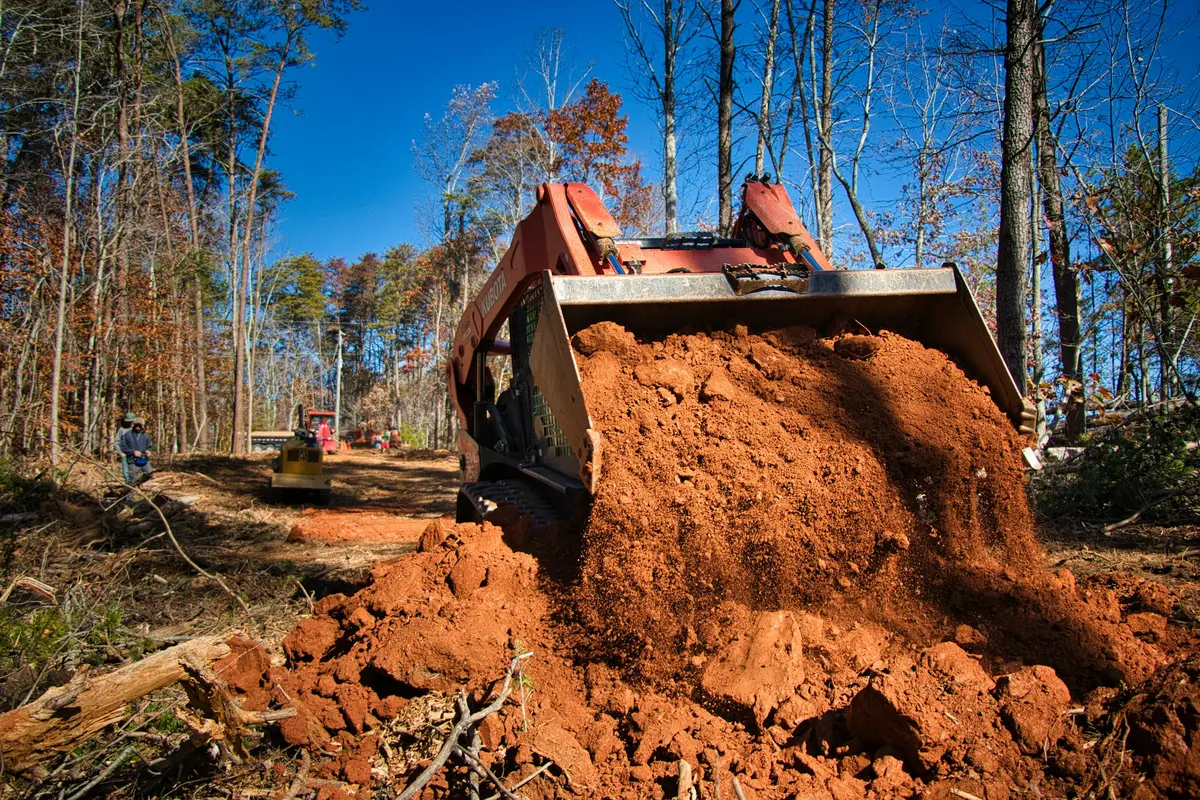
- Whether debris can be processed on site or must all be hauled.
- Access for equipment and for the trucks that take material away.
- Vine load, which slows everything and hides what is underneath.
- Whether material can be lowered clear of the enclosure or has to be taken out in pieces small enough to be handled over it.
- Whether roof or gutter clearance is part of the objective, which is a different scope from general canopy work.
- How close the canopy sits to the roofline, gutters and any carport. Low single-storey roofs sit well inside the fall radius of limbs that look comfortably clear from the ground.
Debris and cleanup
Stump treatment is the decision that most often gets deferred and most often causes problems later. Land cleared with stumps left in place is not ready for construction or for most groundworks, so it is worth settling early.
- Where limbs sit directly over a roof, material is lowered rather than dropped, and gutters are worth checking afterwards for anything that has washed into them.
- Long-unmanaged canopies carry more accumulated deadwood than expected, so the volume coming down on a first visit is often higher than on subsequent ones.
- Where a pool or enclosure sits beneath the work, keeping debris out of the water is part of the plan rather than an afterthought, and it usually means smaller cuts and more of them.
Hauled away, chipped on site, or stacked in an agreed position — all three are normal, and they are different amounts of work. Whichever you want should be stated in the scope before the day rather than settled afterwards.
Have this ready when scoping
- Where equipment can access and whether any of it crosses a neighbour's land.
- Known locations of wells, septic systems, easements and buried services.
- Whether debris can stay on site in any form.
- If the tree has not been worked on for some years, say so. The first visit after a long gap is usually a bigger job than the ones that follow, and it is better to know that upfront.
- Decide whether the objective is storm preparation or general maintenance. They lead to different work on the same tree.
- Decide how much clearance you actually want between the canopy and the roof — that number is more useful than asking for the tree to be 'cut back'.
Land and Lot Clearing in Largo: common questions
Can a small parcel be cleared with occupied houses either side?
Yes, with lighter equipment and more hand work than an open site would need. The constraint is protecting the neighbouring properties rather than the volume of vegetation.
How is the boundary established?
From a survey or plat, marked physically before work starts. On parcels this size an existing fence is not a reliable guide, and clearing past the line onto occupied property is a serious error.
Can wet or low-lying ground be cleared?
Sometimes, with the right approach and timing, and sometimes it should not be touched at all. Areas near wetlands or watercourses can be subject to specific protections, which is exactly the situation where confirming requirements locally matters most.
Can a tree be pruned to make it safer in a storm?
Selective work can reduce specific risks — removing deadwood, addressing a poorly attached limb, clearing material from directly above something that matters. What it cannot do is make a tree storm-proof, and heavy topping generally makes a tree less stable rather than more. Anyone promising a storm-proof tree is overstating what pruning does.
Can branches over the roof be removed without cutting the whole tree back?
Usually, yes. Clearance work targets the specific limbs creating the problem and leaves the rest of the canopy intact, which is both better for the tree and less work than a general reduction. What it cannot do is create clearance that the tree will not simply regrow into, so it is worth agreeing how much you want and how often you would accept revisiting it.
Related tree services in Largo
If what remains is stumps
Cleared of trees and cleared to grade are different scopes with different work in them.
Read about stump grindingFor the volume it produces
Clearing generates material by the load rather than by the tree.
See how debris hauling worksFor a managed or commercial parcel
Phasing, access and who authorises a change on the day shape the plan more than the trees do.
Read about commercial tree workScope a Lot Clearing Project in Largo
Tell us the parcel size, the intended use and where the boundaries run. On a Largo parcel the boundary certainty comes first.
- Phone: 877-269-2454
- Serving Tampa Bay, Florida
Information on this page is general guidance for property owners and managers in the Tampa Bay area. It is not an arboricultural assessment, a legal opinion, a permitting determination or an insurance decision. Tree condition and site risk can only be judged in person.