Wesley Chapel, Florida
Fallen Tree Removal in Wesley Chapel, FL
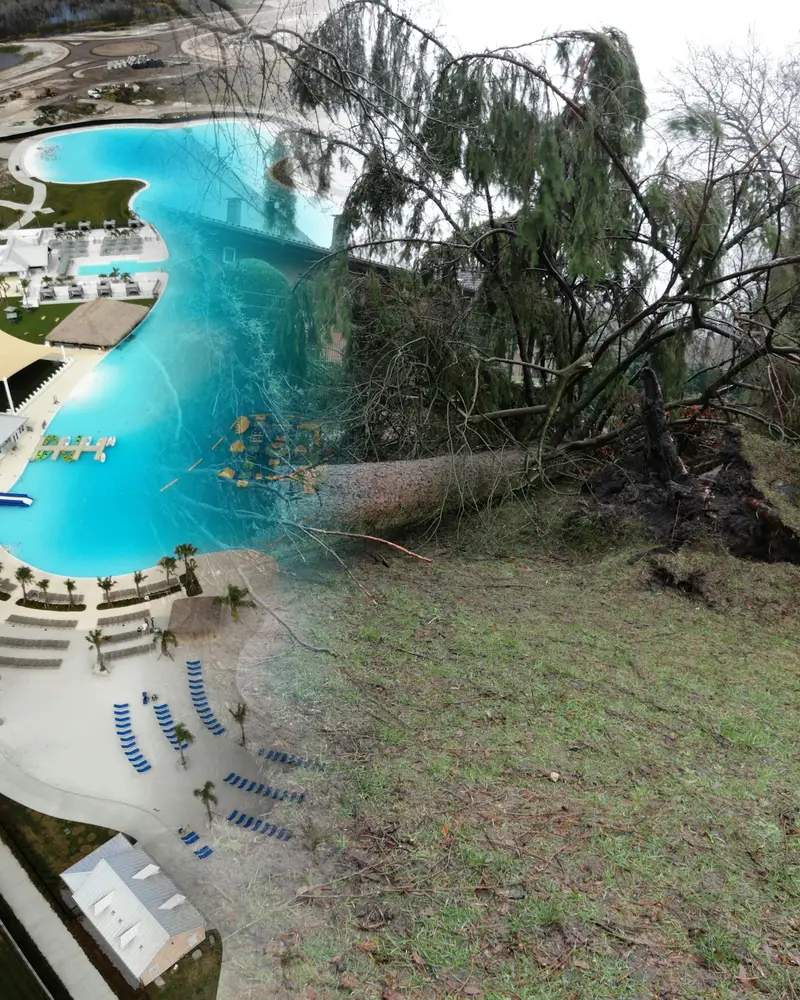
When a pine comes down in Wesley Chapel it usually spans something. Sixty or seventy feet of stem crosses a rear fence, a lanai and part of a neighbouring lot in one line, which means the trunk is bridging between supports and the middle is under bending load rather than resting.
- Pasco County
- Master-planned communities
- Sandy soils
If the tree is threatening people, an occupied building or your only access, call straight away rather than waiting.
Before anyone goes near it
The dangerous part of a downed tree is not its weight, it is where that weight is held. Trunks bridging between two supports snap upward or downward when cut in the wrong place, and limbs pinned beneath a stem can whip sideways with real force when released. This is the situation that injures the most well-intentioned property owners.
Never approach, move or work near a downed or sagging power line, and do not assume a line is inactive. Keep people, pets and vehicles well clear, and report the line to your electric utility or emergency services before anyone goes near the area.
What this means on Wesley Chapel properties
Where the top has landed in a conservation area behind the lot line, clearing becomes a question of what may be entered and disturbed as well as how the material comes out. Establishing that before work starts is more sensible than discovering the restriction with a crew on site.
Community layouts generally allow reasonable vehicle access, but HOA-managed common areas, conservation easements behind lots and shared retention areas often complicate who authorises what.
Wesley Chapel is unincorporated, so Pasco County provisions apply, and community-level rules may apply on top of them. Requirements can vary by property and jurisdiction. Property owners should confirm current requirements with the relevant local authority before work begins.

Things that make a downed tree more complicated than it looks
Where a pine comes down across a rear screen enclosure with the canopy in a preserve behind the lot, what may be entered on that side needs establishing before clearing rather than during it.
- Part of the canopy is still attached to a standing stem that has split.
- The ground underneath is saturated, so the tree may settle further as it dries.
- The trunk is lying across a utility connection, meter or irrigation line.
- Growth crossing a common-area or shared boundary line, where the standard applied is the community's rather than yours.
- Thinning or dieback on a tree that was retained through building work.
A tree is down: what you can clear and what needs equipment
Plenty of a fallen tree is genuinely a homeowner job. The part that is not is the part holding load, and telling the two apart is what keeps this from turning into an injury or a bigger repair bill.
Reasonable to handle yourself Loose and light
- Material well clear of the trunk, fences, vehicles and any line.
- Limbs already detached and lying flat with nothing on top of them.
Leave for equipment and rigging Bearing weight or under tension
- A trunk or limb resting on a fence, roof, cage, deck or vehicle.
- Anything bridging between two points of support — it is a loaded beam.
How a downed tree is normally cleared
- Read the load path
Before any cut, the crew works out what is holding what. Which end is bearing, where the bend is, and what will move when the first section comes off.
- Relieve tension deliberately
Bent and pinned limbs are released in an order that lets stored energy out in a controlled direction rather than toward the crew or the structure.
- Section the main stem
The trunk is cut into lengths that can be moved with the equipment and access available, working from the free end where possible.
- Deal with the root plate
A tipped plate is either cut free and removed or laid back into the hole, depending on what the ground needs to become.
- Clear and finish
Brush chipped, wood removed or staged, and access surfaces cleared so the property works normally again.
What makes one fallen tree a bigger job than another
- How far material has to be carried to reach the truck.
- How much of the property has to stay usable while work is happening.
- Whether the remaining stump or standing stem is part of the same job.
- Whether the tree sits on the property, on common ground or on a managed boundary — that determines who authorises the work before anything else can be planned.
- Whether there is height clearance for sections to be taken down the stem, since a tall stem over a house has little margin for error.
- Whether the tree is a tall single-stem pine or a spreading broadleaf canopy. They are different planning problems — one carries its weight high on a slender stem, the other spreads its load wide.
Helpful before clearing starts
- Identify what is underneath it that you cannot see — irrigation, cabling, a low wall, a septic lid.
- Confirm whether any part of the tree or its canopy sits on a neighbouring property.
- Check whether anything valuable is pinned underneath that needs care rather than speed.
- Walk the property before you call and count what actually needs attention, rather than describing the single tree that prompted it. Several trees in one visit is normally more efficient than separate calls.
- Establish who owns the tree before booking anything. Where it sits on common ground or a shared boundary, the association usually has to authorise the work rather than the resident.
- Mention any construction, trenching, paving or grade change near the tree in recent years, even if it looked harmless at the time. Root damage shows up slowly.
Debris and cleanup
Clearing a downed tree is mostly a materials-handling problem. Brush chips easily; trunk sections are heavy, awkward and often the constraint on how quickly the site can be cleared. Where access is tight, sectioning smaller and carrying more is usually faster than trying to force a machine in.
- Larger parcels usually allow material to be staged near the working area, so the carry is short and the loading happens in one place.
- Where a community sets rules on where material may be placed or for how long, confirm those before a pile is built rather than after.
- Where there is room, chip and trunk rounds can often be left in an agreed position rather than hauled, which reduces what has to be carried and loaded.
Hauled away, chipped on site, or stacked in an agreed position — all three are normal, and they are different amounts of work. Whichever you want should be stated in the scope before the day rather than settled afterwards.
Fallen Tree Removal in Wesley Chapel: common questions
Part of the tree is in the preserve behind my lot. Can it be removed?
It depends on the designation and on who manages that land. Some areas allow removal of fallen material and some restrict entry. It is worth clarifying with your association or the county before work is scheduled.
Why is a bridging trunk more dangerous?
Because a cut in the wrong place releases bending load suddenly — the stem can spring or roll rather than simply falling. It is the single most common way people are injured clearing a downed pine.
The tree fell from next door onto my property. Who deals with it?
Responsibility depends on the circumstances and on your respective insurers, and it is not something a tree crew can determine. Practically, clearing usually proceeds first if there is a hazard, with the question of who bears the cost settled separately.
Is a tall pine handled differently from an oak?
Yes, in a way that matters. A pine carries most of its weight high on a comparatively slender stem and tends to fail as a whole stem rather than by shedding limbs, so the target assessment and the takedown sequence are both different. It is worth saying which you have when you call.
The tree may be on association land. What happens then?
The work has to be authorised by whoever is responsible for that ground, which is normally the association rather than the resident. Establishing ownership first saves a wasted visit. We can talk through what is involved either way, but we will not carry out work on ground you do not control.
Related tree services in Wesley Chapel
If anything is still under load
A trunk resting on a structure, a blocked sole access or material overhead is not a scheduled job.
See what counts as urgentFor what is left once it is cut
Cutting and hauling are different scopes, and the second is easy to underestimate.
See how debris hauling worksFor what remains at ground level
A failed tree usually leaves a stump and a disturbed root plate behind it.
Read about stump grindingGet a Fallen Tree Cleared in Wesley Chapel
Tell us what it crossed, whether it reaches into a preserve area and whether the trunk is bridging. Leave anything under bending load exactly as it is.
- Phone: 877-269-2454
- Serving Tampa Bay, Florida
Information on this page is general guidance for property owners and managers in the Tampa Bay area. It is not an arboricultural assessment, a legal opinion, a permitting determination or an insurance decision. Tree condition and site risk can only be judged in person.