New Port Richey, Florida
Fallen Tree Removal in New Port Richey, FL
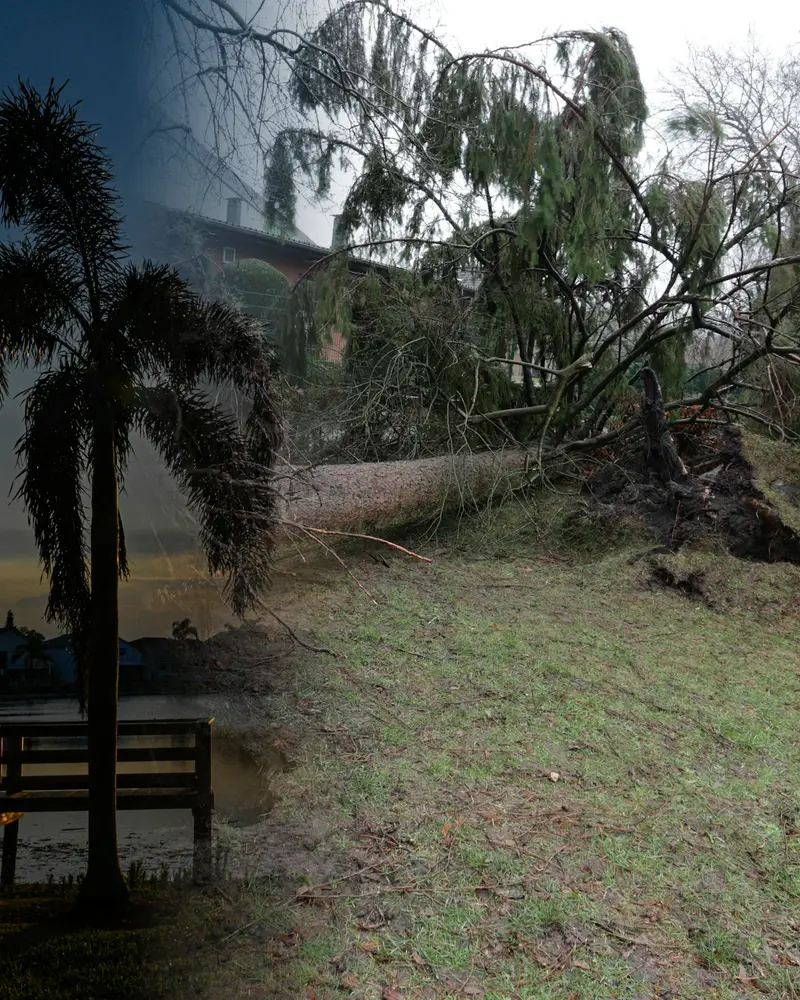
A downed tree in New Port Richey frequently involves both older housing and difficult ground. Mid-century structures with porches, carports and light additions take impact badly, and where the lot falls toward the river the recovery has to work uphill rather than on the level.
- Pasco County
- Older coastal-adjacent housing
- Cotee River
If the tree is threatening people, an occupied building or your only access, call straight away rather than waiting.
What this means on New Port Richey properties
Trees that have gone into the river are their own category. Material in the water has to be recovered under control rather than cut and left, and a saturated bank is the least suitable ground on the property for positioning anything heavy. That combination usually means the work is done in smaller pieces from a position back from the water.
Compact mid-century lots, riverfront properties and long-established plantings are the norm. Trees planted when these neighbourhoods were built are now well beyond the scale the lots were laid out for.
New Port Richey is an incorporated Pasco County city with its own code, distinct from surrounding unincorporated Pasco areas. Requirements can vary by property and jurisdiction. Property owners should confirm current requirements with the relevant local authority before work begins.
Before anyone goes near it
The dangerous part of a downed tree is not its weight, it is where that weight is held. Trunks bridging between two supports snap upward or downward when cut in the wrong place, and limbs pinned beneath a stem can whip sideways with real force when released. This is the situation that injures the most well-intentioned property owners.
Never approach, move or work near a downed or sagging power line, and do not assume a line is inactive. Keep people, pets and vehicles well clear, and report the line to your electric utility or emergency services before anyone goes near the area.
Things that make a downed tree more complicated than it looks
Where a tree is down across a riverbank with the canopy in the water and the trunk on a bank too soft to work from, the working position has to be established before the first cut. Recovering material from the water is far harder than preventing it.
- The trunk is bridging between two points, so the middle is under bending load.
- The failure crossed a boundary and material lies on two properties.
- The root plate has tipped up but is still attached, and can rotate back when weight shifts.
- Growth overhanging a dock, deck or seawall, where anything dropped would go into the water rather than onto ground.
- Growth closing in over a narrow side route that is the only way in or out.
A tree is down: what you can clear and what needs equipment
Plenty of a fallen tree is genuinely a homeowner job. The part that is not is the part holding load, and telling the two apart is what keeps this from turning into an injury or a bigger repair bill.
Reasonable to handle yourself Loose and light
- Small brush and leaf litter that lifts freely off the ground.
- Photographing the damage from a safe distance while you wait.
Leave for equipment and rigging Bearing weight or under tension
- The root plate and any void it has opened at the base.
- Limbs pinned or bent under the weight of the tree above them.
How a downed tree is normally cleared
- Read the load path
Before any cut, the crew works out what is holding what. Which end is bearing, where the bend is, and what will move when the first section comes off.
- Relieve tension deliberately
Bent and pinned limbs are released in an order that lets stored energy out in a controlled direction rather than toward the crew or the structure.
- Take weight off structures first
Where the tree lies on a building, fence or vehicle, sections are lifted or lowered away rather than dragged, so the object is not damaged further on the way out.
- Deal with the root plate
A tipped plate is either cut free and removed or laid back into the hole, depending on what the ground needs to become.
- Clear and finish
Brush chipped, wood removed or staged, and access surfaces cleared so the property works normally again.
What makes one fallen tree a bigger job than another
- Whether the tree is fully down or partly hung up in a neighbouring canopy.
- Whether the fall damaged irrigation, lighting, fencing or paving that needs care during clearing.
- Whether it landed on open ground or on something that has to be protected as it comes off.
- Whether the tree has outgrown the space it was planted in. Landscape trees chosen for a new plot frequently reach the roofline and the fence line decades later, and that is a different problem from a defect.
- Whether material can be dropped at all, or whether every piece has to be rigged and lowered into a small space — the difference between those two is substantial.
- Where the truck and chipper can legally and practically stand. On narrow older streets that position, rather than the tree, often sets the shape of the day.
Helpful before clearing starts
- Check whether anything valuable is pinned underneath that needs care rather than speed.
- Have someone available who can authorise decisions about the stump and the root plate.
- Confirm whether any part of the tree or its canopy sits on a neighbouring property.
- If the tree has not been worked on for some years, say so. The first visit after a long gap is usually a bigger job than the ones that follow, and it is better to know that upfront.
- Decide whether vehicles can be moved off the driveway for the day, and whether a gate or side access can be unlocked and left open.
- Move boats, lifts and anything on the dock clear of the working area if that is possible, or say what cannot be moved.
Debris and cleanup
If the tree tipped a root plate, there is usually a hole and a mound of soil-bound roots to resolve. Backfilling to a safe grade is a separate decision from removing the trunk, and it matters if the area is going to be walked on or mowed.
- Staging space on a frontage lot is usually limited, so material tends to be loaded as it comes down rather than piled.
- Long-unmanaged canopies carry more accumulated deadwood than expected, so the volume coming down on a first visit is often higher than on subsequent ones.
- Trunk wood is cut to a size the access will take rather than to the largest size the machine could handle.
Hauled away, chipped on site, or stacked in an agreed position — all three are normal, and they are different amounts of work. Whichever you want should be stated in the scope before the day rather than settled afterwards.
Fallen Tree Removal in New Port Richey: common questions
Part of the tree is in the river. Can it be recovered?
Usually, though it is slower and more deliberate work. Material has to be brought back to the land side under control, and the bank cannot be used as a working platform for it.
Can a machine work on a saturated bank?
Generally not. Slope plus saturation is poor ground for anything heavy, so the work is done from firmer positions back from the water with material brought to them.
Can I cut it up myself and have the pieces taken away?
You can, and people do, but the risk sits in exactly the part that looks simplest: cutting sections that are holding load. If any part of the tree is bridging, pinned or resting on a structure, that is the part to leave alone.
Can a tree be pruned to make it safer in a storm?
Selective work can reduce specific risks — removing deadwood, addressing a poorly attached limb, clearing material from directly above something that matters. What it cannot do is make a tree storm-proof, and heavy topping generally makes a tree less stable rather than more. Anyone promising a storm-proof tree is overstating what pruning does.
There is nowhere obvious to park a truck. Is that a problem?
It is a planning question rather than a blocker. What matters is whether a chipper can be positioned within a workable carry of the tree, and whether that position can be held for the day. Tell us what the street is like when you call and it can be worked out beforehand rather than on arrival.
Related tree services in New Port Richey
If anything is still under load
A trunk resting on a structure, a blocked sole access or material overhead is not a scheduled job.
See what counts as urgentFor what is left once it is cut
Cutting and hauling are different scopes, and the second is easy to underestimate.
See how debris hauling worksFor what remains at ground level
A failed tree usually leaves a stump and a disturbed root plate behind it.
Read about stump grindingGet a Fallen Tree Cleared in New Port Richey
Tell us what it landed on, whether any of it is in the water and how the ground is. Leave anything under load exactly where it is.
- Phone: 877-269-2454
- Serving Tampa Bay, Florida
Information on this page is general guidance for property owners and managers in the Tampa Bay area. It is not an arboricultural assessment, a legal opinion, a permitting determination or an insurance decision. Tree condition and site risk can only be judged in person.