New Port Richey, Florida
Stump Grinding and Removal in New Port Richey, FL
Two local factors govern stump work here. Ground that holds water means a grinder marks a lawn more than it would on dry sand, and sloping riverfront lots mean the machine may not be able to reach a stump from the side that would be most useful.
- Pasco County
- Cotee River
- Older coastal-adjacent housing
What this means on New Port Richey properties
Older irrigation adds the usual uncertainty. Systems on properties of this age have generally been extended and repaired over decades, so the layout rarely matches anything documented. Where a stump sits in an established bed, walking the area and pointing out visible heads and valve boxes is genuinely more useful than assuming.
New Port Richey is an incorporated Pasco County city on the Cotee (Pithlachascotee) River, a short distance inland from the Gulf, with older housing stock through much of the city.
New Port Richey is an incorporated Pasco County city with its own code, distinct from surrounding unincorporated Pasco areas. Requirements can vary by property and jurisdiction. Property owners should confirm current requirements with the relevant local authority before work begins.

Grinding or full removal
These are different operations with different outcomes and different amounts of disturbance. Grinding is the usual choice; full extraction is occasionally necessary.
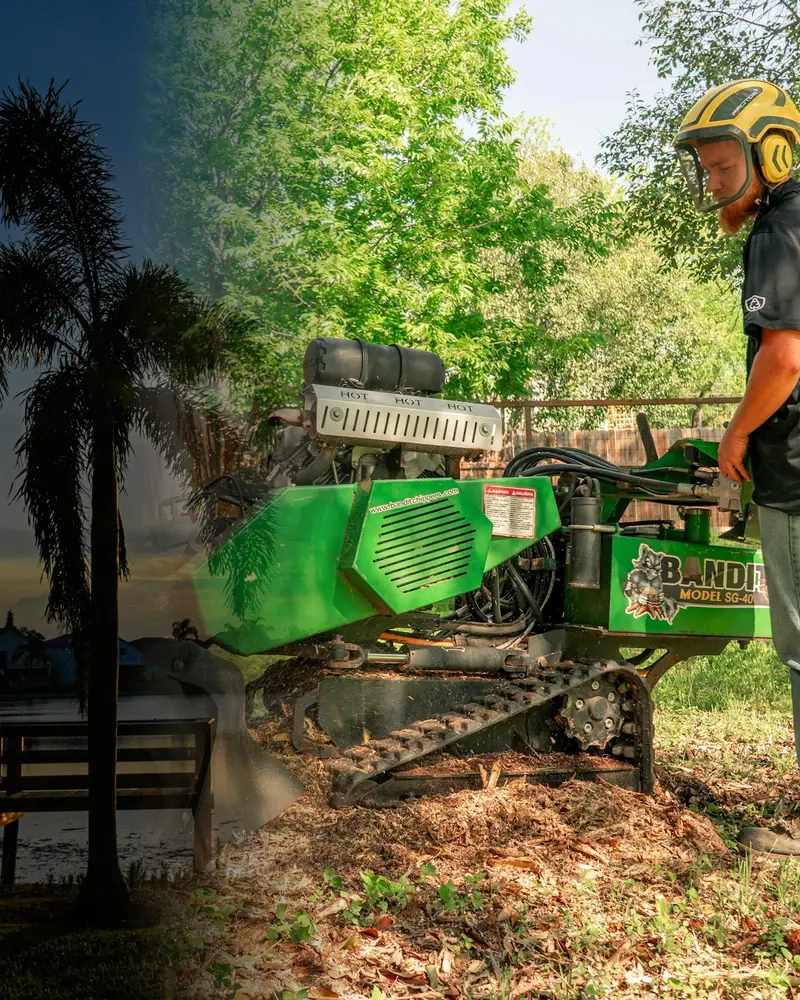
Stump grinding Most situations
- Far less disturbance to surrounding soil, turf and paving.
- Leaves a chip-and-soil void that is backfilled or cleared.
Full stump removal Occasionally needed
- Heavier equipment and much more disruption to the surrounding area.
- The stump and major root mass are excavated out of the ground.
Reasons stumps get dealt with
Where a stump sits partway down a sloping lot on ground that stays soft, the grinder usually has one workable approach and the spoil has to be carried uphill rather than barrowed out.
- It sits in a lawn and catches the mower every time.
- Paving, a slab, a shed base or a fence line is planned across it.
- Surface roots radiating from it are lifting turf or paving.
- Growth over a street frontage or footpath where vehicles and pedestrians pass beneath.
- A tree that has reached the roofline or the fence line decades after being planted for a smaller space.
What has to be checked before grinding
Grinding converts solid wood into a loose chip-and-soil mix that occupies noticeably more volume than the stump appeared to. If it is being left on site, agree where it goes beforehand; if it is being removed, that is loading work in its own right.
Never approach, move or work near a downed or sagging power line, and do not assume a line is inactive. Keep people, pets and vehicles well clear, and report the line to your electric utility or emergency services before anyone goes near the area.
How grinding is normally carried out
- Confirm what is underground
Buried utilities, irrigation lines and low-voltage cable near a stump are a real hazard to a grinder. Locating comes before cutting.
- Set the target depth
Depth is chosen for the intended use — lawn, planting bed, or something that will be built on. Deeper costs more time and produces more spoil.
- Grind the stump and the flare
The visible stump plus the buttress roots at the surface are reduced, since leaving the flare intact leaves an obvious ridge.
- Handle the spoil
Grindings are a mix of wood chip and soil. They are either removed, or backfilled into the void and topped, depending on what you want.
- Level and finish
The area is brought back to a grade that suits its next use, and the surrounding surface is cleared down.
What changes a stump job
- The spread of surface roots, since these often matter more than the stump itself.
- Proximity to a wall, fence or paving that limits how the machine can be worked.
- Rock, rubble or old concrete around the base.
- The width of the narrowest point on the route in. A side gate frequently decides which machine can be used, and machine size then decides how long the work takes.
- Whether the tree has outgrown the space it was planted in. Landscape trees chosen for a new plot frequently reach the roofline and the fence line decades later, and that is a different problem from a defect.
- How far cut material has to be carried to reach the truck or chipper. Carry distance is often a bigger factor than the size of the tree.
Worth sorting before the grinder arrives
- Mark irrigation heads, valve boxes, lighting cable and any known service runs.
- Note any nearby tree you want protected from root damage during the grind.
- Clear pots, furniture and ornaments from around the stump.
- Decide whether vehicles can be moved off the driveway for the day, and whether a gate or side access can be unlocked and left open.
- Say whether the area around the tree holds water after heavy rain. It affects the timing, the equipment and occasionally the assessment itself.
- Note anything fixed on the route — an air-conditioning unit, meter box, irrigation head or low wall — that cannot simply be stepped over.
Debris and cleanup
Grinding produces more spoil than people expect — a stump ground below grade yields a mound of chip and soil considerably larger than the stump looked. It has to go somewhere, and that is a decision worth making in advance.
- Where the work is close to water, catching material before it enters is part of the method, and it normally means smaller sections and more rigging than the same tree inland.
- Where the vehicle has to stand away from the property, everything is carried to it, so the distance between the tree and the kerb is a real part of the cleanup time.
- Trunk wood is cut to a size the access will take rather than to the largest size the machine could handle.
Hauled away, chipped on site, or stacked in an agreed position — all three are normal, and they are different amounts of work. Whichever you want should be stated in the scope before the day rather than settled afterwards.
Stump Grinding and Removal in New Port Richey: common questions
Can a stump on a slope be ground?
Usually, though the machine needs a stable position and that may only exist on one side. Where the workable approach is limited, part of the flare on the far side may not be fully reachable.
Will the lawn recover on soft ground?
Generally yes, with more marking than on dry sand. It is usually cosmetic, and positioning can keep the worst of it away from the areas that matter most.
How deep does grinding go?
It depends on what the space is for. A lawn finish needs relatively little; a planting hole needs more; anything being built on needs a specific depth agreed in advance. Deeper means more time and more spoil, so it is worth being clear about the end use.
How much room does a crew actually need?
Less than most people expect for the cutting and more than most people expect for the material. The working area around the tree matters, but so does somewhere to put what comes down and a route to move it. Describing both when you call gets you a more useful answer than describing the tree alone.
The ground around the tree stays wet. Does that make it less stable?
It can. Saturated soil holds a root plate less firmly, which is why trees with no visible defect sometimes move during sustained wet weather rather than during the strongest wind. Whether it applies to a particular tree needs someone at the base of it — soil movement is one of the few things that genuinely cannot be judged from a photograph.
Related tree services in New Port Richey
If the tree is still standing
Felling and grinding are separate operations, and planning them together saves a second mobilisation.
Read about tree removalIf there are several across the property
Multiple stumps, or an area being cleared for a change of use, is scoped by area rather than per stump.
Read about land and lot clearingFor the spoil it produces
Grinding generates a chip-and-soil pile noticeably larger than the stump looked.
See how debris removal worksAsk About Stump Grinding in New Port Richey
Tell us how wet the ground gets, whether the lot slopes and what you know about the irrigation. That covers stump work here.
- Phone: 877-269-2454
- Serving Tampa Bay, Florida
Information on this page is general guidance for property owners and managers in the Tampa Bay area. It is not an arboricultural assessment, a legal opinion, a permitting determination or an insurance decision. Tree condition and site risk can only be judged in person.