Town ’n’ Country, Florida
Commercial Tree Removal in Town ’n’ Country, FL
Commercial property here is mostly neighbourhood-scale — strip retail, small offices, multifamily developments — where the parking is the site and there is no separate service area to work from. That means the exclusion zone takes bays out of use directly, and sequencing matters more than it would on a larger site.
- Hillsborough County
- Low elevation
- Near Old Tampa Bay
What this means on Town ’n’ Country properties
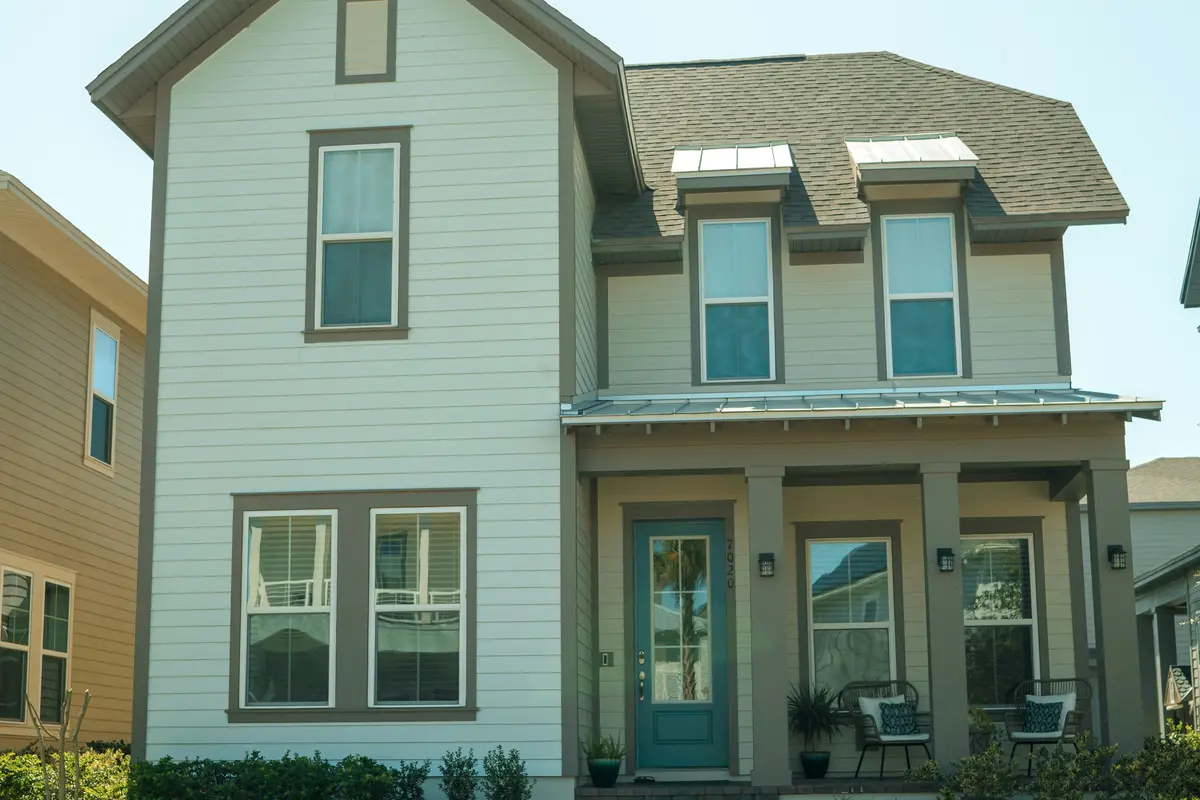
Multifamily property is a large part of the picture in this area, and it brings a specific requirement: residents need continuous access to their own doors and parking. Unlike a retail site that can absorb a closed section for a morning, a residential building cannot simply be shut off, so the work is phased around occupancy.
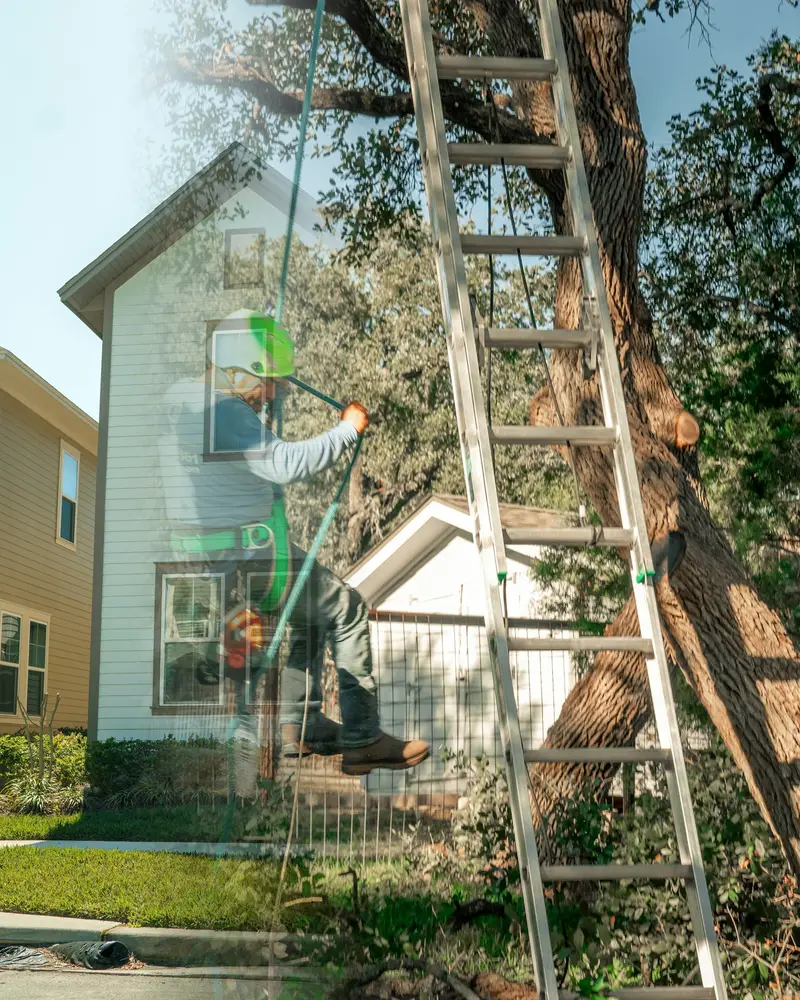
Lots are regular and generally accessible, but low rooflines and screen enclosures sit close under canopies, which restricts where material can be dropped even when the yard itself looks open.
Town ’n’ Country is unincorporated, so Hillsborough County provisions apply. Requirements can vary by property and jurisdiction. Property owners should confirm current requirements with the relevant local authority before work begins.
Typical commercial triggers
Trees along a multifamily parking area are normally done in short sections so residents keep access to their own bays, rather than losing a whole row for a day.
- Trees flagged during a property condition report or a handover inspection.
- A tree obstructing a delivery route, service yard or refuse collection point.
- Roots lifting a footpath, kerb or accessible route across a site.
- Material overhanging a screened enclosure or pool deck, which cannot take anything that lands on it.
- Growth in contact with a low roofline, gutter run or carport, where the clearance was adequate when the tree was planted.
Access and coordination questions that come first
- Whether adjoining tenants or neighbouring businesses need notice.
- Which hours the work can occupy the site without disrupting trading or tenants.
- How pedestrians will be routed around an exclusion zone, and who signs off on that.
- Whether parking bays or drive aisles need to be taken out of use, and for how long.
- Whether lighting, signage, cameras or overhead services sit within the drop zone.
In hours or out of hours?
On an operating site the cutting is rarely the constraint. What decides the plan is how much of the site can be out of use at once, and when the people who use it are not there.
Normal hours usually work Low-traffic footprint
- Bays or aisles can be coned off without cutting the site's usable capacity.
- Pedestrians can be routed around the exclusion zone on an existing path.
Out of hours earns its cost Access or occupancy pressure
- The only equipment position is a customer entrance or a fire route.
- The exclusion zone would cross the site's main pedestrian desire line.
Keeping a working site safe
On a live site the people who need managing are the ones who did not read the signage. Barriers, a routed diversion and someone watching the boundary matter more than cones. The exclusion zone stays closed while work is active, not while it is convenient.
Never approach, move or work near a downed or sagging power line, and do not assume a line is inactive. Keep people, pets and vehicles well clear, and report the line to your electric utility or emergency services before anyone goes near the area.
How a commercial job is normally organised
- Site walk with the responsible person
Trees, access, service routes and operating constraints are reviewed together, so the plan reflects how the site actually runs.
- Define the working window
Early mornings, off-peak hours or closed days often cost less disruption than a mid-day start, and that is usually the deciding factor.
- Sequence multi-tree work
On larger sites the order is chosen so that no more of the site is out of use at once than necessary.
- Stage debris out of circulation
Material is collected somewhere that does not obstruct fire lanes, loading or accessible routes while work continues.
- Hand the area back clean
Surfaces cleared, bays reopened, and the site walked with the responsible person before the crew leaves.
What drives cost and duration on commercial sites
- Overhead services, lighting columns and rooftop equipment near the canopy.
- Coordination with other trades already working on the site.
- Documentation and sign-off expected by a managing agent.
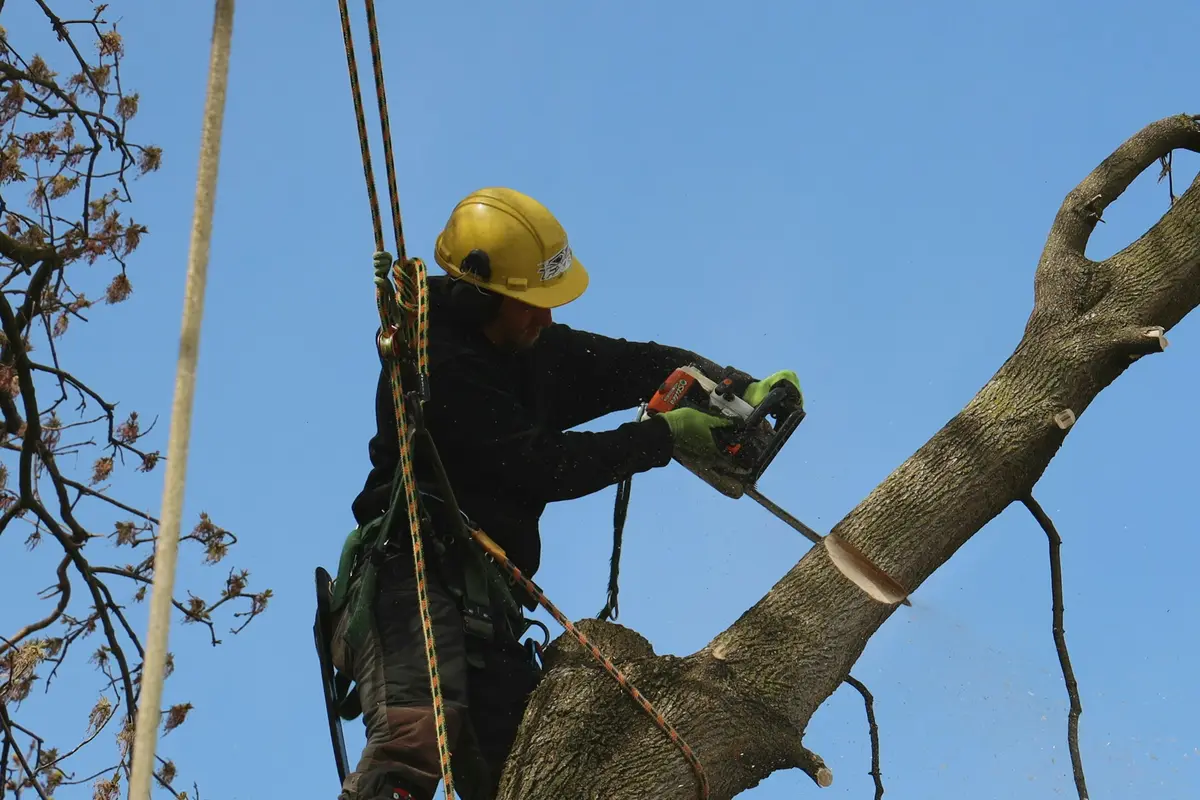
- Whether material can be lowered clear of the enclosure or has to be taken out in pieces small enough to be handled over it.
- Whether a screened enclosure sits within the working radius. A cage offers almost no resistance to a falling limb and cannot be used as a drop zone at any size.
- How close the canopy sits to the roofline, gutters and any carport. Low single-storey roofs sit well inside the fall radius of limbs that look comfortably clear from the ground.
Debris and cleanup
Where volume exceeds what can leave in a single load, a staging point is agreed in advance, sited away from fire lanes, hydrants, drainage and refuse collection. Agreeing it up front avoids a debate on the day.
- Where a pool or enclosure sits beneath the work, keeping debris out of the water is part of the plan rather than an afterthought, and it usually means smaller cuts and more of them.
- On ground that holds water, staging is normally kept to firm surfaces such as a drive or path rather than lawn, which sometimes lengthens the carry.
- Long-unmanaged canopies carry more accumulated deadwood than expected, so the volume coming down on a first visit is often higher than on subsequent ones.
Hauled away, chipped on site, or stacked in an agreed position — all three are normal, and they are different amounts of work. Whichever you want should be stated in the scope before the day rather than settled afterwards.
What speeds up a commercial quote
- Whether documentation is needed for a managing agent or owner's file.
- Permitted working hours and any restricted dates.
- Notice requirements for tenants or adjoining occupiers.
- Look at the ground at the base of the tree and mention anything unusual — cracking, lifting, or soil that has moved in an arc on one side.
- Note whether anything nearby has been removed or thinned recently — a tree that was sheltered and is now exposed is worth flagging.
- Say whether the area around the tree holds water after heavy rain. It affects the timing, the equipment and occasionally the assessment itself.
Commercial Tree Removal in Town ’n’ Country: common questions
Can residents keep their parking during the work?
Mostly, by phasing the exclusion zone across the row rather than closing it. It takes longer than a single closure, which is the trade-off worth deciding at the site walk.
Is early morning work feasible on residential property?
Less so than on retail sites, because of noise and residents sleeping. On multifamily property mid-morning through afternoon is usually the more practical window.
What about trees on a boundary with another business?
Those need agreement before work starts. Access, timing and responsibility all get more complicated across a commercial boundary, and it is much easier to resolve in advance than mid-job.
A nearby tree came down and this one is now in the open. Is that a concern?
It is a legitimate reason to have it looked at. Trees that develop within a group share the wind load and grow accordingly; when that shelter is removed the remaining tree carries a load it never grew for. Whether it matters depends on the tree, which is an on-site question rather than a remote one.
The ground around the tree stays wet. Does that make it less stable?
It can. Saturated soil holds a root plate less firmly, which is why trees with no visible defect sometimes move during sustained wet weather rather than during the strongest wind. Whether it applies to a particular tree needs someone at the base of it — soil movement is one of the few things that genuinely cannot be judged from a photograph.
Related tree services in Town ’n’ Country
For a single tree on the site
Where one tree drives the job, the method question is the same as on a residential property.
Read about tree removalFor a parcel rather than a tree
Scoped by area and by outcome, with retention decided before work starts.
Read about land and lot clearingFor volume across the site
Staging position and carry distance usually matter more than total volume.
See how debris hauling worksDiscuss Commercial Tree Removal Needs in Town ’n’ Country
Tell us the site type, permitted hours and what access has to stay open. On Town ’n’ Country commercial property phasing is the plan.
- Phone: 877-269-2454
- Serving Tampa Bay, Florida
Information on this page is general guidance for property owners and managers in the Tampa Bay area. It is not an arboricultural assessment, a legal opinion, a permitting determination or an insurance decision. Tree condition and site risk can only be judged in person.