
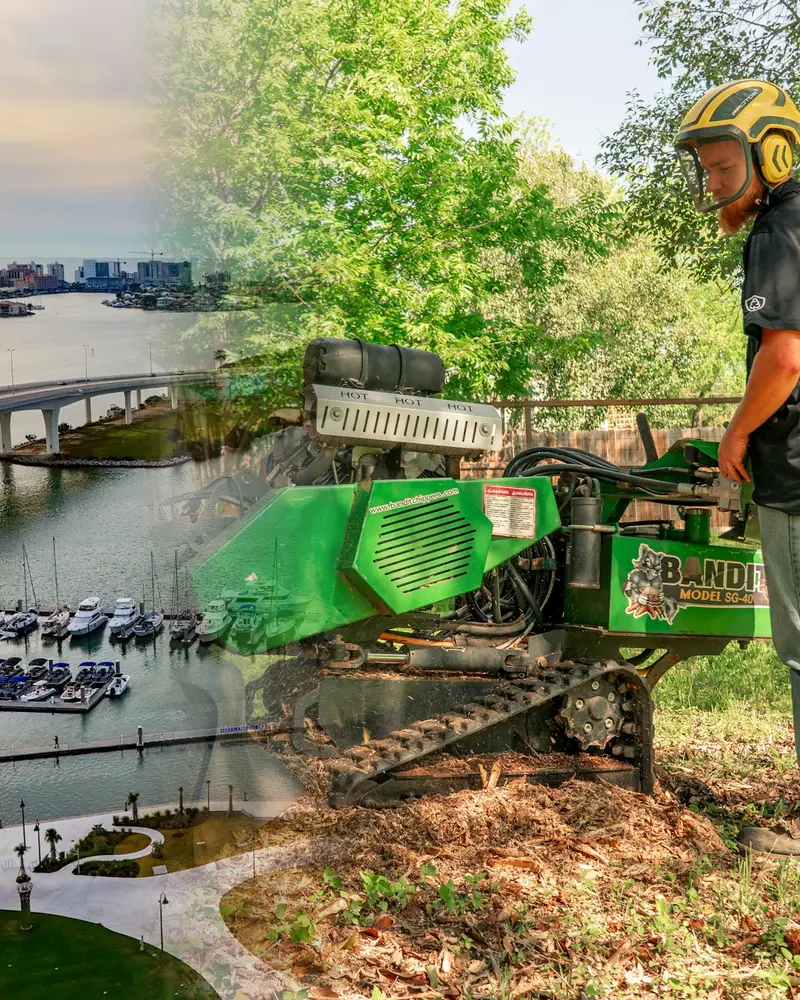
Clearwater, Florida
Stump Grinding and Removal in Clearwater, FL
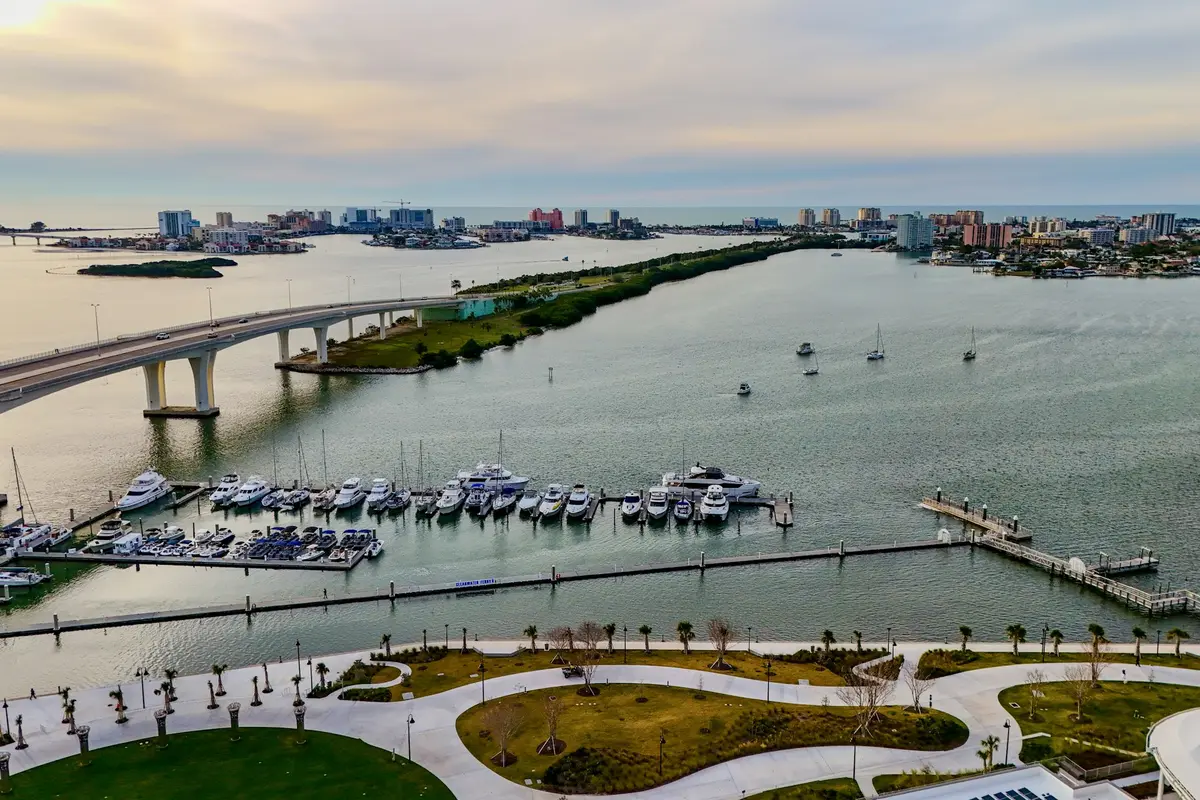
The limiting factor on most Clearwater stumps is hard surface. On waterfront and island lots the stump is frequently surrounded by pavers, a pool deck or a seawall cap, which restricts where a machine can stand and how much of the root flare is reachable from the workable side.
- Pinellas County
- Barrier island and mainland
- Gulf-facing
What this means on Clearwater properties
Sandy coastal soils grind easily, but proximity to structures is the constant. Where a stump sits within a few feet of a seawall, a deck footing or a cage base, the working position has to keep loads off those structures — and the section of flare nearest them may not be fully removable. That is worth knowing before paving or planting is designed over it.
Mainland neighbourhoods include long-established residential streets with substantial canopy, while island and waterfront properties tend toward tighter lots, salt exposure and a heavy proportion of palms and coastal-tolerant planting.
Clearwater is an incorporated Pinellas County city with its own municipal provisions, distinct from unincorporated county areas nearby. Requirements can vary by property and jurisdiction. Property owners should confirm current requirements with the relevant local authority before work begins.
Grinding or full removal
These are different operations with different outcomes and different amounts of disturbance. Grinding is the usual choice; full extraction is occasionally necessary.
Stump grinding Most situations
- Far less disturbance to surrounding soil, turf and paving.
- Depth can be matched to the intended use of the space.
Full stump removal Occasionally needed
- Typically driven by construction, deep excavation or utility work.
- Not usually necessary for replanting, lawn or ordinary landscaping.
Reasons stumps get dealt with
Where a palm stump sits between a pool deck and a seawall, the machine can usually approach from one direction only, and the finished level has to match the surrounding pavers.
- Sprouts keep coming from the stump or from roots around it.
- Surface roots radiating from it are lifting turf or paving.
- It sits in a lawn and catches the mower every time.
- Material overhanging a screened enclosure or pool deck, which cannot take anything that lands on it.
- Growth over a street frontage or footpath where vehicles and pedestrians pass beneath.
What has to be checked before grinding
A stump grinder ejects chip, grit and small stone with real force. Windows, vehicles, pool water and anyone standing nearby need to be outside that arc or screened from it. This is one of the few operations where bystanders should be indoors rather than watching.
Never approach, move or work near a downed or sagging power line, and do not assume a line is inactive. Keep people, pets and vehicles well clear, and report the line to your electric utility or emergency services before anyone goes near the area.
How grinding is normally carried out
- Confirm what is underground
Buried utilities, irrigation lines and low-voltage cable near a stump are a real hazard to a grinder. Locating comes before cutting.
- Check access width
Grinders come in different sizes; the constraint is usually the narrowest gate or gap between a house and a fence on the route in.
- Set the target depth
Depth is chosen for the intended use — lawn, planting bed, or something that will be built on. Deeper costs more time and produces more spoil.
- Handle the spoil
Grindings are a mix of wood chip and soil. They are either removed, or backfilled into the void and topped, depending on what you want.
- Level and finish
The area is brought back to a grade that suits its next use, and the surrounding surface is cleared down.
What changes a stump job
- Slope and whether the grinder can be positioned stably.
- Rock, rubble or old concrete around the base.
- Whether the grindings stay on site or are hauled away.
- Whether material can be dropped at all, or whether every piece has to be rigged and lowered into a small space — the difference between those two is substantial.
- How far cut material has to be carried to reach the truck or chipper. Carry distance is often a bigger factor than the size of the tree.
- Whether material can be lowered clear of the enclosure or has to be taken out in pieces small enough to be handled over it.
Worth sorting before the grinder arrives
- Decide whether grindings stay as backfill or are taken away.
- Measure the narrowest point on the access route, gate posts included.
- Mark irrigation heads, valve boxes, lighting cable and any known service runs.
- Note whether anything nearby has been removed or thinned recently — a tree that was sheltered and is now exposed is worth flagging.
- Where kerbside space is shared or contested, letting immediate neighbours know in advance usually prevents the awkward conversation happening mid-job.
- Move loose furniture, covers and anything on the deck out of the working area, or agree in advance who is moving it.
Debris and cleanup
Backfilling with the grindings is the simplest option, but the mix settles over months and is not a good growing medium. If you are planting in the same spot, removing the grindings and bringing in soil is usually the better result.
- Staging space on a frontage lot is usually limited, so material tends to be loaded as it comes down rather than piled.
- Where the vehicle has to stand away from the property, everything is carried to it, so the distance between the tree and the kerb is a real part of the cleanup time.
- Where a pool or enclosure sits beneath the work, keeping debris out of the water is part of the plan rather than an afterthought, and it usually means smaller cuts and more of them.
Hauled away, chipped on site, or stacked in an agreed position — all three are normal, and they are different amounts of work. Whichever you want should be stated in the scope before the day rather than settled afterwards.
Stump Grinding and Removal in Clearwater: common questions
Can a stump right against a pool deck be ground?
Partly, and how completely depends on the approach angle available. The flare on the deck side may not be fully reachable. If the area is being repaved, it is better to raise that before the work than to discover the limit afterwards.
Do palm stumps grind differently?
They are generally less involved than a spreading hardwood stump, because palm root balls are compact rather than wide. There is still spoil to deal with, and on a paved lot that has to be removed rather than backfilled.
Can I plant a new tree in the same spot?
Not directly into the ground-out hole if it is full of grindings. Wood chip mixed into soil is a poor rooting medium. Removing the spoil and backfilling with soil, or shifting the planting position slightly, both work better.
The tree is right at the water's edge. Does that change the approach?
Considerably. A seawall or dock cannot take dropped material, there is rarely a free drop zone on a frontage lot, and anything that goes into the water is far harder to recover than it is to prevent. Work in that position is normally rigged and lowered in small sections, which takes longer than the same tree would inland.
There is nowhere obvious to park a truck. Is that a problem?
It is a planning question rather than a blocker. What matters is whether a chipper can be positioned within a workable carry of the tree, and whether that position can be held for the day. Tell us what the street is like when you call and it can be worked out beforehand rather than on arrival.
Related tree services in Clearwater
If the tree is still standing
Felling and grinding are separate operations, and planning them together saves a second mobilisation.
Read about tree removalIf there are several across the property
Multiple stumps, or an area being cleared for a change of use, is scoped by area rather than per stump.
Read about land and lot clearingFor the spoil it produces
Grinding generates a chip-and-soil pile noticeably larger than the stump looked.
See how debris removal worksAsk About Stump Grinding in Clearwater
Tell us what surrounds the stump and how a machine could approach it. On Clearwater waterfront lots the access angle matters more than the stump size.
- Phone: 877-269-2454
- Serving Tampa Bay, Florida
Information on this page is general guidance for property owners and managers in the Tampa Bay area. It is not an arboricultural assessment, a legal opinion, a permitting determination or an insurance decision. Tree condition and site risk can only be judged in person.