New Port Richey, Florida
Palm Tree Removal in New Port Richey, FL
Palms here are typically planted tight against something — a wall, a carport, a boundary fence, a bank edge — because that was the space available on a compact lot. The working radius at the base is the governing factor, and on a riverfront property the ground on one side may be unsuitable to work from at all.
- Pasco County
- Older coastal-adjacent housing
- Cotee River
What this means on New Port Richey properties
Bank-edge palms are the specific local case. A palm on a riverbank in saturated ground may be leaning because the bank has moved rather than because the palm has a problem, and that changes the question from whether the palm is sound to whether the position is viable at all.
River corridor and low ground near the Gulf hold water, and the combination of saturated soil and coastal wind is the pattern most often behind trees moving at the root plate here.
New Port Richey is an incorporated Pasco County city with its own code, distinct from surrounding unincorporated Pasco areas. Requirements can vary by property and jurisdiction. Property owners should confirm current requirements with the relevant local authority before work begins.
Why palms end up being removed
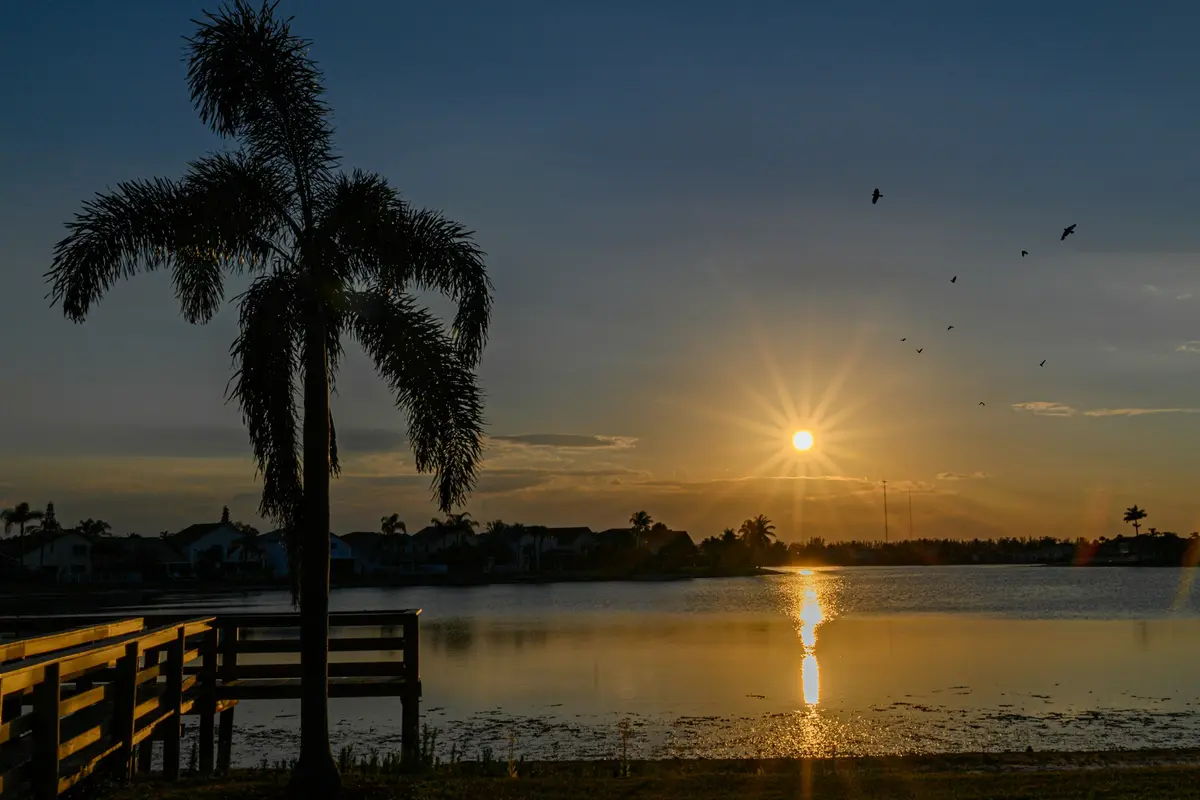
Where a palm at the top of a riverbank leans toward the water with a house on the other side, there may be no firm ground to work from on the bank side at all. Which direction it can safely be taken is the first question.
- It sits too close to a wall, pool deck or driveway for the trunk it has developed.
- The spear leaf at the centre has collapsed or pulls out easily.
- The crown has thinned to a few fronds, or new growth has stopped emerging.
- Growth overhanging a dock, deck or seawall, where anything dropped would go into the water rather than onto ground.
- A tree that has reached the roofline or the fence line decades after being planted for a smaller space.
Remove the palm, or keep maintaining it?
Palms fail differently from broadleaf trees, and they cannot be reduced or reshaped the way an oak can. That narrows the options: maintenance works until it does not, and then removal is the remaining one.
Maintenance still makes sense Crown and trunk sound
- The problem is accumulated dead fronds, seed pods or litter rather than the palm itself.
- The crown is producing healthy new growth from the centre.
Removal is the sensible call Crown or trunk compromised
- It is leaning from root-plate movement rather than from natural curvature.
- A soft or collapsed section of trunk, which does not heal or compartmentalise.
Why palm work is handled differently
Palms do not compartmentalise damage the way broadleaf trees do, so a soft or narrowed section does not recover and cannot be relied on to hold a climber. Where the trunk's condition is in doubt the work is done from a platform or with a lift, not by climbing it.
Never approach, move or work near a downed or sagging power line, and do not assume a line is inactive. Keep people, pets and vehicles well clear, and report the line to your electric utility or emergency services before anyone goes near the area.
How palm removal typically works
- Assess crown and trunk condition
A palm with a compromised crown or a soft upper trunk cannot be climbed, which changes the method before anything else is decided.
- Check overhead and underfoot
Palms are frequently planted close to lines, walls, pool cages and paving, so the clear space around the trunk is often the binding constraint.
- Section the trunk
Palm trunks are dense and heavy for their diameter. They are cut in short sections and lowered rather than dropped where space is tight.
- Deal with the base
Palm root balls are compact rather than spreading, which makes the base a different proposition to a hardwood stump.
- Clear and finish
The area is cleared of frond litter, fruit and fibre, which spread further than people expect during the work.
What affects a palm removal
- Trunk diameter and density, which determine section weight.
- Overall height and how much of the trunk is above the roofline.
- Whether the crown is sound enough for the palm to be climbed.
- How much of the work is correcting years of growth rather than routine maintenance — the first visit to a long-unmanaged tree is normally the largest.
- How far cut material has to be carried to reach the truck or chipper. Carry distance is often a bigger factor than the size of the tree.
- Whether material can be dropped at all, or whether every piece has to be rigged and lowered into a small space — the difference between those two is substantial.
Before booking palm work
- What will occupy the space afterwards.
- Whether the palm is single-trunked or clumping, since that changes the job entirely.
- How close the trunk sits to paving, a pool deck, a cage or a wall.
- Where kerbside space is shared or contested, letting immediate neighbours know in advance usually prevents the awkward conversation happening mid-job.
- Measure the narrowest gate or gap on the route to the tree and have that figure ready. It answers more questions than almost anything else you can tell us.
- Note whether anything nearby has been removed or thinned recently — a tree that was sheltered and is now exposed is worth flagging.
Debris and cleanup
Palm root balls are relatively compact compared with a spreading hardwood root system. That often makes the base easier to deal with, though grinding still produces spoil that needs to be removed or backfilled.
- Where the carry is long or the route is narrow, brush is normally cut into smaller pieces than strictly necessary, because handling size matters more than trips.
- Long-unmanaged canopies carry more accumulated deadwood than expected, so the volume coming down on a first visit is often higher than on subsequent ones.
- Trunk wood is cut to a size the access will take rather than to the largest size the machine could handle.
Hauled away, chipped on site, or stacked in an agreed position — all three are normal, and they are different amounts of work. Whichever you want should be stated in the scope before the day rather than settled afterwards.
Palm Tree Removal in New Port Richey: common questions
My bank-edge palm is leaning. Is the palm failing?
Sometimes the ground is. Bank movement can tilt a perfectly healthy palm, and the useful question then becomes whether that position works at all rather than what condition the palm is in.
Can sections be lowered away from the water?
That is the objective, and it is achievable with controlled lowering even where the space is tight. Anything that goes into the water has to come back out, which is slower than avoiding it.
Can a palm be relocated instead of removed?
Some palms transplant more successfully than most broadleaf trees, but it depends on the species, the size, the season, the equipment access at both ends and where it is going. It is a different job to a removal and needs to be scoped as one.
There is no vehicle access to the back garden. Does that stop the work?
No, but it changes how it is done and how long it takes. Material comes out along whatever route exists, usually in smaller sections and by hand. Where a fence panel or a gate post can come out temporarily, that is sometimes faster overall — worth raising rather than assuming either way.
The ground around the tree stays wet. Does that make it less stable?
It can. Saturated soil holds a root plate less firmly, which is why trees with no visible defect sometimes move during sustained wet weather rather than during the strongest wind. Whether it applies to a particular tree needs someone at the base of it — soil movement is one of the few things that genuinely cannot be judged from a photograph.
Related tree services in New Port Richey
For broadleaf trees on the same property
Palm work and broadleaf removal differ enough in method that they are worth scoping separately.
Read about tree removalIf it is fronds rather than the whole palm
Frond and seed-pod management is maintenance work rather than removal.
Read about trimming and pruningFor the material it generates
Palm debris is bulky and water-heavy, which matters more for hauling than for cutting.
See how debris hauling worksAsk About Palm Removal in New Port Richey
Tell us where the palm sits, how close the structures are and whether it is on a bank. That determines the method here.
- Phone: 877-269-2454
- Serving Tampa Bay, Florida
Information on this page is general guidance for property owners and managers in the Tampa Bay area. It is not an arboricultural assessment, a legal opinion, a permitting determination or an insurance decision. Tree condition and site risk can only be judged in person.