St. Petersburg, Florida
Large and Crane-Assisted Tree Removal in St. Petersburg, FL
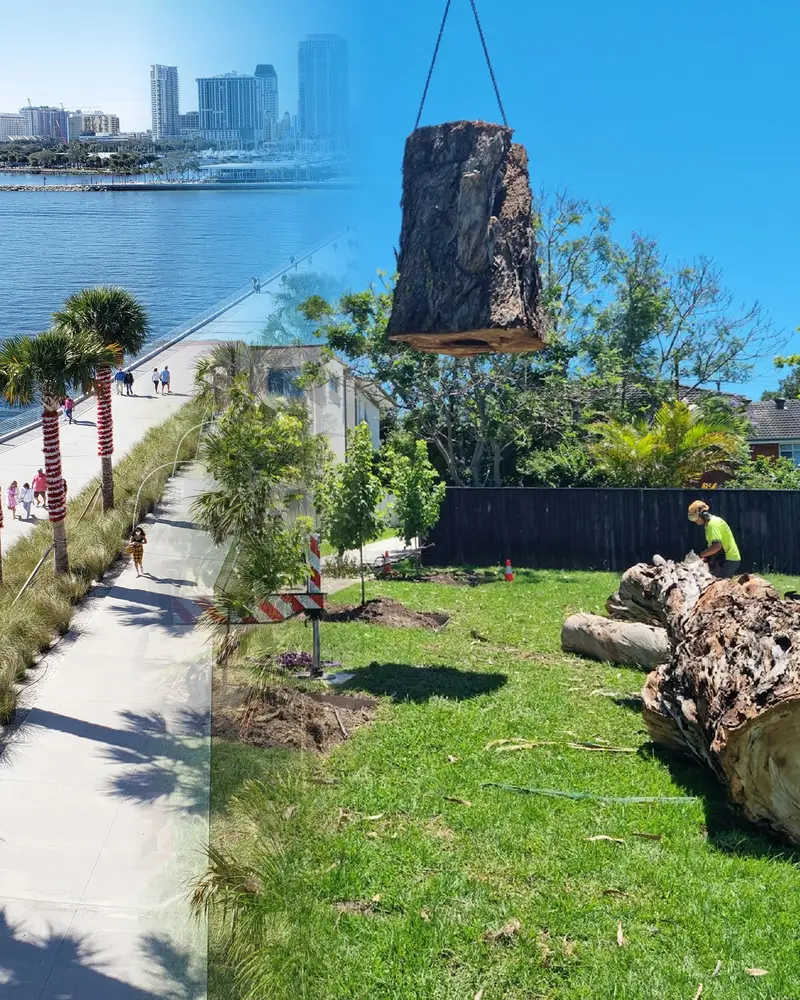
Large-tree work here comes down to whether a machine can be set up at all. On waterfront lots the house, deck, pool enclosure and seawall occupy nearly the whole parcel; in the older grid the possible position is the street, and narrow frontages with parked vehicles frequently rule it out.
- Pinellas County
- Peninsula city
- Coastal exposure
What this means on St. Petersburg properties
Ground bearing is the second question and it is a real one on this peninsula. Outrigger loads are concentrated, driveways and pavers vary widely in what they will take, and fill from earlier site work is not always visible. Where a surface is questionable that has to be raised at the assessment rather than tested on the day.
Wind exposure is a genuine planning factor across the peninsula. Trees that have grown up sheltered by neighbouring canopy can become suddenly exposed when that shelter is removed, and low-lying coastal ground drains slowly after storm rain.
St. Petersburg is an incorporated Pinellas County city administering its own code provisions for trees. Requirements can vary by property and jurisdiction. Property owners should confirm current requirements with the relevant local authority before work begins.
Constraints that point toward a lift-assisted approach
Where a large tree overhangs a pool enclosure on a water-facing lot, a lift is often plainly right and the only viable setup position is a driveway of uncertain construction. That construction is worth establishing beforehand.
- Ground too soft or too congested for material to be handled where it lands.
- A very long carry from the tree to where a truck can stand.
- Overhead constraints that limit which direction sections can travel.
- Decay or storm damage that makes the stem unsafe to climb or to rig against.
- No usable drop zone — the tree stands in a courtyard, between buildings or over a pool.
What has to be established before a lift is planned
- Whether the machine's reach covers the tree from the only available position.
- Whether the tree is sound enough for a climber to attach picks, or whether another method is needed.
- Section weights, and whether they fall within capacity at the required radius.
- Where a crane could physically set up, and whether that ground will take the load.
- What sits between the setup point and the tree — lines, canopies, structures, kerbs.
A lift, or climb and rig?
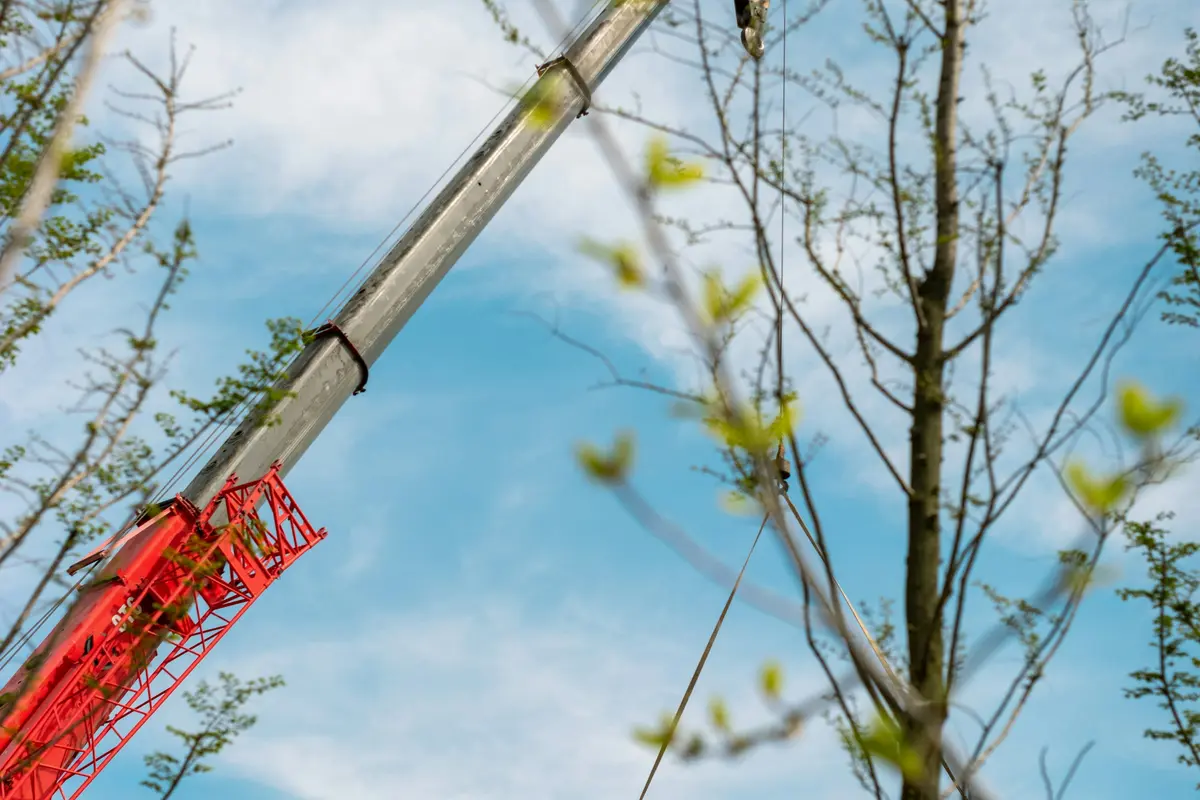
A crane is a tool, never a default. It buys you reach and controlled set-down, and it costs setup space, a load-bearing position and money — so the question is whether the site actually needs what it buys.
Climbing and rigging is the right method Reachable and sound
- The canopy can be taken down in pieces light enough to handle by rope.
- Material can be carried or dragged out along an existing route.
A lift earns its place No drop zone or no trustworthy stem
- Sections have to travel up and over a structure rather than down through it.
- The stem's condition makes climbing it the wrong risk to take.
What has to be true before anything is lifted
Green timber is heavy and a misjudged section is how lifting work goes wrong. Sections are sized to the equipment rather than to what would be convenient at the tree, which is why a lift often means more, smaller cuts than people expect.
Never approach, move or work near a downed or sagging power line, and do not assume a line is inactive. Keep people, pets and vehicles well clear, and report the line to your electric utility or emergency services before anyone goes near the area.
How a lift-assisted removal is planned and run
- Site assessment
The tree, the setup area, the travel path and the landing zone are looked at as one system. Any of them can rule the approach out.
- Confirm the method is warranted
A crane is a tool, not a default. If the tree can be dismantled conventionally without unacceptable risk, that is usually the better answer.
- Establish the exclusion zone
The zone covers the swing path, not just the tree. It is closed for the duration and nobody works or stands beneath a suspended load.
- Process at the landing zone
Sections are set down away from the structure and cut up there, which is faster and safer than processing in a confined space.
- Demobilise and finish
Ground protection lifted, surfaces inspected and cleared, and the stump handled as agreed.
What determines whether this approach is practical
- Whether neighbouring property access is needed and has been agreed.
- The condition of the stem and whether it can be worked from at all.
- Overhead clearance along the whole lift path, not just above the tree.
- The width of the narrowest point on the route in. A side gate frequently decides which machine can be used, and machine size then decides how long the work takes.
- How far cut material has to be carried to reach the truck or chipper. Carry distance is often a bigger factor than the size of the tree.
- Where the truck and chipper can legally and practically stand. On narrow older streets that position, rather than the tree, often sets the shape of the day.
Information that makes planning realistic
- Photographs showing the tree, everything around its base and the route in from the street.
- Whether the stump is included and what the space becomes afterwards.
- Any known soft ground, septic field or drainage feature near a possible setup point.
- Have a think about where a truck and chipper could stand near the property, and whether that space can be kept clear on the day.
- Say whether the area around the tree holds water after heavy rain. It affects the timing, the equipment and occasionally the assessment itself.
- Note whether there is alley access behind the property and whether it is currently usable, because it is frequently the difference between an easy job and a hand-carry.
Debris and cleanup
The landing zone does take a beating, so where it sits matters. A driveway with protection down, or a verge, is often preferable to a lawn — and it is worth agreeing before the machine arrives.
- On ground that holds water, staging is normally kept to firm surfaces such as a drive or path rather than lawn, which sometimes lengthens the carry.
- Long-unmanaged canopies carry more accumulated deadwood than expected, so the volume coming down on a first visit is often higher than on subsequent ones.
- Where an alley is the only route, material is loaded as it comes down rather than staged, because there is usually nowhere to stage it.
Hauled away, chipped on site, or stacked in an agreed position — all three are normal, and they are different amounts of work. Whichever you want should be stated in the scope before the day rather than settled afterwards.
Large and Crane-Assisted Tree Removal in St. Petersburg: common questions
There is no room on my lot. Can the machine work from the street?
Sometimes, depending on frontage width, overhead clearance, parked vehicles and who controls the roadway. It has to be arranged properly in advance — on the older grid it is ruled out more often by lines and parking than by width.
Will my driveway take the load?
That is exactly the right question, and it is assessed on site rather than assumed. Load spreading and ground protection are standard, but some surfaces should not be used at all, and knowing that beforehand avoids an expensive discovery.
Will my tree definitely need a crane?
Not necessarily, and it should not be assumed. Plenty of very large trees are removed conventionally by dismantling and rigging. A lift becomes the sensible choice when there is nowhere to put material, or when the stem cannot be trusted.
The ground around the tree stays wet. Does that make it less stable?
It can. Saturated soil holds a root plate less firmly, which is why trees with no visible defect sometimes move during sustained wet weather rather than during the strongest wind. Whether it applies to a particular tree needs someone at the base of it — soil movement is one of the few things that genuinely cannot be judged from a photograph.
Is rear alley access better than working from the street?
Sometimes considerably, and sometimes not at all — a rear alley can be the shortest route to the tree or too narrow and too congested to use. It is worth telling us it exists either way, so the approach can be decided before a truck is committed to a street position.
Related tree services in St. Petersburg
If a lift is not actually needed
A crane is a tool for trees with no usable drop zone or a stem that cannot be climbed — not a default.
Compare with conventional removalIf the stem cannot be trusted
Where decay or storm damage rules out climbing, the assessment drives the method.
Read about hazardous tree assessmentOn an operating site
Street or car park positioning, exclusion zones and permitted hours usually decide the day.
Read about commercial tree workDiscuss a Large Tree Removal in St. Petersburg
Send photographs of the tree, everything around its base and the approach from the street. On a St. Petersburg lot the setup position decides whether a lift is workable.
- Phone: 877-269-2454
- Serving Tampa Bay, Florida
Information on this page is general guidance for property owners and managers in the Tampa Bay area. It is not an arboricultural assessment, a legal opinion, a permitting determination or an insurance decision. Tree condition and site risk can only be judged in person.