Largo, Florida
Large and Crane-Assisted Tree Removal in Largo, FL
Largo generates plenty of situations where a lift would be the right answer and very few positions to set one up in. Compact lots, narrow internal lanes and closely parked vehicles mean the ground a machine would need is usually already occupied, and the honest outcome is often a longer conventional dismantle.
- Pinellas County
- Mid-peninsula city
- Densely built
What this means on Largo properties
Where a position does exist it is usually the street, and that brings its own questions on this peninsula: frontage width, overhead clearance, parked vehicles and who controls the roadway. In the communities, internal lanes are frequently too narrow and too soft-edged for a machine of any size.
Mid-peninsula position means exposure from either direction depending on a storm's track, and there is very little of the sheltering distance from open water that inland areas have.
Largo is an incorporated Pinellas County city administering its own code, and adjacent unincorporated areas are governed differently. Requirements can vary by property and jurisdiction. Property owners should confirm current requirements with the relevant local authority before work begins.
Constraints that point toward a lift-assisted approach
Where a large tree sits between two units, a lift can be the sensible method while the nearest viable position is a public street some distance away with parked cars along it. Whether that position can be held for the day is the practical question.
- Overhead constraints that limit which direction sections can travel.
- Neighbouring structures close enough that a swinging section is unacceptable.
- A very long carry from the tree to where a truck can stand.
- No usable drop zone — the tree stands in a courtyard, between buildings or over a pool.
- A canopy spread over a roof, pool cage or conservatory where nothing can be dropped free.
What has to be established before a lift is planned
- Whether the tree is sound enough for a climber to attach picks, or whether another method is needed.
- Whether the same job could be completed conventionally with more time and less equipment.
- Where lifted sections will be set down and processed.
- Whether the machine's reach covers the tree from the only available position.
- Where a crane could physically set up, and whether that ground will take the load.
A lift, or climb and rig?
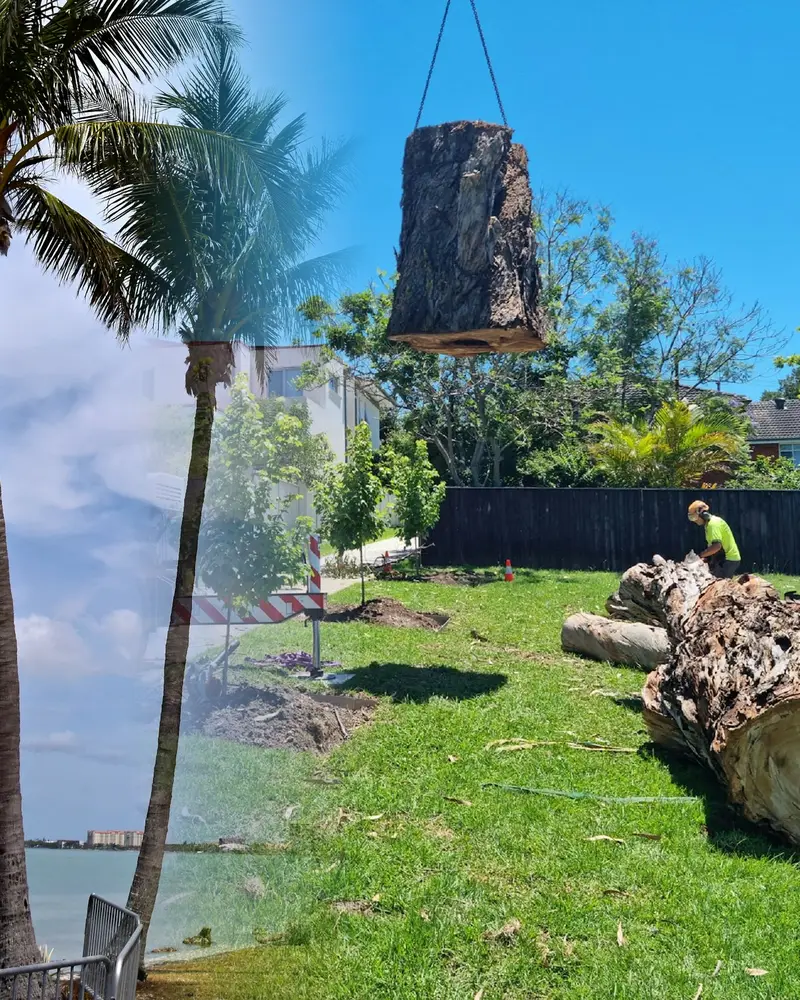
A crane is a tool, never a default. It buys you reach and controlled set-down, and it costs setup space, a load-bearing position and money — so the question is whether the site actually needs what it buys.
Climbing and rigging is the right method Reachable and sound
- There is somewhere — even a small area — to lower sections into.
- The canopy can be taken down in pieces light enough to handle by rope.
A lift earns its place No drop zone or no trustworthy stem
- Lifting out shortens the time the site is disrupted enough to justify the cost.
- There is a firm, load-bearing position within reach of the tree.
What has to be true before anything is lifted
The exclusion zone for lifting work is larger than for a conventional dismantle and it includes the whole travel path, not just the tree and the set-down area. It stays clear while a section is in the air, without exception.
Never approach, move or work near a downed or sagging power line, and do not assume a line is inactive. Keep people, pets and vehicles well clear, and report the line to your electric utility or emergency services before anyone goes near the area.
How a lift-assisted removal is planned and run
- Site assessment
The tree, the setup area, the travel path and the landing zone are looked at as one system. Any of them can rule the approach out.
- Confirm the method is warranted
A crane is a tool, not a default. If the tree can be dismantled conventionally without unacceptable risk, that is usually the better answer.
- Establish the exclusion zone
The zone covers the swing path, not just the tree. It is closed for the duration and nobody works or stands beneath a suspended load.
- Pick sections in sequence
Each piece is rigged, cut and lifted clear in a planned order that keeps the remaining tree stable and predictable.
- Demobilise and finish
Ground protection lifted, surfaces inspected and cleared, and the stump handled as agreed.
What determines whether this approach is practical
- Ground bearing capacity where the machine sets up.
- Whether neighbouring property access is needed and has been agreed.
- Overhead clearance along the whole lift path, not just above the tree.
- The width of the narrowest point on the route in. A side gate frequently decides which machine can be used, and machine size then decides how long the work takes.
- Whether the structure beneath the canopy is a lightweight or manufactured one, which changes what a falling section would do and therefore how material is handled.
- Whether a screened enclosure sits within the working radius. A cage offers almost no resistance to a falling limb and cannot be used as a drop zone at any size.
Information that makes planning realistic
- Whether a shared drive, verge or neighbouring property would be involved.
- The position of overhead lines anywhere near the tree or the approach.
- Any known soft ground, septic field or drainage feature near a possible setup point.
- Where a screened enclosure, pool deck or spa sits under the canopy, say so when you call — it changes the rigging plan more than the size of the tree does.
- Note anything mounted on the roof or wall within the working area: solar panels, satellite dishes, lighting, gutter guards or a carport roof.
- Decide whether the objective is storm preparation or general maintenance. They lead to different work on the same tree.
Debris and cleanup
The landing zone does take a beating, so where it sits matters. A driveway with protection down, or a verge, is often preferable to a lawn — and it is worth agreeing before the machine arrives.
- Trunk wood is cut to a size the access will take rather than to the largest size the machine could handle.
- Long-unmanaged canopies carry more accumulated deadwood than expected, so the volume coming down on a first visit is often higher than on subsequent ones.
- Where limbs sit directly over a roof, material is lowered rather than dropped, and gutters are worth checking afterwards for anything that has washed into them.
Hauled away, chipped on site, or stacked in an agreed position — all three are normal, and they are different amounts of work. Whichever you want should be stated in the scope before the day rather than settled afterwards.
Large and Crane-Assisted Tree Removal in Largo: common questions
Can a machine work from a community lane?
Rarely. Internal lanes are usually too narrow, and the edges are often unpaved and unsuitable for concentrated outrigger loads. Street positions are more likely, subject to reach.
What happens when a lift is not possible?
Conventional dismantling with more rigging, smaller sections and more time. On Largo lots that is frequently the only realistic method, and it is better to plan for it than to hope for a lift.
Will my tree definitely need a crane?
Not necessarily, and it should not be assumed. Plenty of very large trees are removed conventionally by dismantling and rigging. A lift becomes the sensible choice when there is nowhere to put material, or when the stem cannot be trusted.
Can branches over the roof be removed without cutting the whole tree back?
Usually, yes. Clearance work targets the specific limbs creating the problem and leaves the rest of the canopy intact, which is both better for the tree and less work than a general reduction. What it cannot do is create clearance that the tree will not simply regrow into, so it is worth agreeing how much you want and how often you would accept revisiting it.
How is pruning planned around a screened pool enclosure?
By treating the cage as something that cannot take any load at all. Limbs above it are normally rigged and lowered rather than dropped, cut sizes are kept small enough to control, and the sequence works outward so nothing swings back over the screen. It is slower than open-ground work, and that is the point of it.
Related tree services in Largo
If a lift is not actually needed
A crane is a tool for trees with no usable drop zone or a stem that cannot be climbed — not a default.
Compare with conventional removalIf the stem cannot be trusted
Where decay or storm damage rules out climbing, the assessment drives the method.
Read about hazardous tree assessmentOn an operating site
Street or car park positioning, exclusion zones and permitted hours usually decide the day.
Read about commercial tree workDiscuss a Large Tree Removal in Largo
Send photographs of the tree, the surrounding structures and the nearest street frontage. In Largo the setup position is the limiting factor.
- Phone: 877-269-2454
- Serving Tampa Bay, Florida
Information on this page is general guidance for property owners and managers in the Tampa Bay area. It is not an arboricultural assessment, a legal opinion, a permitting determination or an insurance decision. Tree condition and site risk can only be judged in person.