Carrollwood, Florida
Land and Lot Clearing in Carrollwood, FL
There is little conventional lot clearing in Carrollwood — the land was developed decades ago. What comes up instead is selective work within established properties: understorey and vine growth that has taken over a rear portion, self-seeded volunteers crowding mature specimens, and overgrowth along lakeside boundaries.
- Hillsborough County
- Established canopy
- Lake Carroll area
What this means on Carrollwood properties
The point of this work here is almost always to protect what is already there. Volunteer growth competing with a mature oak, or vines loading a specimen canopy, are the actual problems — so the clearing is defined by what stays rather than by what goes. Carrollwood is unincorporated, so Hillsborough County provisions apply, and some neighbourhoods have their own requirements.
Mature landscaping is itself an access problem. Established beds, walls, screening hedges and lakeside setbacks frequently leave no clear route for equipment to the tree that needs work.
Carrollwood is unincorporated, so Hillsborough County provisions apply; some neighbourhoods additionally operate their own association rules. Requirements can vary by property and jurisdiction. Property owners should confirm current requirements with the relevant local authority before work begins.

Typical reasons a lot gets cleared
Clearing volunteer growth and vine load from beneath a stand of mature oaks is a retention job as much as a clearing one. The constraint is doing it without disturbing the root zones of the trees that stay.
- A paddock, yard or storage area being reclaimed after years of neglect.
- Dense understorey and vines making a property unusable or unsafe to walk.
- A firebreak or defensible margin being established around a building.
- Growth crossing a common-area or shared boundary line, where the standard applied is the community's rather than yours.
- Dead material held aloft in an interlocking canopy rather than falling clear, above areas that are in daily use.
Site questions that come before any pricing
- Where the boundaries actually run, and whether they are marked on the ground.
- Whether overhead or underground services cross the site.
- Whether the whole area is being cleared or specific trees are being retained.
- What the land is being cleared for, since that sets the finish standard more than anything else.
- How equipment gets on and off the site, including any soft or low-lying stretch.
Clear the whole parcel, or clear selectively?
"Cleared" means different things to different people, and the gap between them is most of the price. Deciding what stays is the first job, before anyone quotes an area.
Selective clearing fits Keeping structure and screening
- Boundary trees that provide privacy from adjoining property.
- Mature specimens worth retaining for shade, screening or amenity.
Broader clearance makes sense Whole-site change of use
- The intended use needs the full area open, not a partly wooded lot.
- Vegetation is dense enough that working around retained trees costs more than it saves.
Site hazards on an uncleared parcel
The most common damage during clearing is not to the trees being removed but to the ones being kept. Repeated machine passes over a root zone compact it, and the effect shows in the canopy a season or two later. Protected areas are marked before clearing begins.
Never approach, move or work near a downed or sagging power line, and do not assume a line is inactive. Keep people, pets and vehicles well clear, and report the line to your electric utility or emergency services before anyone goes near the area.
How a clearing project is normally staged
- Define the area and the outcome
Walk the boundary, agree what stays, and agree what 'clear' means in practice — cleared to grade is very different to cleared of trees.
- Mark retained vegetation
Anything being kept is identified and protected physically before machines start, because retention decisions made on the day get lost.
- Take out the large material first
Trees come down before understorey, so the smaller machines are not working under standing hazards.
- Handle stumps as agreed
Cut low, ground, or removed — the choice depends entirely on what the land is going to be used for.
- Process debris and finish to the agreed standard
Material is chipped, stacked or hauled, and the surface is left in the state that was scoped rather than an assumed one.
What drives a clearing scope
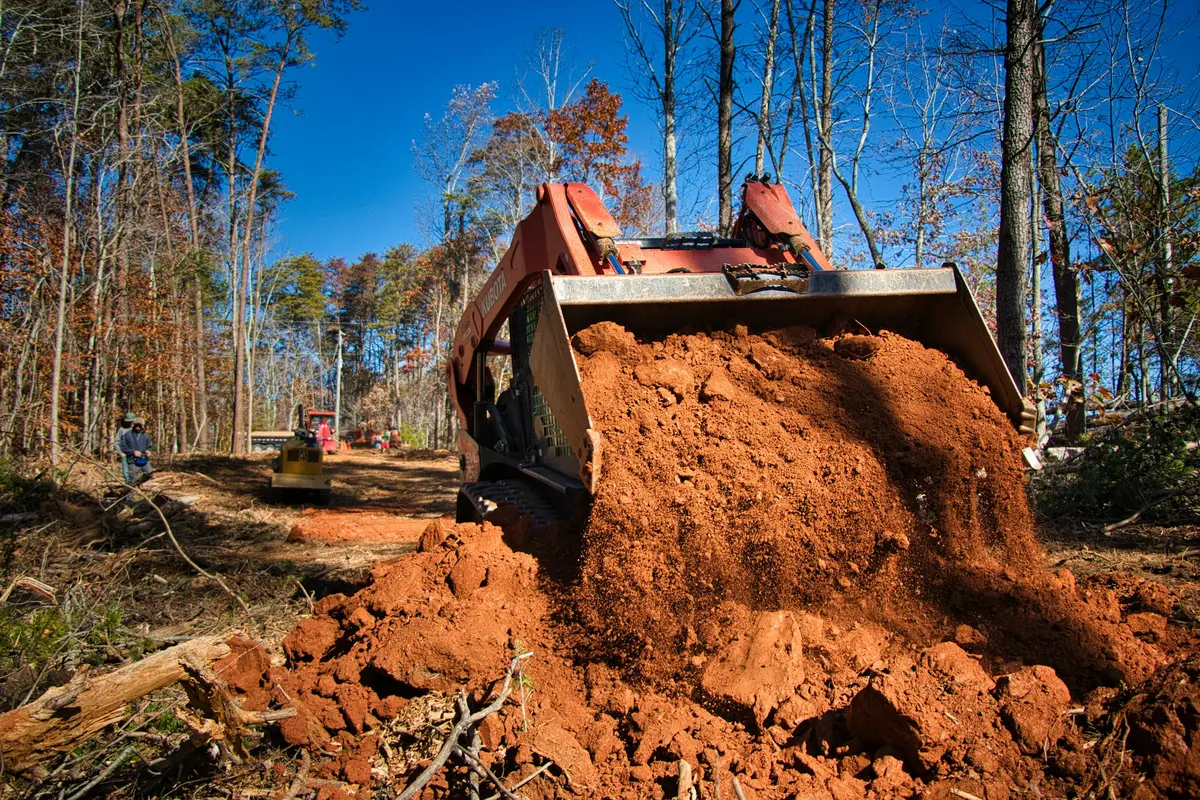
- Whether the clear is total or selective, which changes the method fundamentally.
- Access for equipment and for the trucks that take material away.
- Boundary accuracy and the risk of clearing beyond the line.
- Whether a seawall, dock, bulkhead or shoreline edge sits inside the working radius. Those are load-bearing structures that cannot be used as a landing area.
- Whether the tree has outgrown the space it was planted in. Landscape trees chosen for a new plot frequently reach the roofline and the fence line decades later, and that is a different problem from a defect.
- Whether the tree sits on the property, on common ground or on a managed boundary — that determines who authorises the work before anything else can be planned.
Debris and cleanup
Clearing generates volume out of proportion to the site's appearance, and how that volume is handled is often the largest single variable in the project. Chipping on site, stacking for later collection and full haul-away all produce very different numbers.
- Overlapping canopies tend to produce more brush than expected, because material caught in a neighbouring crown comes down as well as the material that was cut.
- Where the route out runs through planted areas, material is usually carried in smaller pieces rather than dragged, which takes longer but avoids scraping through beds.
- Where a crown extends over a boundary, agree in advance which side brush will be brought down to — dragging it back under the tree is often the slower option.
Hauled away, chipped on site, or stacked in an agreed position — all three are normal, and they are different amounts of work. Whichever you want should be stated in the scope before the day rather than settled afterwards.
Have this ready when scoping
- A survey, plat or marked aerial image showing the parcel boundaries.
- Any prior report on the site — environmental, survey, engineering.
- The timeline and whether another trade follows immediately.
- If the tree has not been worked on for some years, say so. The first visit after a long gap is usually a bigger job than the ones that follow, and it is better to know that upfront.
- Note which limbs actually concern you. Under a dense crown it is easy to point at the wrong tree from the ground.
- Say what sits between the tree and the water — a seawall, dock, lift, bulkhead or open bank — and roughly how much clear ground is left between them.
Land and Lot Clearing in Carrollwood: common questions
Will clearing underneath harm the mature trees?
Not if it is planned. The risks are root disturbance and compaction from machinery, so this kind of work is often done with lighter equipment and more hand cutting than open-ground clearing would need.
Are vines a real problem for mature trees?
They can be. Heavy vine load adds weight and wind resistance to a canopy and can obscure defects underneath. Removing it from a valued specimen is usually worthwhile work.
Can wet or low-lying ground be cleared?
Sometimes, with the right approach and timing, and sometimes it should not be touched at all. Areas near wetlands or watercourses can be subject to specific protections, which is exactly the situation where confirming requirements locally matters most.
Will the surrounding planting be damaged?
That is planned for rather than hoped for — sections are lowered into agreed positions and protection goes down where it is needed. In a genuinely tight space some contact is occasionally unavoidable, which is why it helps to say beforehand what matters most to you.
Can dead limbs high in a dense canopy be seen from the ground?
Often not reliably. Under a heavy interlocking crown, dead material thirty or forty feet up is genuinely difficult to identify from below, and it tends to be held in place rather than falling clear. That is a reasonable reason to have someone look rather than to guess.
Related tree services in Carrollwood
If what remains is stumps
Cleared of trees and cleared to grade are different scopes with different work in them.
Read about stump grindingFor the volume it produces
Clearing generates material by the load rather than by the tree.
See how debris hauling worksFor a managed or commercial parcel
Phasing, access and who authorises a change on the day shape the plan more than the trees do.
Read about commercial tree workScope a Lot Clearing Project in Carrollwood
Tell us what is overgrown, what must be protected and how far in it extends. In Carrollwood the retention list defines the scope.
- Phone: 877-269-2454
- Serving Tampa Bay, Florida
Information on this page is general guidance for property owners and managers in the Tampa Bay area. It is not an arboricultural assessment, a legal opinion, a permitting determination or an insurance decision. Tree condition and site risk can only be judged in person.