Brandon, Florida
Fallen Tree Removal in Brandon, FL
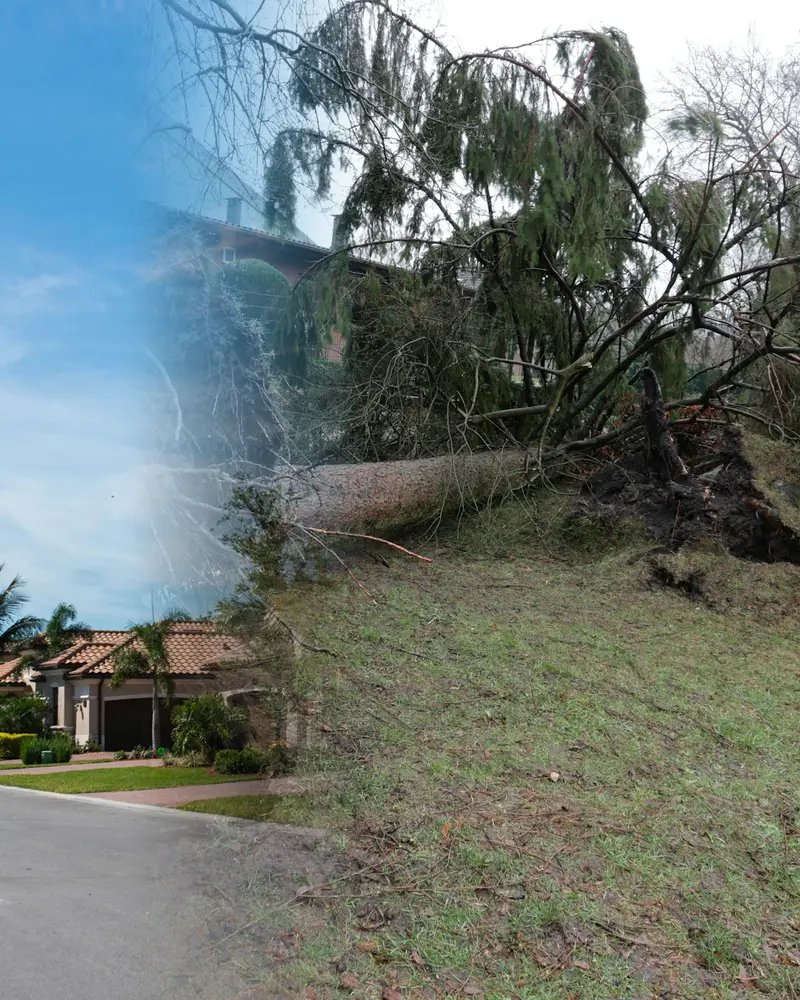
In Brandon a downed tree has usually landed inside a fenced rear yard, which changes the clearing problem entirely. The tree is enclosed, the access is a single gate, and whatever it hit — a pool cage, a shed, a rear roofline, the fence itself — is now part of what is holding it in place.
- Hillsborough County
- 1970s–1990s subdivisions
- Suburban
If the tree is threatening people, an occupied building or your only access, call straight away rather than waiting.
Before anyone goes near it
A root plate that tipped up is a large mass held in a partly rotated position. When the trunk is cut and the counterweight is removed, the plate can drop back into the hole quickly. Nobody should be standing in that hole, and nothing should be stored in it, while cutting is in progress.
Never approach, move or work near a downed or sagging power line, and do not assume a line is inactive. Keep people, pets and vehicles well clear, and report the line to your electric utility or emergency services before anyone goes near the area.
What this means on Brandon properties
Subdivision fencing complicates the geometry. Where a tree has come down across a shared boundary fence, material sits on two properties and both households need the fence back. Clearing usually proceeds on hazard grounds first, but it is worth agreeing access through the neighbour's side early, because it is frequently the shorter route out.
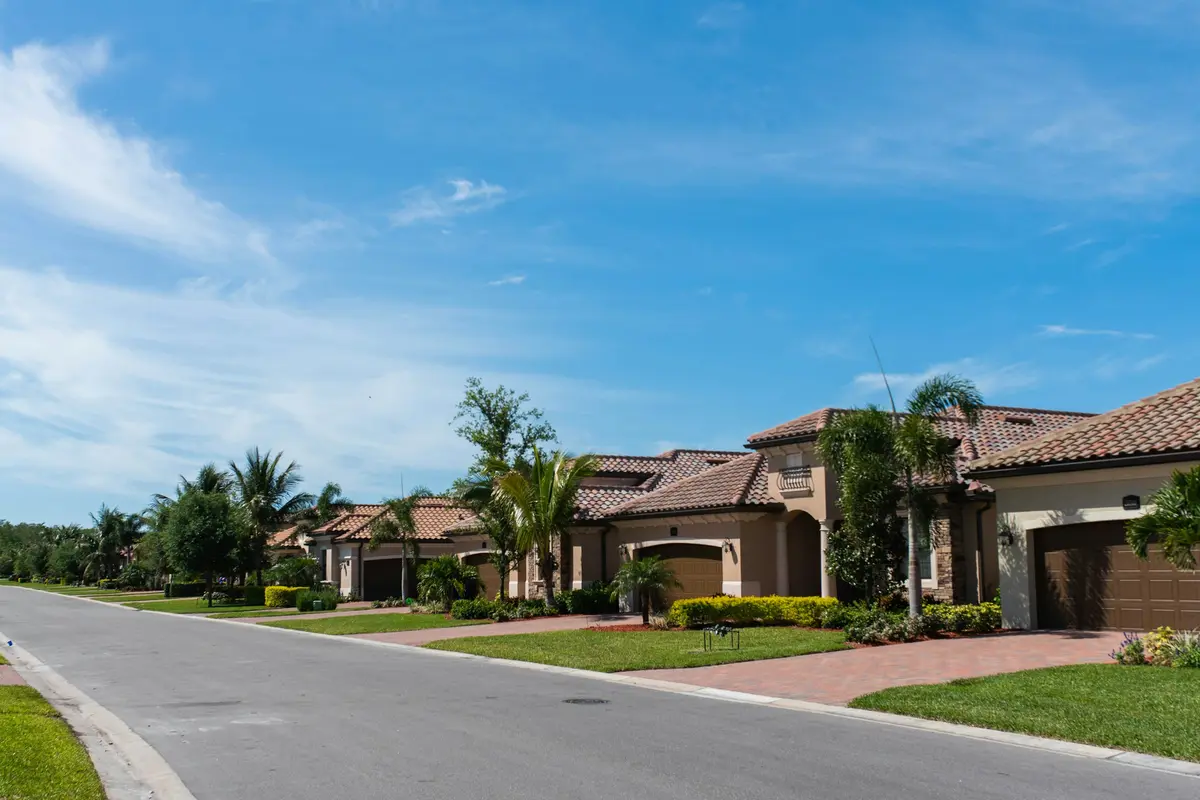
Typical suburban access — a driveway, a side gate and a rear yard — which usually works, but rear-yard trees behind a narrow gate are a common constraint on what equipment can be used.
Brandon is unincorporated, so Hillsborough County provisions apply rather than a city code. Requirements can vary by property and jurisdiction. Property owners should confirm current requirements with the relevant local authority before work begins.
Things that make a downed tree more complicated than it looks
Where a trunk comes down across a rear boundary fence, the canopy generally ends up in the neighbour's yard while the lifted root plate leaves an open void on yours. Both sides need dealing with, and access has to be agreed for the first.
- The ground underneath is saturated, so the tree may settle further as it dries.
- The trunk is lying across a utility connection, meter or irrigation line.
- The root plate has tipped up but is still attached, and can rotate back when weight shifts.
- A tree that has reached the roofline or the fence line decades after being planted for a smaller space.
- Growth closing in over a narrow side route that is the only way in or out.
A tree is down: what you can clear and what needs equipment
Plenty of a fallen tree is genuinely a homeowner job. The part that is not is the part holding load, and telling the two apart is what keeps this from turning into an injury or a bigger repair bill.
Reasonable to handle yourself Loose and light
- Material well clear of the trunk, fences, vehicles and any line.
- Small brush and leaf litter that lifts freely off the ground.
Leave for equipment and rigging Bearing weight or under tension
- Anything bridging between two points of support — it is a loaded beam.
- A trunk or limb resting on a fence, roof, cage, deck or vehicle.
How a downed tree is normally cleared
- Read the load path
Before any cut, the crew works out what is holding what. Which end is bearing, where the bend is, and what will move when the first section comes off.
- Relieve tension deliberately
Bent and pinned limbs are released in an order that lets stored energy out in a controlled direction rather than toward the crew or the structure.
- Section the main stem
The trunk is cut into lengths that can be moved with the equipment and access available, working from the free end where possible.
- Deal with the root plate
A tipped plate is either cut free and removed or laid back into the hole, depending on what the ground needs to become.
- Clear and finish
Brush chipped, wood removed or staged, and access surfaces cleared so the property works normally again.
What makes one fallen tree a bigger job than another
- Whether the tree is fully down or partly hung up in a neighbouring canopy.
- The amount of stored tension in pinned and bent material.
- Ground softness, which is often the deciding factor on machine access after rain.
- Whether neighbouring canopies overlap the tree being worked on — where they interlock, material cannot always fall clear and has to be lowered instead of dropped.
- Whether the canopy can be reached from one setup or needs repositioning. Overlapping crowns frequently mean several climbing or lifting positions for a single tree.
- How much deadwood is held aloft rather than having fallen out. Dense canopy retains dead limbs, so the volume coming down is often larger than it looks from below.
Helpful before clearing starts
- Have someone available who can authorise decisions about the stump and the root plate.
- Check whether anything valuable is pinned underneath that needs care rather than speed.
- Photograph the tree where it lies before anything is moved.
- Note anything fixed on the route — an air-conditioning unit, meter box, irrigation head or low wall — that cannot simply be stepped over.
- Measure the narrowest gate or gap on the route to the tree and have that figure ready. It answers more questions than almost anything else you can tell us.
- Note which limbs actually concern you. Under a dense crown it is easy to point at the wrong tree from the ground.
Debris and cleanup
If the tree tipped a root plate, there is usually a hole and a mound of soil-bound roots to resolve. Backfilling to a safe grade is a separate decision from removing the trunk, and it matters if the area is going to be walked on or mowed.
- Overlapping canopies tend to produce more brush than expected, because material caught in a neighbouring crown comes down as well as the material that was cut.
- Where the carry is long or the route is narrow, brush is normally cut into smaller pieces than strictly necessary, because handling size matters more than trips.
- Trunk wood is cut to a size the access will take rather than to the largest size the machine could handle.
Hauled away, chipped on site, or stacked in an agreed position — all three are normal, and they are different amounts of work. Whichever you want should be stated in the scope before the day rather than settled afterwards.
Fallen Tree Removal in Brandon: common questions
Can you work from my neighbour's side?
Often that is the practical route, and it needs their agreement in advance. Where a tree spans a boundary, sorting access before the crew arrives usually saves a considerable amount of time.
What happens to the hole the roots left?
It can be backfilled and levelled or left if the area is being reworked. An open root void in a lawn is a real trip hazard, so it is worth deciding rather than leaving to chance.
The tree is already down. Is it still urgent?
Often yes, but for different reasons than a standing hazard. Urgency comes from what it is blocking, what it is resting on, and whether the failure left something else unstable — a split stem, a hung-up limb, a lifted plate.
Can dead limbs high in a dense canopy be seen from the ground?
Often not reliably. Under a heavy interlocking crown, dead material thirty or forty feet up is genuinely difficult to identify from below, and it tends to be held in place rather than falling clear. That is a reasonable reason to have someone look rather than to guess.
The tree has not been touched in years. Where should it start?
Normally with deadwood and anything making direct contact with a structure, because those are the parts creating actual risk or damage. Shaping and reduction can follow once the tree's condition is clear. Trying to correct decades of growth in one visit tends to take more off the tree than is good for it.
Related tree services in Brandon
If anything is still under load
A trunk resting on a structure, a blocked sole access or material overhead is not a scheduled job.
See what counts as urgentFor what is left once it is cut
Cutting and hauling are different scopes, and the second is easy to underestimate.
See how debris hauling worksFor what remains at ground level
A failed tree usually leaves a stump and a disturbed root plate behind it.
Read about stump grindingGet a Fallen Tree Cleared in Brandon
Tell us where it landed, whether it crossed a fence line and how wide the gate is. Leave anything bridging or resting on the fence exactly where it is.
- Phone: 877-269-2454
- Serving Tampa Bay, Florida
Information on this page is general guidance for property owners and managers in the Tampa Bay area. It is not an arboricultural assessment, a legal opinion, a permitting determination or an insurance decision. Tree condition and site risk can only be judged in person.