Carrollwood, Florida
Emergency Tree Removal in Carrollwood, FL
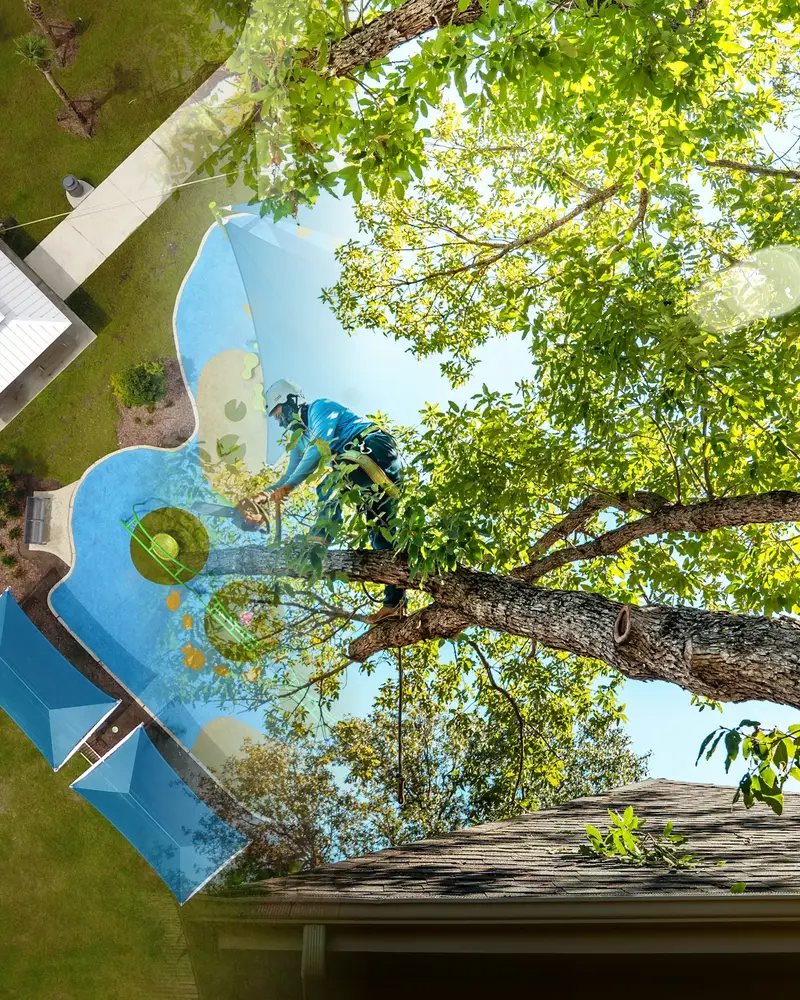
Carrollwood's defining feature works against it in an emergency. The canopy here is among the heaviest in the county, and it sits over houses, pools, garages and driveways with very little unoccupied ground between them — so a limb failure that would land harmlessly elsewhere lands on something that matters.
- Hillsborough County
- Established canopy
- Lake Carroll area
If the tree is threatening people, an occupied building or your only access, call straight away rather than waiting.
Before anyone goes near it
The most common avoidable injuries in this situation happen to people who walk under a hanging limb to look at it, or who try to pull debris away from a fence or gate. Keep children and pets indoors, park vehicles elsewhere, and rope off or block the affected route rather than relying on people to remember to avoid it.
Never approach, move or work near a downed or sagging power line, and do not assume a line is inactive. Keep people, pets and vehicles well clear, and report the line to your electric utility or emergency services before anyone goes near the area.
What this means on Carrollwood properties
The mature landscaping is the second problem. Established beds, screening hedges, walls and specimen plantings frequently leave no route for equipment to the tree that has failed, which means the first productive step is often working out how to reach it rather than how to cut it.
This is one of the more heavily canopied residential areas in the county. Original plantings are now large mature specimens, and it is normal to find several substantial trees on a single lot with canopies that overlap the house, the drive and the neighbour.
Carrollwood is unincorporated, so Hillsborough County provisions apply; some neighbourhoods additionally operate their own association rules. Requirements can vary by property and jurisdiction. Property owners should confirm current requirements with the relevant local authority before work begins.
Situations that are usually treated as urgent
Where a limb from an overhanging oak comes down onto a pool cage and the route to it runs through decades-old planting, working out how to reach it is normally the first real question rather than how to cut it.
- A tree has shifted since the last time you looked at it, or new cracks have opened in the soil around its base.
- Branches are hanging above a driveway, walkway, doorway or parking area where people pass underneath.
- A limb failed once already and neighbouring limbs on the same side show similar attachment.
- Growth overhanging a dock, deck or seawall, where anything dropped would go into the water rather than onto ground.
- A tree that has reached the roofline or the fence line decades after being planted for a smaller space.
Is this actually an emergency, or can it be scheduled?
Calling it an emergency when it is not costs you money; calling it routine when it is not can cost a great deal more. The dividing line is not how alarming the tree looks — it is what sits underneath it and whether anything is still moving.
Can reasonably be scheduled Serious, but stable
- A tree touching a roofline without bearing weight on it.
- Storm debris already on the ground, with nothing left suspended above it.
Should not wait Load, access or occupancy
- Soil cracked or lifted in an arc at the base — the root plate has already moved once.
- Material suspended in a canopy over a driveway, walkway or doorway in daily use.
How an urgent call usually proceeds
- Describe the hazard by phone
Location, what the tree is touching, whether anyone is inside the affected part of the building, and whether access is blocked. This determines how the visit is prioritised.
- On-site hazard assessment
The crew reads lean, load, tension in bent limbs, ground condition and what sits underneath before choosing a method.
- Set up the work zone
Exclusion area, drop zone, access route and rigging points are set before cutting starts, and the zone stays closed while work is active.
- Release load in a controlled sequence
Weight is taken off in stages so the remaining structure does not shift unpredictably onto what it is resting against.
- Clear access, then finish the site
Blocked routes are usually opened first so the property can function again, followed by the remaining cut-up and cleanup.
Useful to have ready when you call
- Photographs taken from a safe distance, if you can capture them without walking under the canopy.
- Whether any power, phone or cable line is involved, sagging or on the ground.
- What the tree is touching right now, and whether that part of the building is occupied.
- If the tree has not been worked on for some years, say so. The first visit after a long gap is usually a bigger job than the ones that follow, and it is better to know that upfront.
- Identify which plants in the surrounding area you would not want damaged, and which you would accept being crossed. That single answer changes the route and often the method.
- Move boats, lifts and anything on the dock clear of the working area if that is possible, or say what cannot be moved.
What changes the shape of an emergency job
- How close the failure is to a wall, roof edge, pool cage, meter or fence line.
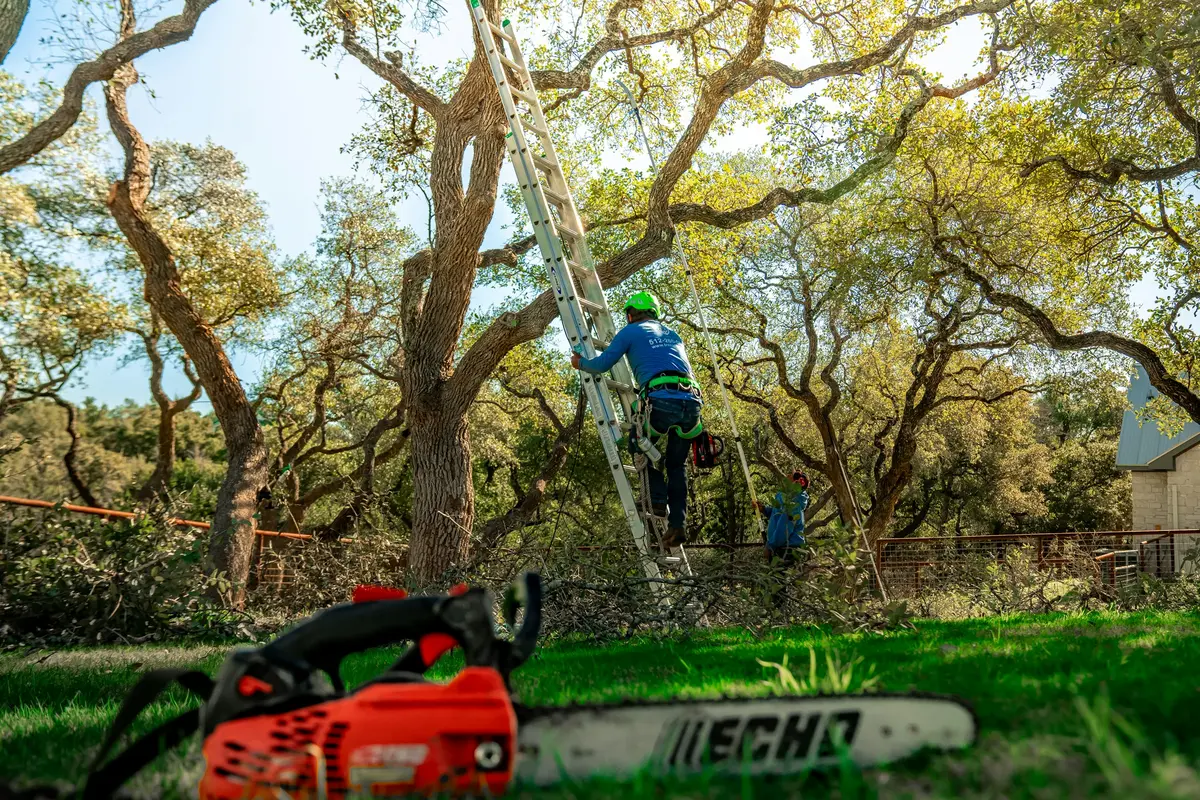
- Whether a machine can reach the tree or every piece has to be lowered by rope.
- Whether the tree is resting on something, and how much of its weight has already transferred.
- Whether adjacent trees have to be protected while this one is worked, which slows rigging but is usually cheaper than repairing what gets hit.
- Whether the canopy can be reached from one setup or needs repositioning. Overlapping crowns frequently mean several climbing or lifting positions for a single tree.
- Whether material risks entering the water, which has to be prevented rather than recovered afterwards.
Debris and cleanup
Cleanup after an urgent removal is graded by need. Hard surfaces people walk and drive on get cleared properly; lawn areas are usually raked to a reasonable finish rather than restored, since the priority in the first visit is removing risk.
- Staging space on a frontage lot is usually limited, so material tends to be loaded as it comes down rather than piled.
- Where a crown extends over a boundary, agree in advance which side brush will be brought down to — dragging it back under the tree is often the slower option.
- Where a community sets rules on where material may be placed or for how long, confirm those before a pile is built rather than after.
Hauled away, chipped on site, or stacked in an agreed position — all three are normal, and they are different amounts of work. Whichever you want should be stated in the scope before the day rather than settled afterwards.
Emergency Tree Removal in Carrollwood: common questions
There is no way through to the tree. What happens?
Then the material comes out by hand along whatever route exists, which is slower. Where a section of hedge or fence can come out temporarily, that is sometimes the faster overall option — it is worth discussing rather than assuming.
The limb came from next door's tree. Does that change the response?
Not the urgency. Where material is on your property and creating a hazard, dealing with it is the priority. Who bears the cost depends on circumstances and is settled separately from the clearing.
What information makes the biggest difference on the call?
What the tree is touching, whether anyone is under or inside that part of the building, whether a line is involved, and whether a truck can reach the tree. Those four answers shape the entire response.
The tree has not been touched in years. Where should it start?
Normally with deadwood and anything making direct contact with a structure, because those are the parts creating actual risk or damage. Shaping and reduction can follow once the tree's condition is clear. Trying to correct decades of growth in one visit tends to take more off the tree than is good for it.
Can dead limbs high in a dense canopy be seen from the ground?
Often not reliably. Under a heavy interlocking crown, dead material thirty or forty feet up is genuinely difficult to identify from below, and it tends to be held in place rather than falling clear. That is a reasonable reason to have someone look rather than to guess.
Related tree services in Carrollwood
If the tree is already down
Material on the ground is still holding load, and the first cut is a reading problem before it is a cutting problem.
Read about fallen tree clearingIf several trees are involved
Damage across a property after a storm is triaged differently from a single failure.
Read about storm damage responseOnce the hazard is cleared
What remains on the ground afterwards is usually a larger volume than it looks.
See how debris hauling worksDiscuss a Dangerous Tree in Carrollwood
Tell us what the limb or tree landed on and how a crew could physically reach it. In Carrollwood the access route is usually the first real question.
- Phone: 877-269-2454
- Serving Tampa Bay, Florida
Information on this page is general guidance for property owners and managers in the Tampa Bay area. It is not an arboricultural assessment, a legal opinion, a permitting determination or an insurance decision. Tree condition and site risk can only be judged in person.