Clearwater, Florida
Commercial Tree Removal in Clearwater, FL
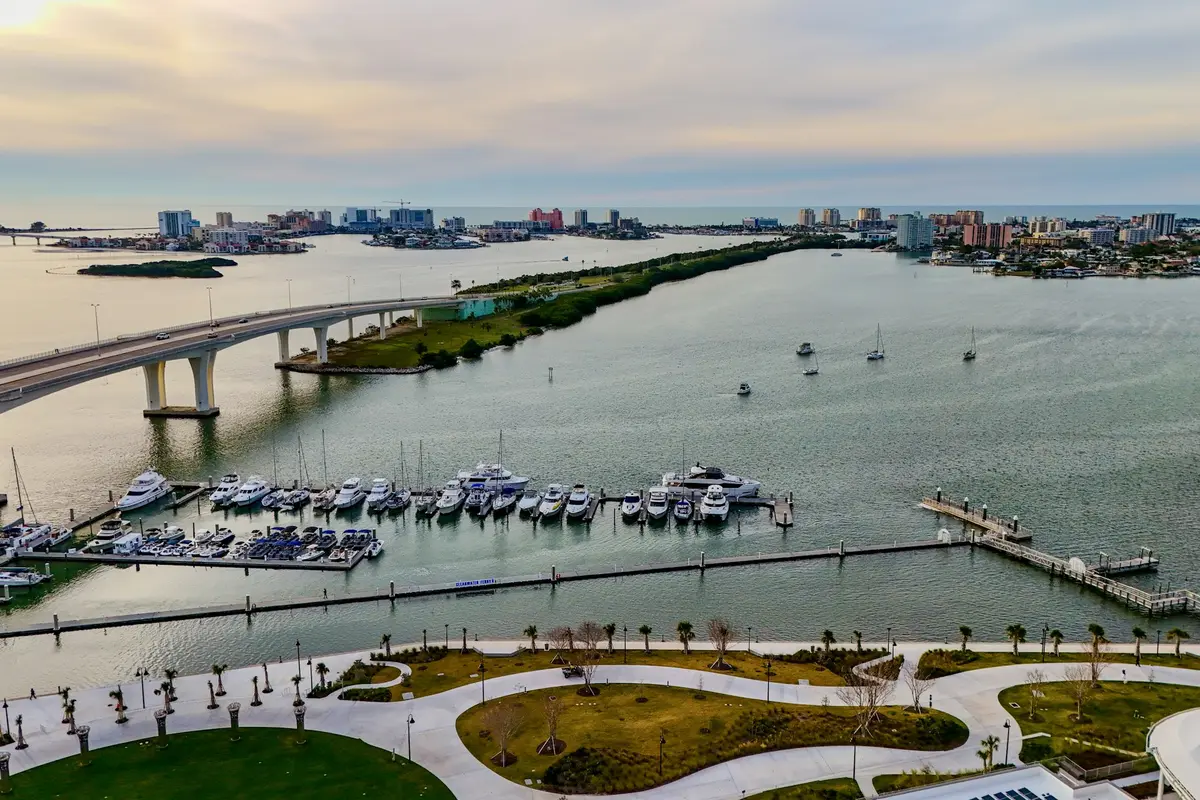
Commercial tree work in Clearwater frequently means working around visitors rather than staff. Hospitality and beach-side properties have arrival and departure patterns rather than fixed trading hours, and the practical working window is often narrow and early.
- Pinellas County
- Barrier island and mainland
- Gulf-facing
What this means on Clearwater properties
Access on the island side is the other half of it. Deliveries, guest parking and service vehicles already compete for limited space, and adding a chipper and a truck to that has to be planned rather than improvised. Mainland commercial sites — office and retail with their own parking — usually offer far more flexibility for the same work.
Mainland neighbourhoods include long-established residential streets with substantial canopy, while island and waterfront properties tend toward tighter lots, salt exposure and a heavy proportion of palms and coastal-tolerant planting.
Clearwater is an incorporated Pinellas County city with its own municipal provisions, distinct from unincorporated county areas nearby. Requirements can vary by property and jurisdiction. Property owners should confirm current requirements with the relevant local authority before work begins.
Typical commercial triggers
On a beach-side frontage, work often has to be complete before mid-morning arrivals, with an exclusion zone that keeps a guest walkway open throughout. Those constraints set the sequence before the trees do.
- Canopy pressing on a roofline, parapet or rooftop unit.
- A boundary tree affecting a neighbouring commercial occupier.
- Roots lifting a footpath, kerb or accessible route across a site.
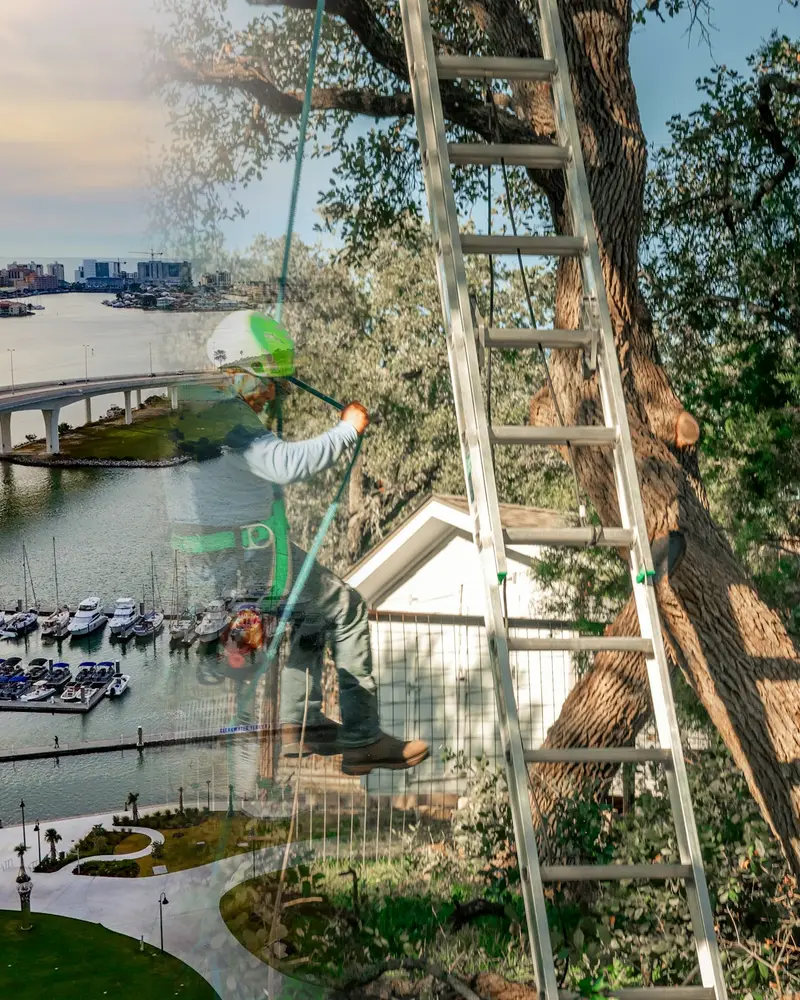
- Growth overhanging a dock, deck or seawall, where anything dropped would go into the water rather than onto ground.
- Growth over a street frontage or footpath where vehicles and pedestrians pass beneath.
Access and coordination questions that come first
- Whether adjoining tenants or neighbouring businesses need notice.
- Where a chipper and truck can stand without blocking a fire lane or loading area.
- Whether deliveries, waste collection or emergency access run through the work area.
- Who on site holds keys, gate codes and authority to change the plan on the day.
- Whether lighting, signage, cameras or overhead services sit within the drop zone.
In hours or out of hours?
On an operating site the cutting is rarely the constraint. What decides the plan is how much of the site can be out of use at once, and when the people who use it are not there.
Normal hours usually work Low-traffic footprint
- Bays or aisles can be coned off without cutting the site's usable capacity.
- The work is a single visit rather than a phased programme.
Out of hours earns its cost Access or occupancy pressure
- The only equipment position is a customer entrance or a fire route.
- Tenants, residents or patients would be inside the noise footprint all day.
Keeping a working site safe
Taking a whole car park or frontage out of use at once is rarely necessary. Working in phases keeps most of the site usable and shortens the period any one area is affected, which is usually worth more than finishing half a day sooner.
Never approach, move or work near a downed or sagging power line, and do not assume a line is inactive. Keep people, pets and vehicles well clear, and report the line to your electric utility or emergency services before anyone goes near the area.
How a commercial job is normally organised
- Site walk with the responsible person
Trees, access, service routes and operating constraints are reviewed together, so the plan reflects how the site actually runs.
- Define the working window
Early mornings, off-peak hours or closed days often cost less disruption than a mid-day start, and that is usually the deciding factor.
- Plan the exclusion zone
Where it sits, how it is signed, how pedestrians and vehicles get around it, and how it is opened and closed each day.
- Sequence multi-tree work
On larger sites the order is chosen so that no more of the site is out of use at once than necessary.
- Hand the area back clean
Surfaces cleared, bays reopened, and the site walked with the responsible person before the crew leaves.
What drives cost and duration on commercial sites
- Whether debris can be staged on site or must leave with each load.
- Restricted working hours, which lengthen the calendar even when the work is small.
- Whether the work is one visit or part of a longer maintenance arrangement.
- Whether the work needs any pedestrian or vehicle management on the street side, which has to be planned rather than improvised.
- Whether material risks entering the water, which has to be prevented rather than recovered afterwards.
- How much of the working footprint is left once the house, the deck and the water's edge are accounted for — on a frontage lot the answer is often very little.
Debris and cleanup
On an operating site, debris handling is a logistics problem as much as a clearing one. Material is normally taken directly to the truck rather than piled, because a pile on a commercial property blocks something — a bay, a lane, an accessible route.
- Where the vehicle has to stand away from the property, everything is carried to it, so the distance between the tree and the kerb is a real part of the cleanup time.
- Where a pool or enclosure sits beneath the work, keeping debris out of the water is part of the plan rather than an afterthought, and it usually means smaller cuts and more of them.
- Staging space on a frontage lot is usually limited, so material tends to be loaded as it comes down rather than piled.
Hauled away, chipped on site, or stacked in an agreed position — all three are normal, and they are different amounts of work. Whichever you want should be stated in the scope before the day rather than settled afterwards.
What speeds up a commercial quote
- Whether any bays or routes can be closed, and who arranges that.
- The name and contact of the person who can authorise work and access.
- Permitted working hours and any restricted dates.
- Where a screened enclosure, pool deck or spa sits under the canopy, say so when you call — it changes the rigging plan more than the size of the tree does.
- Mention anything that has changed since recent coastal weather — dieback on one side, thinning, or a lean that was not there before.
- Note anything fixed on the route — an air-conditioning unit, meter box, irrigation head or low wall — that cannot simply be stepped over.
Commercial Tree Removal in Clearwater: common questions
Can work be done before guests are up?
Early starts are common on hospitality sites here and are often the only workable option. Noise expectations and access outside hours set the limits, so it is worth agreeing them at the site walk.
Can a pedestrian route stay open during the work?
Usually, by phasing the exclusion zone rather than closing the whole area at once. It takes longer than closing the route outright, which is the trade-off worth deciding up front.
Do you work with property managers and agents?
Yes. Multi-tenant and managed properties are a common context for this work. What we cannot do is make claims about credentials or approvals we have not documented, so please ask directly for whatever your process requires.
How is pruning planned around a screened pool enclosure?
By treating the cage as something that cannot take any load at all. Limbs above it are normally rigged and lowered rather than dropped, cut sizes are kept small enough to control, and the sequence works outward so nothing swings back over the screen. It is slower than open-ground work, and that is the point of it.
How much room does a crew actually need?
Less than most people expect for the cutting and more than most people expect for the material. The working area around the tree matters, but so does somewhere to put what comes down and a route to move it. Describing both when you call gets you a more useful answer than describing the tree alone.
Related tree services in Clearwater
For a single tree on the site
Where one tree drives the job, the method question is the same as on a residential property.
Read about tree removalFor a parcel rather than a tree
Scoped by area and by outcome, with retention decided before work starts.
Read about land and lot clearingFor volume across the site
Staging position and carry distance usually matter more than total volume.
See how debris hauling worksDiscuss Commercial Tree Removal Needs in Clearwater
Send your access constraints, permitted hours and who authorises changes on the day. On Clearwater commercial property the working window shapes everything else.
- Phone: 877-269-2454
- Serving Tampa Bay, Florida
Information on this page is general guidance for property owners and managers in the Tampa Bay area. It is not an arboricultural assessment, a legal opinion, a permitting determination or an insurance decision. Tree condition and site risk can only be judged in person.